

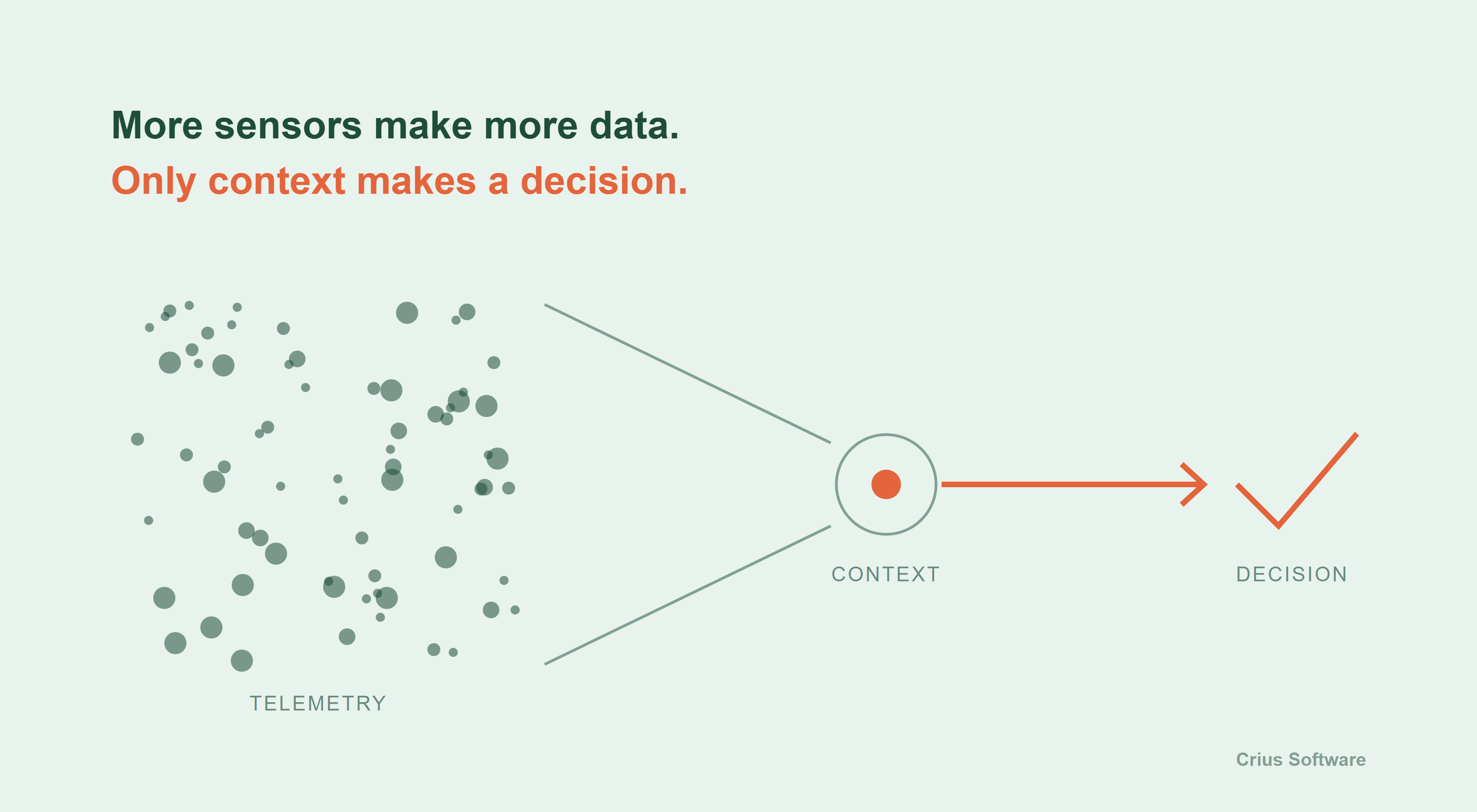
The billion-dollar gap in industrial IoT is no longer sensing capacity. It is decision quality. Enterprises across manufacturing, logistics, chemicals, healthcare, smart cities, and connected infrastructure are deploying more sensors than ever, yet many remain stuck in a sensor-rich but insight-poor state. This article maps the leading IoT sensor categories shaping Industry 4.0 in 2026, explains the end-to-end data lifecycle that turns signals into action, and outlines where AI, edge processing, energy-harvesting, and stronger security models are redefining scale economics.
Imagine you are at your desk, coffee in hand, thinking you are casually working away, while in reality hundreds of IoT sensors are quietly pulling the strings behind the scenes. In 2026, these small devices are not just peripheral gadgets. They are becoming the architects of a more responsive, connected, and data-driven industrial world.
Yet many leaders still repeat the same pattern: they buy sensing infrastructure, accumulate dashboards, and then discover that data alone does not create business value. What matters is the ability to move from raw inputs to action. Sensors become strategic only when they are embedded inside a broader operational architecture.
Part 1: The All-Star Cast of IoT Sensors
In 2026, sensors have evolved beyond passive measurement devices into adaptive operational partners. The most effective deployments treat them not as isolated components, but as specialized inputs to a larger industrial intelligence model. Each sensor family answers a distinct business question: what is changing, what is moving, what is degrading, what is unsafe, and what requires intervention now.
1.1 Environmental Sensors: The Condition Trackers
These are the vigilant guardians of industrial conditions, effectively acting like meteorologists for production, storage, cleanroom, and urban infrastructure environments.
Technical mechanismThey use thermistors for heat, capacitive methods for humidity, and optical or chemical sensing for air-quality indicators such as CO₂ and VOCs.
Industrial applicationIn semiconductor manufacturing, even minor humidity deviations can create defects. In smart-city deployments, environmental sensing supports emissions monitoring and more sustainable urban planning.
2026 trendNext-generation models increasingly assess soil nutrients in real time and integrate with AI models to anticipate fire hazards, mold growth, or environmental degradation before obvious symptoms emerge.
1.2 Proximity Sensors: The Polite Gatekeepers
Proximity sensing enables object detection without physical contact, creating a foundation for safe automation, inventory movement, and machine coordination.
Key technologiesCapacitive for non-metallic materials, inductive for metallic detection, ultrasonic where visibility is constrained, and photoelectric for long-range object recognition.
Business impactHigh-throughput fulfilment and robotic environments use these sensors to coordinate automated fleets around people, products, and equipment with far less friction.
2026 evolutionAdvanced proximity systems increasingly work with AI routing layers, dynamically adjusting robot paths based on traffic conditions and context in real time.
1.3 Motion Sensors: The Silent Guardians
Motion sensors operate like quiet, vigilant sentinels. They help identify vibration anomalies, movement signatures, and physical deviation before failure becomes visible.
The trio of techAccelerometers capture velocity and acceleration shifts, gyroscopes handle rotational precision, and ultrasonic sensing supports vibration and movement analysis in certain conditions.
Real-world impactApplied to rotating assets and critical machinery, motion signatures can reveal misalignment, wear, and instability long before catastrophic breakdown occurs.
2026 visionOutside the factory, these sensors increasingly appear in smart homes and assisted-living systems, where unusual movement patterns may indicate health risk or emergency conditions.
1.4 Optical Sensors: The Quality Inspectors
Optical sensing remains central to visual quality control, traceability, and precision inspection.
Technical basePhotodiodes and camera systems based on CMOS or CCD imaging evaluate texture, color, shape, alignment, and visible defects.
Manufacturing precisionThey are essential where tiny blemishes, surface inconsistencies, or assembly deviations carry downstream quality costs.
2026 trendOptical systems are moving from defect detection to defect prediction, using machine learning models trained on historical production patterns to flag likely quality failures earlier.
1.5 Pressure Sensors: The Reassuring Plumbers
Pressure sensors quietly protect fluid and gas systems by identifying unsafe conditions before they escalate into operational or environmental incidents.
Safety firstThey serve as an early warning layer in pipelines, hydraulic systems, process plants, medical devices, and utility networks.
2026 miniaturizationAdvances in MEMS are pushing pressure sensing into wearables such as smartwatches while also improving municipal water optimization and leakage reduction in smart-city infrastructure.
1.6 Chemical Sensors: The Sniffers
Chemical sensors function like industrial bloodhounds, identifying gas leaks, chemical concentrations, and reaction conditions that matter for both safety and process efficiency.
Technical mechanismElectrochemical reactions are commonly used to detect harmful gases such as carbon monoxide or ammonia.
Industrial safetyIn chemical environments, these sensors help optimize reactions, reduce waste, and support safer operating windows.
Future reachNanotechnology is pushing sensitivity toward single-molecule detection, opening the door to finer-grained industrial, environmental, and healthcare use cases.
1.7 Biometric Sensors: The Body Whisperers
Biometric sensors extend industrial intelligence into the human domain by monitoring vital signs such as heart rate, skin temperature, stress, and fatigue indicators.
Workforce safetyThese systems can identify early signs of overexertion, heat stress, or fatigue in physically demanding environments.
Healthcare shiftThey also support continuous remote monitoring of chronic conditions, reducing the need for repeated in-person intervention.
Where these systems take operator behaviour as a context factor, consultation with the works council is customary in European plants — in Germany it is the norm rather than the exception, and it belongs in the design phase rather than after deployment.
Part 2: The Data Lifecycle — Turning Raw Data into Gold
IoT sensors do not create value in isolation. They sit inside a continuous lifecycle in which physical phenomena are measured, transported, interpreted, and then converted into automated or human decisions. The organizations that scale successfully design this lifecycle deliberately.
Collection is where the magic begins. The transducer layer converts the physical world into machine-readable signals. In water treatment, that means maintaining safe quality parameters. In manufacturing, it means capturing the operating condition of a line before a deviation turns into scrap or downtime.
Transmission is the secure journey. Connectivity decisions depend on range, power, resilience, and site constraints. Agricultural deployments often rely on LoRaWAN because long-distance, low-power communications are essential across large field footprints.
Processing is the decision layer. Raw telemetry is rarely useful in its initial state. AI and machine learning models are required to detect trends, classify anomalies, and prioritize meaningful deviations. Processing can happen centrally in the cloud or near the asset at the edge to reduce latency.
Utilization is where insight becomes operational. The goal is not better dashboards for their own sake. It is action: shutting down an overheating machine before it causes a fire, rerouting traffic in a smart city, or escalating a maintenance workflow before failure spreads.
Part 3: The 2026 Innovation Frontier
Industrial IoT has moved beyond simple monitoring. The frontier now centers on autonomy, local intelligence, lower maintenance burden, and stronger economics at scale.
3.1 AI-Powered Proactive Sensors
Traditional sensors are reactive. They measure and report. AI-powered sensors are increasingly proactive: they learn patterns, identify abnormal signatures, and support corrective action before an operator notices visible failure. A vibration profile no longer just says that something is wrong; it can indicate what kind of failure is developing and how urgently teams should respond.
3.2 Energy-Harvesting: Goodbye, Batteries
At pilot scale, battery swaps may look manageable. At production scale, they become a maintenance burden and a cost multiplier. Ambient energy-harvesting changes that equation by drawing power from light, heat, or vibration, reducing labor overhead, waste, and deployment friction.
When sensors begin to recognize patterns, prioritize anomalies, and sustain themselves with ambient energy, the architecture stops being a monitoring stack and starts becoming an operating system for industrial decisions.
Part 4: Navigating Challenges with Clever Solutions
4.1 Challenge: Data Overload
Sensors generate enormous data volumes, and sending everything upstream clogs networks, increases storage burden, and slows response. The practical fix is edge computing. By filtering and prioritizing data locally, teams reduce transmission cost and act on what matters in milliseconds rather than after centralized backlog processing.
4.2 Challenge: Security and Compliance
A compromised sensor can create both information risk and physical risk. Stronger trust layers matter. A tamper-resistant record model, along with encryption and traceability, helps protect data integrity and support compliance obligations where auditability matters.
| Architecture decision | What weak programs do | What scalable programs do |
|---|---|---|
| Sensor deployment | Buy more devices without a decision model. | Map each sensor to a business question, workflow, and owner. |
| Transmission design | Push everything to the cloud. | Choose protocol by power, latency, distance, and environment. |
| Processing | Centralize all analytics regardless of urgency. | Use edge processing for fast, local filtering and action. |
| Security | Treat sensors as low-risk endpoints. | Design for traceability, trust, encryption, and compliance from day one. |
| Scale readiness | Ignore maintenance burden until rollout. | Account for battery replacement, device health, and lifecycle economics early. |
Part 5: The ROI Math — Why the World Is Moving to 2026 Standards
The financial case for industrial IoT is no longer theoretical. The strongest justification comes from reduced operating costs, higher uptime, better yield, lower safety risk, and faster decisions. But ROI only materializes when sensing is connected to a broader response architecture.
These numbers should be read as outcome indicators, not promises from hardware alone. The real ROI model connects sensor classes to decisions, decisions to workflows, and workflows to measurable financial impact.
Lead Magnet: The Global Sensor Audit
Before expanding your next deployment, ask three filtering questions:
Transmission fit
Are you using the right transmission model for the environment, such as LoRaWAN or 5G where appropriate?
Security fit
Does your security layer include encryption and a trustworthy model for data integrity and traceability?
Processing fit
Is your processing strategy happening where it should: at the edge for speed, in the cloud for scale, or in a hybrid model?
The Strategic Message for Leaders
Factories that treat sensors like gadgets will stay stuck in pilot mode. Leaders that treat sensors like gatekeepers of margin will build an operating advantage. In 2026, a sensor that does not connect to analytics, context, and decision logic is not a strategy. It is a stranded endpoint.
If you are tired of 12-month pilots that go nowhere, the next conversation should not start with “Which sensor should we buy?” It should start with “Which industrial decisions are we trying to improve, and what architecture will get us there?”
Enhanced Full Blog Text — Board-Ready Report Format
Executive Summary. Industrial IoT in 2026 has entered a new phase of maturity. The constraint is no longer simply whether organizations can deploy sensors. The constraint is whether they can convert sensor output into operational and financial outcomes. Many organizations remain sensor-rich but insight-poor, accumulating dashboards and telemetry while failing to build the decision layer required for measurable value. This report outlines the primary IoT sensor categories now shaping Industry 4.0, explains how data moves from physical signal to action, and highlights the innovations, constraints, and ROI logic that should inform executive decisions on scale-up.
Introduction: The Billion-Dollar Data Gap
Imagine you’re at your desk, coffee in hand, thinking you’re casually working away, while in reality, hundreds of IoT sensors are quietly pulling the strings behind the scenes. In 2026, these “little guys” are no longer just tech gadgets; they are the architects of a smarter, more connected world.
However, many global leaders are still falling into the same trap I saw in 2024: they are sensor-rich but insight-poor. They have “Dashboard Fever” — plenty of 3D graphs but zero actionable intelligence. From making sure factories breathe easy to ensuring your online shopping arrives on time, sensors are the unsung heroes, but only if you understand how to move from raw data to a decision.
Part 1: The All-Star Cast of IoT Sensors (Updated for 2026)
In 2026, sensors have evolved beyond mere data collectors into adaptive, sophisticated partners capable of transforming entire operations. Here is the breakdown of the key players and how they’ve matured.
1.1 Environmental Sensors: The Condition Trackers
These are the vigilant guardians of conditions, acting like meteorologists for the modern industrial age.
Technical Mechanism: They utilize thermistors for heat, capacitive techniques for humidity, and optical/chemical sniffers for air quality (CO₂, VOCs).
Industrial Application: In semiconductor manufacturing, a slight deviation in humidity results in defects. Globally, they are now used in “Smart Cities” to guide sustainable urban planning by monitoring emissions.
2026 Trend: Next-generation sensors now analyze soil nutrient levels in real-time, integrating with AI to predict fire hazards or mold growth before they occur.
1.2 Proximity Sensors: The Polite Gatekeepers
These sensors detect objects without physical touch, acting like a friend who always respects personal space but uses lasers or electromagnetic fields.
Key Technologies: Capacitive (non-metallic), Inductive (metallic), Ultrasonic (low visibility), and Photoelectric (long-range).
Business Impact: High-throughput fulfilment centers rely on these to keep robotic fleets running smoothly alongside human workers. They prevent your order from getting squashed in the chaos.
2026 Evolution: Advanced proximity sensors now use AI to adjust robot routes in real-time based on traffic patterns, while in retail, they offer tailored recommendations directly to customer devices.
1.3 Motion Sensors: The Silent Guardians
Think of these as the “Spider-Men” of the sensor universe — quiet, vigilant, and always ready to act.
The “Trio” of Tech: Accelerometers (velocity), Gyroscopes (rotational precision), and Ultrasonic (vibration).
Real-World Impact: Rolls-Royce uses these in jet engines to identify misalignments or wear before they escalate into major problems.
2026 Vision: Future motion sensors act as health monitors in smart homes, detecting unusual patterns that may indicate health risks for the elderly.
1.4 Optical Sensors: The Quality Inspectors
These are the sharp-eyed overseers of perfection, using photodiodes and imaging tech (CMOS/CCD) to analyze visual characteristics.
Manufacturing Precision: Toyota uses these to inspect every vehicle for tiny paint blemishes or surface inconsistencies.
2026 Trend: They no longer just detect flaws; they use machine learning to predict their occurrence by analyzing production trends in real-time.
1.5 Pressure Sensors: The Reassuring Plumbers
Quietly ensuring fluid and gas systems operate safely, they are critical to avoiding disasters.
Safety First: BP employs pressure sensors in pipelines as the first line of defense against catastrophic spills.
2026 Miniaturization: Advances in MEMS technology allow these to be embedded in smartwatches to monitor blood pressure or in smart cities to optimize water networks and minimize waste.
1.6 Chemical Sensors: The Sniffers
These are the “bloodhounds” of IoT, using electrochemical reactions to identify harmful gas leaks like carbon monoxide or ammonia.
Industrial Safety: At BASF, they optimize chemical reactions, reducing waste and cost while ensuring safety standards are met.
Future Reach: Nanotechnology now enables these sensors to identify single molecules, pushing accuracy to unprecedented levels.
1.7 Biometric Sensors: The Body Whisperers
These monitor vitals such as heart rate, skin temperature, and stress levels.
Workforce Safety: Heavy-industry operators use these to detect early signs of fatigue or overexertion in physically demanding environments. Where these systems take operator behaviour as a context factor, consultation with the works council is customary in European plants — in Germany it is the norm rather than the exception, and it belongs in the design phase rather than after deployment.
Healthcare Shift: They enable continuous monitoring of chronic conditions like diabetes without hospital visits.
Part 2: The Data Lifecycle — Turning Raw Data into Gold
IoT sensors don’t exist in isolation; they are part of a continuous loop where raw data is transformed into actionable insights.
2.1 Collection: The Magic Begins
Sensors use transducers to convert physical signals (heat, motion) into electrical ones. In water treatment, this ensures water quality meets safety standards.
2.2 Transmission: The Secure Journey
Data travels via protocols like Wi-Fi, Bluetooth, Zigbee, or LoRaWAN. Agricultural sensors use LoRaWAN for long-distance, low-power transmission across expansive farmlands.
2.3 Processing: The Decision Layer
Raw data is analyzed by AI and machine learning to extract trends or anomalies. This can occur in the cloud or at the Edge (closer to the source) to reduce latency.
2.4 Utilization: Insights in Action
The goal is to trigger automated responses, like shutting down an overheating machine before it causes a fire. In smart cities, this modifies traffic signals to improve flow.
Part 3: The 2026 Innovation Frontier
We have moved past simple monitoring into a new era of intelligence.
3.1 AI-Powered “Proactive” Sensors
Traditional sensors were reactive; AI-powered sensors are proactive. They can recognize a machine’s vibration signature and take corrective action before it fails. Bosch’s AI sensors are a prime example of this in action.
3.2 Energy-Harvesting: Goodbye, Batteries!
Changing thousands of batteries in an industrial plant is a maintenance nightmare.
Ambient Energy: Modern sensors draw power from light, heat, or even vibrations.
Sustainability: EnOcean sensors power themselves using indoor light, cutting down on electronic waste and operational costs.
Part 4: Navigating Challenges with Clever Solutions
Even the best tech has growing pains.
4.1 Challenge: Data Overload
Sensors generate overwhelming volumes of data that can clog networks.
The Fix: Edge Computing. By filtering data locally, only critical insights are sent to the cloud, reducing response times and costs.
4.2 Challenge: Security and Compliance
A compromised sensor can lead to data breaches or physical hazards.
The Fix: A decentralised record model with cryptographically chained, independently verifiable entries, alongside encryption and traceability. It keeps sensor data traceable and helps protect its integrity, which supports compliance obligations wherever auditability is required.
Part 5: The ROI Math — Why the World Is Moving to 2026 Standards
Industrial IoT could add $14.2 trillion to the global economy by 2030.
Operating Costs: Companies implementing IoT reduce these by an average of 4-6%.
Uptime: IIoT can increase production output by up to 25% and reduce downtime by 30%.
Conclusion: Let’s Build the Future Together
In 2026, IoT sensors are no longer the “backbone” of Industry 4.0; they are the heart and soul of the innovation economy. The future isn’t just bright and connected — it is sensor-powered.
If you are tired of twelve-month pilots that go nowhere, the next conversation should not begin with which sensor to buy. It should begin with which decision in your plant is still being made too slowly, and what it would take to make that one decision faster. That is a smaller question, and it is the one that tends to move.
Related reading
- The Pilot Purgatory Survival Guide: Why 75% of Smart Factory Initiatives Never Escape the Lab
- Beyond Asset Tracking: Why Agentic AI Is Replacing Passive IoT in Industrial Operations
- 10 IoT Mistakes Manufacturers Make in 2026: Why Smart Factory Initiatives Stall and How Scalable Industrial IoT Leaders Avoid It
Check this against your own plant
The Factory Data Readiness self-check is free: 18 questions across six dimensions, scored on our side. You unlock the result with a work email — a maturity score per dimension, how you compare with peer manufacturers, and which use-case pays back first on your answers. The full written report is optional and asks for a phone number.
Arjun updated on 19 Feb 2026, 08:12AM
The “sensor-rich but insight-poor” framing is exactly what we see in brownfield plants. We have plenty of telemetry, but very little operational context attached to it. The point about moving from raw data to decisions is where most programs either scale or stall.Hannah updated on 19 Feb 2026, 09:01AM
Agreed. We learned that collecting more tags did not improve outcomes until we tied readings to asset state, work orders, and line conditions. Without that context, dashboards just became noise.Lukas updated on 19 Feb 2026, 10:46AM
The section on proximity sensors stood out for me. Many teams still treat them as simple safety or detection components, but route optimization and dynamic adjustments at runtime are where the real value starts to appear.Meera updated on 19 Feb 2026, 12:20PM
Yes, and that is also where edge intelligence matters. Sending every detection event upstream creates latency and clutter. Local decision logic changes the economics.Eleanor updated on 20 Feb 2026, 07:55AM
Strong explanation of the data lifecycle. Collection and transmission are usually over-discussed, while processing and utilization remain under-designed. The article correctly points out that insight only matters when it triggers action.Nikhil updated on 20 Feb 2026, 11:18AM
The battery discussion is more important than many strategy decks admit. Once deployments move from pilot to hundreds or thousands of endpoints, maintenance overhead becomes a board-level cost issue, not just a technical detail.Greta updated on 20 Feb 2026, 01:04PM
Exactly. Energy-harvesting is not only a sustainability story; it is an operating model story. Fewer battery swaps means lower downtime exposure and lower labor drag.Sophie updated on 21 Feb 2026, 09:27AM
I appreciated the challenge section. Data overload and security are still the two reasons our internal teams hesitate to approve wider rollouts. Edge filtering and stronger trust layers are practical answers, not just buzzwords.Rohan updated on 21 Feb 2026, 10:42AM
Same here. We also found that security conversations become more concrete when teams map the physical consequences of a compromised sensor, not only the IT consequences.Felix updated on 21 Feb 2026, 02:16PM
The ROI numbers are useful, but the bigger takeaway for me is the operating discipline behind them. Savings do not come from sensors alone. They come from integrating sensing, analytics, and response workflows into one architecture.Priya updated on 22 Feb 2026, 08:34AM
The examples across manufacturing, logistics, chemicals, healthcare, and smart cities make this piece stronger than a typical product-led article. It shows that sensor strategy is becoming a cross-sector capability, not a niche automation topic.Jonas updated on 22 Feb 2026, 09:22AM
That breadth matters for executive buy-in. Once leaders see the common pattern across industries, the conversation shifts from “which device should we buy?” to “which data model and decision layer should we build?”Clara updated on 23 Feb 2026, 11:05AM
The line about a sensor that does not talk to AI being a digital paperweight is sharp, but fair. We still have isolated instrumentation in several facilities, and the business case weakens every year that data remains disconnected.Devansh updated on 23 Feb 2026, 03:41PM
Would be interesting to see a follow-up on governance. Specifically, who owns thresholds, alert confidence, and escalation logic once these sensor systems move into production? That is often where accountability gets fuzzy.Miriam updated on 23 Feb 2026, 05:02PM
Completely agree. Mature deployments need clear ownership between operations, engineering, and digital teams. Otherwise the technology works, but adoption still fails.Owen updated on 24 Feb 2026, 08:58AM
The final call to stop running 12-month pilots hit home. The article does a good job of showing that scaling requires architecture choices early, especially around transmission, processing, and trust.