

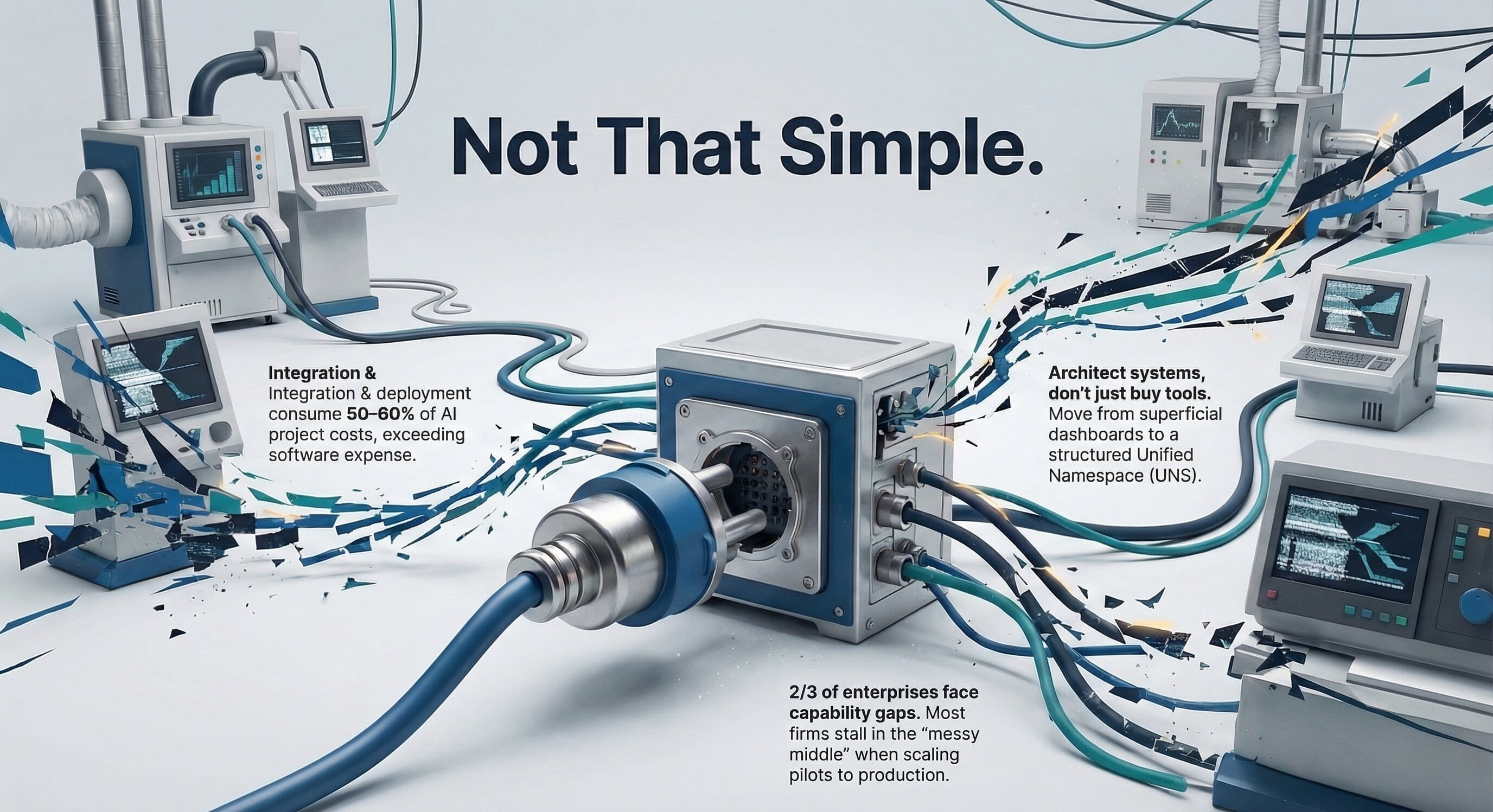
The Promise That Built the Illusion
"Deploy in weeks." "Connect any machine instantly." "Out-of-the-box insights." "Plug. Play. Scale."
If you have attended even one industrial trade show — Hannover Messe, SPS Nürnberg, any vendor demo — you have heard some version of this pitch. On the surface it sounds reasonable. In a world where cloud servers provision in minutes, no-code platforms ship applications in days, and AI models train via API, why should factories not work the same way?
Factories are not software environments. They are living, evolving systems built over decades — and they do not yield to plug-and-play logic.
Attempting to force plug-and-play thinking onto a German Mittelstand production floor is like running a Formula 1 race using Google Maps. The route looks obvious. The track does not agree.
The Moment Reality Hits — the Five-Phase Curve
Almost every IIoT journey in the Mittelstand follows the same five-phase trajectory. Werkleitungs warn each other about it.
Phase 1 — Excitement
Vendor demo is clean. Dashboards look impressive. ROI is forecast over three years and lands in the range the board wants to hear. Budget approved. Workshops with Anlagentechnik are constructive.
Phase 2 — Pilot
One to three machines are connected. Data starts flowing. Early wins are celebrated internally. IT is engaged; the Betriebsrat informed; Instandhaltung skeptical but cooperative.
Phase 3 — Friction
Integrations with MES, ERP, CMMS turn out more complex than planned. Sensor values do not reconcile across machines. IT security demands audits the original timeline never allowed for. OPC UA implementations diverge by vendor in ways no one documented. The second plant takes three times longer than the first.
Phase 4 — Stall
Scaling beyond the pilot plant slows. Costs exceed original forecasts. Stakeholder confidence erodes. Other initiatives claim attention.
Phase 5 — Silent Abandonment
Platform remains installed, barely used. Another evaluation is announced. A different vendor is invited. The cycle restarts.
This is not a technology failure. It is a failure of problem-framing. The plug-and-play narrative promises the easiest step — connectivity — and stays silent on the hardest — the architecture that lets scale survive.
Why Plug-and-Play Breaks Down in Real Factories
1. The Standardization Myth
Vendor assumption: machines speak standard protocols. Reality: every machine is a one-off. A typical plant carries legacy machines aged ten to thirty years, modern CNCs with proprietary extensions, PLCs from several different vendors, custom-built equipment with undocumented interfaces. Even where protocols exist, OPC UA implementations differ, Modbus mappings are inconsistent, naming conventions are arbitrary. Plug-and-play becomes connect-and-debug-for-weeks.
2. Data Is Not a Product — It Is a Liability Until Processed
Raw industrial data is incomplete, inconsistent, misaligned, often wrong. Machine A reports temperature 85. Machine B reports 185. Machine C reports NULL. Are these Celsius, Fahrenheit, sensor errors, or a mix? No dashboard will tell you. Data earns value only after transformation, validation, and contextualization.
3. Context Is the Missing Middle Layer
Machine speed, temperature, cycle time are trivial to capture. What matters: which product is running? Which order? What is the expected cycle time? Is a deviation symptom or cause? Without those answers you do not have intelligence. You have noise with charts.
4. OT / IT Convergence — the Organizational Bottleneck
Technology is rarely the biggest blocker. People are. IT wants control and security. OT wants stability and uptime. Leadership wants ROI yesterday. Werkleitung does not want the PLC touched. The Betriebsrat demands employee-data protection. Plug-and-play ignores this organizational reality entirely.
5. The Scaling Trap
What works on one line fails on fifty. Complexity is not linear — it is exponential. Data volume, latency, integration overhead, cost unpredictability all grow faster than the number of connected assets.
The Vendor Narrative, Decoded
When vendors say "plug-and-play" they operationally mean: fast onboarding, pre-configured demo, out-of-the-box dashboards. They explicitly do not mean: enterprise architecture, multi-site data governance, integration into MES / ERP / CMMS, survivability over ten years. The demo is the beginning. The real work starts after.
The Shift — The Decision That Separates Pilots from Rollouts
Stop thinking in terms of tools. Start thinking in terms of systems.
IIoT is not a dashboard, a platform, or a pilot. IIoT is a data architecture strategy — a ten-year decision, not a twelve-month purchase.
The Real IIoT Architecture — Five Layers
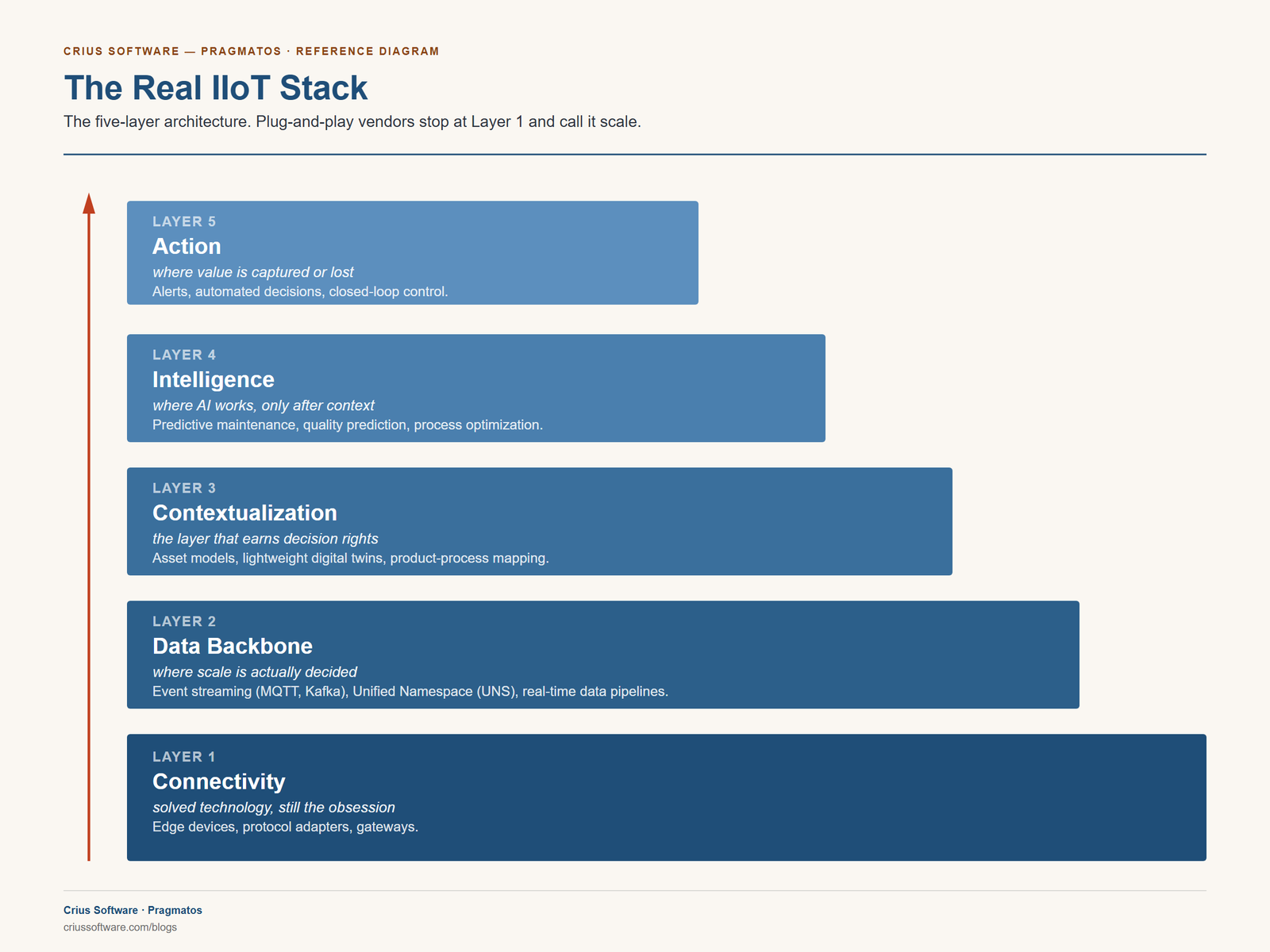
Layer 1 — Connectivity (Solved Technology, Still the Obsession)
Edge devices, protocol adapters, gateways. Anyone can connect machines today. Most IIoT projects stop here and call the result transformation. It is the easiest layer. Hours-to-connect does not equal value-delivered.
Layer 2 — Data Backbone (Where Scale Is Actually Decided)
Event streaming (MQTT, Kafka), Unified Namespace (UNS), real-time data pipelines. Decouples systems, enables scale. Without this layer: spaghetti architecture, permanent debt.
Layer 3 — Contextualization (The Layer That Earns Decision Rights)
Asset models, lightweight digital twins, product-process mapping. Answers: what is happening, why, and is it good or bad? Without this layer, the AI model on top — no matter how sophisticated — learns junk.
Layer 4 — Intelligence (Where AI Works, Only After Context)
Predictive maintenance, quality prediction, process optimization. AI without context is useless. With solid context, agentic AI can act — not just predict.
Layer 5 — Action (Where Value Is Captured or Lost)
Alerts, automated decisions, closed-loop control. If your initiative does not reach this layer, you do not have transformation. You have visualization. The plug-and-play pitch never mentions Layer 5 by name.
Unified Namespace — the Backbone of Modern IIoT
Instead of System A talking to System B talking to System C, a Unified Namespace creates a single source of truth where all data flows in real time. A central nervous system for the factory. Result: scalability, flexibility, interoperability. Without it, every integration is one-off.
Agentic AI — the Operating Layer Above Context
The progression is from reactive factories (dashboards → human decides) to autonomous factories (AI agents → decisions executed). The prerequisite is not model quality — it is data architecture. Without solid Layers 2 and 3, agentic AI delivers automated noise. Garbage in, automated garbage out.
A Practical Playbook — No Shortcuts
- Accept there is no shortcut. This mindset shift alone saves millions.
- Define the data model before connecting anything. Assets, events, aggregates, namespacing. Hierarchy.
- Build a scalable backbone. MQTT, event streaming, UNS architecture.
- Pilot small — architect big. One line as a pilot; the entire enterprise as the architectural frame.
- Prioritize context over dashboards. Dashboards do not create value. Context does.
- Align OT and IT early. Non-negotiable. Signed, not just connected.
Audio Overview
For a 6-minute Deep Dive of this article — two-host format, senior industrial architect plus operations lead — listen here.
Cinematic Video
90-second cinematic overview of the five-layer architecture and the failure curve.
The Cost of Believing the Lie
Organizations that follow the plug-and-play narrative typically lose twelve to eighteen months in pilot phases, fail to scale, rebuild architecture later, and lose internal trust in digitalization. Hidden costs: opportunity loss, delayed transformation, competitive disadvantage.
The Opportunity — If You Get This Right
Approached correctly, IIoT unlocks real-time operations, autonomous decision-making, cross-plant visibility, continuous optimization. The progression: digital visibility → digital control → digital autonomy.
Final Reality Check
The goal was never "connect machines." The real goal is a system that continuously improves decisions at scale. That requires architecture, discipline, long-term thinking. Not plug-and-play fantasies.
Plug-and-play IIoT is not a strategy. It is a shortcut that leads to a dead end. The companies that win in 2026 and beyond are not those that connect fastest. They are those that architect smartest.
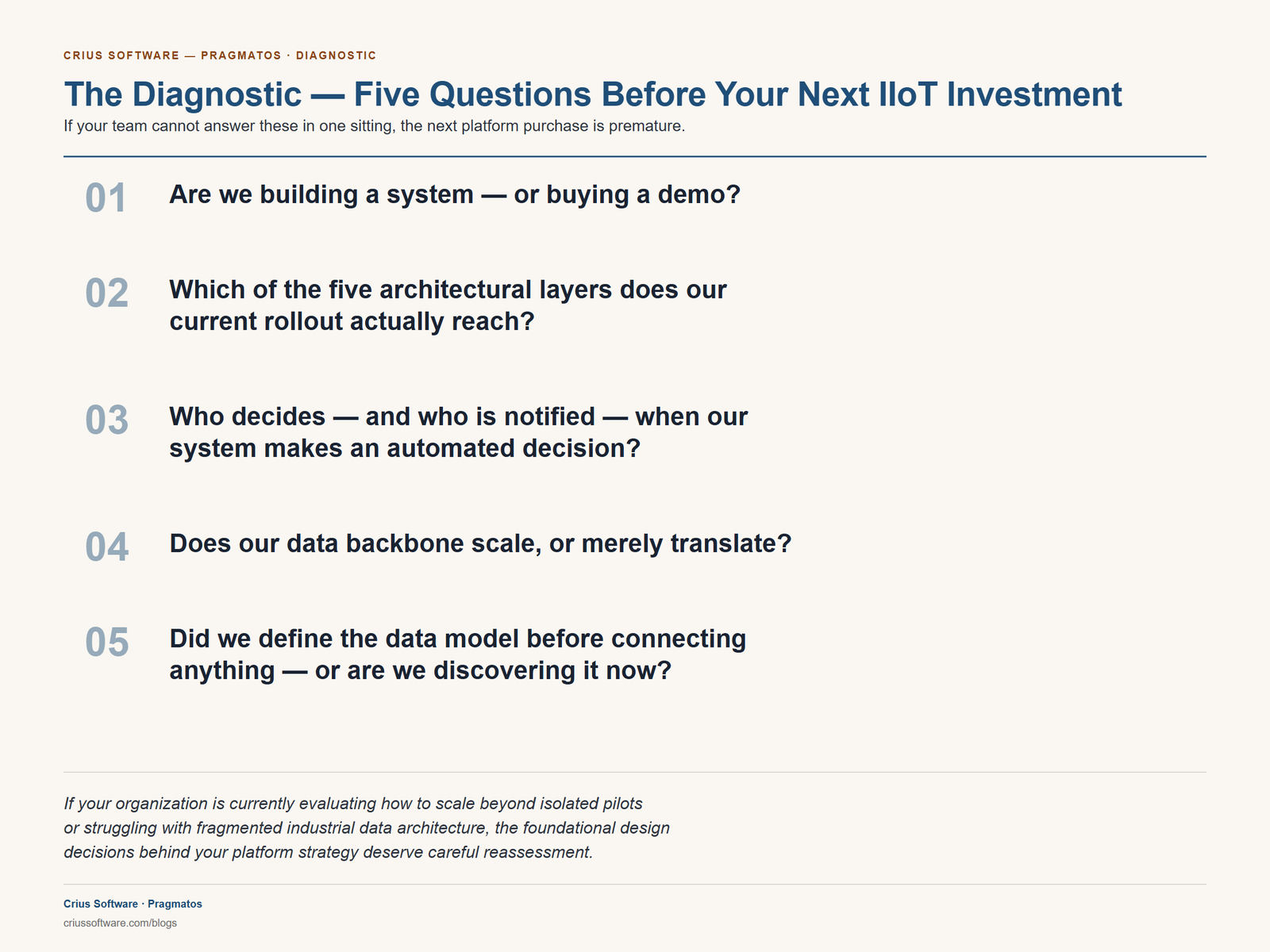
The Diagnostic — Five Questions for Your Team
- Are we building a system — or buying a demo?
- Which of the five architectural layers does our current rollout actually reach?
- Who decides — and who is notified — when our system makes an automated decision?
- Does our data backbone scale, or merely translate?
- Did we define the data model before connecting anything — or are we discovering it now?
If your organization is currently evaluating how to scale beyond isolated pilots or struggling with fragmented industrial data architecture, the foundational design decisions behind your platform strategy deserve careful reassessment.
Enhanced Full Blog Text — Board-Ready Report Format
Executive Summary
Plug-and-play IIoT is not a strategy; it is a narrative that collapses at scale. The pattern is consistent: an excited pilot phase, a friction phase when the second plant reveals what the first hid, a stall phase when scaling costs outpace planning, and a silent abandonment. The failure is structural, not motivational. It lives in the assumption that factories can be treated like software environments. They cannot. Factories are decades-old, heterogeneous, regulated, and governed by works councils, procurement cycles, and Instandhaltung realities that no vendor demo captures.
The alternative is not a bigger platform. It is a data architecture strategy — one that treats connectivity as the easy layer and builds the four harder ones deliberately: a real data backbone (Unified Namespace), a contextualization layer that earns decision rights, intelligence that works only after context is solid, and an action layer where value is actually captured.
Why the Promise Works on Paper
In cloud infrastructure, servers do provision in minutes. In web development, no-code tools do ship applications in days. In AI, API-trained models do reach production faster than the older build-from-scratch cycle. The extrapolation — "so why not factories?" — is superficially plausible. It breaks on one observation: factories are not greenfield. They are accretions of capital purchases across thirty years, each with proprietary extensions, undocumented interfaces, and regulatory contexts that are not negotiable. Plug-and-play assumes a homogeneous substrate. Real Mittelstand production has none.
The Five-Phase Failure Curve
Phase 1 — Excitement. Demo overcomes skepticism. Budget approved. Initial workshops constructive.
Phase 2 — Pilot. One to three machines connected. Data flows. First wins celebrated. Instandhaltung cooperating but watchful.
Phase 3 — Friction. Integration scope expands. Sensor values disagree. IT demands audits. Vendor-specific OPC UA implementations diverge. The second plant takes three times longer.
Phase 4 — Stall. Scaling stops. Costs overrun. Confidence erodes. Competing priorities reclaim attention.
Phase 5 — Silent Abandonment. Platform unused. Next evaluation announced. Cycle restarts.
The technology did not fail. The assumption about what the technology needed to carry did.
Five Structural Failure Modes
The standardization myth. OPC UA differs by vendor. Modbus mappings inconsistent. Legacy machines undocumented. Plug-and-play becomes connect-and-debug-for-weeks.
Data as liability until processed. Raw values are incomplete, inconsistent, and often wrong. Without transformation, validation, and contextualization, the dashboard shows noise in clothing.
The missing middle layer — context. Knowing a machine's temperature is trivial. Knowing whether that temperature indicates product, process, or procedure drift requires contextualization. Without it, intelligence is noise with charts.
OT / IT convergence as organizational bottleneck. Technology is the second-hardest problem. People are the first. IT wants control; OT wants stability; leadership wants ROI yesterday; Werkleitung wants the PLC untouched; the Betriebsrat wants employee-data protection. Plug-and-play addresses none of this.
The scaling trap. Complexity is exponential, not linear. Pilot-plant patterns do not replicate at the fiftieth line.
The Vendor Narrative, Decoded
When vendors say "plug-and-play," operationally they mean fast onboarding, pre-configured demo, out-of-the-box dashboards. They do not mean enterprise architecture, multi-site data governance, MES/ERP/CMMS integration, or ten-year survivability. The demo is a beginning. The real work starts after.
The Shift
Stop thinking in tools. Start thinking in systems. IIoT is not a dashboard, platform, or pilot — it is a data architecture strategy, a multi-year decision.
The Five-Layer Architecture
Layer 1 — Connectivity. Solved technology, still the obsession. Edge devices, protocol adapters, gateways. Anyone can connect machines today.
Layer 2 — Data Backbone. Where scale is actually decided. MQTT, Kafka, Unified Namespace, real-time pipelines. Decouples systems; enables scale.
Layer 3 — Contextualization. The layer that earns decision rights. Asset models, lightweight digital twins, product-process mapping.
Layer 4 — Intelligence. Where AI works, only after context. Predictive maintenance, quality prediction, process optimization. Agentic AI sits here — but depends on the layer below.
Layer 5 — Action. Where value is captured or lost. Alerts, automated decisions, closed-loop control. No transformation without this layer.
Unified Namespace
Instead of System A talking to B talking to C, a UNS creates a single source of truth where all data flows in real time. A central nervous system for the factory. Result: scalability, flexibility, interoperability.
Agentic AI — The Layer Above Context
Progression is from reactive factories (dashboards; humans decide) to autonomous factories (AI agents; decisions executed). Prerequisite: solid Layers 2 and 3. Otherwise: automated noise.
A Practical Playbook
Step 1 — Accept there is no shortcut. This mindset alone saves millions.
Step 2 — Define the data model before connecting anything. Assets, events, aggregates, namespacing, hierarchy.
Step 3 — Build a scalable backbone. MQTT, event streaming, UNS architecture.
Step 4 — Pilot small, architect big. One line as pilot; enterprise as architectural frame.
Step 5 — Prioritize context over dashboards. Dashboards do not create value. Context does.
Step 6 — Align OT and IT early. Non-negotiable. Signed, not just connected.
The Cost of the Lie
Organizations following the plug-and-play narrative lose twelve to eighteen months in pilot phases, fail to scale, rebuild architecture later, and lose internal trust in digitalization. Hidden costs: opportunity loss, delayed transformation, competitive disadvantage.
The Opportunity
Done correctly, IIoT unlocks real-time operations, autonomous decision-making, cross-plant visibility, continuous optimization. Progression: digital visibility → digital control → digital autonomy.
Closing
Plug-and-play IIoT is not a strategy. It is a shortcut that leads to a dead end. The companies that win in 2026 and beyond are not those that connect fastest. They are those that architect smartest.
Diagnostic Questions
1. Are we building a system — or buying a demo?
2. Which of the five layers does our current rollout reach?
3. Who decides — and who is notified — on Layer 5?
4. Does our data backbone scale, or translate?
5. Did we define the data model before connecting — or after?
Anjali Krishnan updated on 22 Apr 2026, 08:14AM
The five-phase curve hits home. We just exited Phase 4 on a SCADA-replacement initiative — not because the technology failed, but because the second site's PLCs spoke a Modbus dialect the integrator had assumed away. Six weeks of debugging billed back to us as "scope expansion."Stefan Brandt updated on 22 Apr 2026, 11:30AM
The dialect problem is a tax most pilots do not budget. We started insisting on a discovery week per site before any commitment. Costly upfront, half the cost over the rollout.Markus Weber updated on 23 Apr 2026, 09:42AM
The IT-OT signing model point is the one our board still does not internalise. They see "platform deployed" in the status report and assume someone owns Layer 5. No one does. The platform sits at Layer 1 forever.Priya Subramanian updated on 24 Apr 2026, 02:18PM
"You don't have intelligence. You have noise with charts." — quoted this in our quarterly review. Got an uncomfortable silence from the dashboard vendor in the room. Useful silence.Klaus Hoffmann updated on 25 Apr 2026, 10:05AM
That sentence has done more for our internal alignment than the previous twelve months of consultant decks. Worth remembering when the next demo wraps with a "looks impressive" from the COO.Rajiv Menon updated on 26 Apr 2026, 07:50AM
Slight pushback on Layer 1 being the most overrated. For brownfield modernization with thirty-year-old machines, getting OPC UA mapped consistently IS the hard part. After that, yes, the upper layers are where value lives.Dirk Bauer updated on 26 Apr 2026, 12:14PM
Both true depending on the plant. Fair point — for greenfield, Layer 1 is solved. For brownfield, it is the eighteen-month tax nobody mentions.Heike Schultz updated on 27 Apr 2026, 09:30AM
The works council reference is rare in IIoT writing in English. As a Mittelstands-Werkleiter — that is our actual blocker on Layer 5 automation. No one wants to be the first to test how the Betriebsrat reads "AI agent decided to trigger maintenance."Sandeep Iyer updated on 28 Apr 2026, 11:45AM
Practical playbook step 4 — pilot small but architect big — sounds easy until budget meets calendar. Curious how Crius would advise on the first two months of "architect big" before any code.Crius Software updated on 29 Apr 2026, 08:22AM
Three artefacts in those two months: the data model (assets, events, aggregates, namespacing), the OT/IT signing matrix (who decides what at which layer), and the failure-mode register from the brownfield site assessment. Everything else compounds from those.Thomas Lange updated on 30 Apr 2026, 10:12AM
The "Plug. Play. Scale." vendor pitch quote is uncomfortably close to the slide deck I sat through last Hannover. The honest version of that slide is "Plug. Demo. Pilot. Stall." Same letters, different ending.Vinay Pillai updated on 01 May 2026, 03:20PM
Question on Layer 4: how do you draw the line between "AI works because Layer 3 is solid" and "AI works because the model is good"? In our experience the Layer 3 maturity gap is the dominant variable, but vendors keep selling the model.Crius Software updated on 02 May 2026, 09:18AM
Vendor incentive aligns with selling the model — it is the easier component to demo. The Layer 3 work is invisible in a 30-minute demo and undersells unless you have a buyer who knows to ask. The buyer-education problem is also a Crius problem; the more we name Layer 3 explicitly, the less the model gets oversold.