

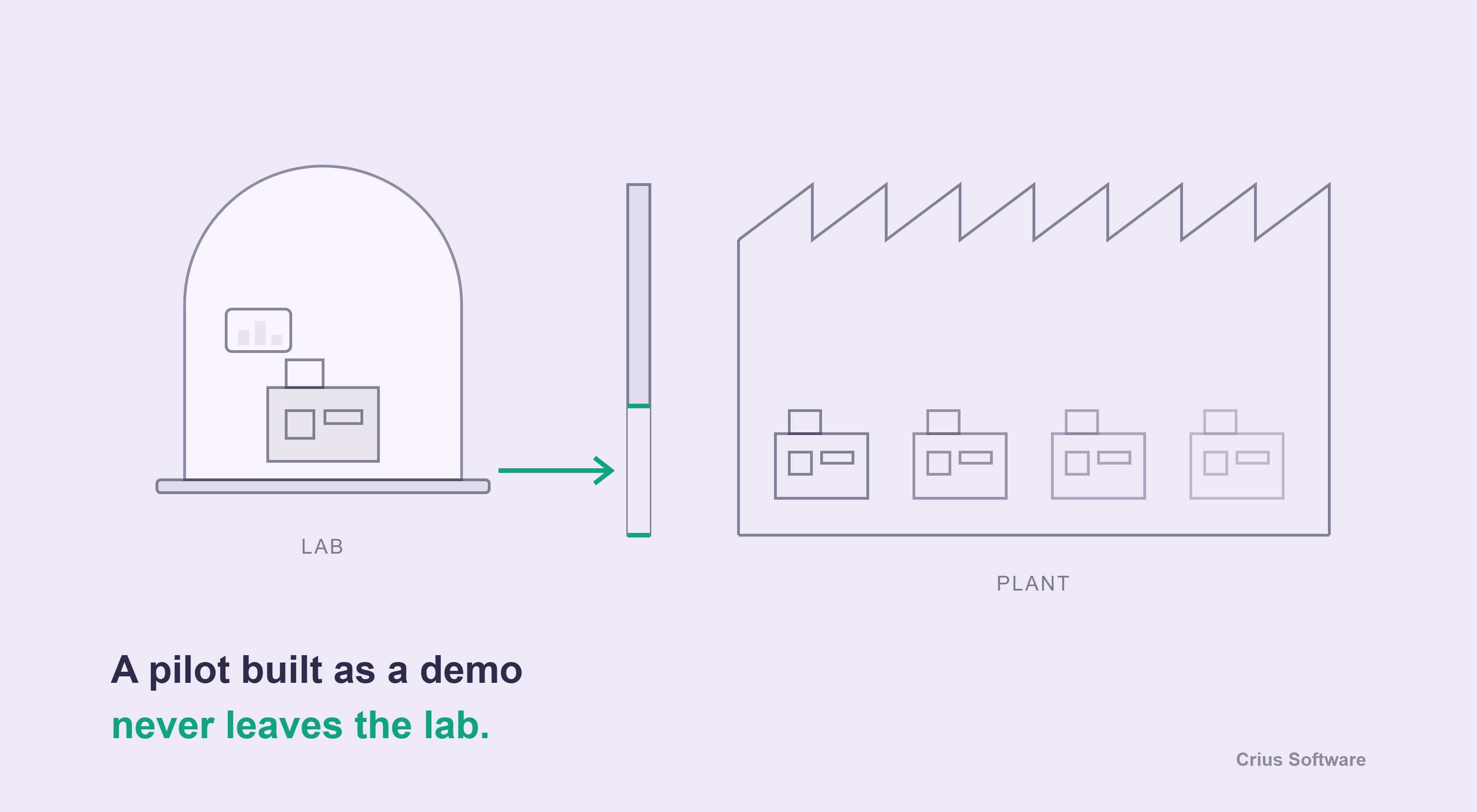
Why “Pilot Purgatory” Keeps Happening
Let’s be honest for a moment. We’ve all been there. You’re in the boardroom. The coffee is decent, the lighting is dim, and a vendor is showing you a dashboard that looks like it belongs on the bridge of the Starship Enterprise. There are spinning 3D turbines, real-time gauges, and a predictive maintenance alert that feels like magic. Everyone nods. The pilot gets approved.
Fast forward six months. That “magic” dashboard is currently tracking one machine in a corner of the factory, the data feed breaks every time the microwave in the breakroom runs, and IT and OT are no longer speaking to each other. Welcome to Pilot Purgatory.
You aren’t alone. Depending on who you ask, and how honest they are, somewhere between 70% and 75% of IoT projects fail to scale beyond the proof-of-concept phase. They do not die with a bang; they die with a whimper, usually buried under a pile of spreadsheet workarounds, brittle integrations, and custom code that nobody wants to own in year two.
Industrial IoT programs often prove technical possibility but fail at operational repeatability.
One connected machine is a demo. Hundreds of devices across plants are an architecture test.
Security and architecture debt become dramatically more expensive when fixed after rollout pressure begins.
Audio Brief: Want to Listen?
Executive audio version
Use this audio version for stakeholder reviews, internal circulation, or leadership briefings when the audience prefers a faster narrative format over full-text reading.
Video Overview: Want to Watch?
Visual walkthrough of the pilot-to-scale challenge
This video asset can be used as a compact explainer for internal teams aligning around architecture, governance, and rollout sequencing.
The Industrial Reality Check: This Is Not Plug-and-Play
The biggest lie in the market is the phrase “seamless integration.” In a brownfield factory, where a machine from 1985 sits beside a robot from 2024, nothing is seamless. It is a shmozzle of gateways, protocols, legacy controls, conflicting standards, and site-specific tribal knowledge.
The typical collapse pattern
- The Shiny Object Syndrome: a smart sensor solution works beautifully in its proprietary app.
- The Spaghetti Monster: someone tries to connect the same data to ERP, MES, and SCADA, creating fragile point-to-point links.
- The “Oh No” Moment: the team realizes that scaling to a second site means rebuilding the entire setup almost from scratch.
What leadership often misses
A successful demonstration creates emotional momentum. A successful production model requires data ownership, supportability, security, semantic consistency, integration resilience, and operating governance. Those are far less glamorous than a dashboard, but they determine whether value survives contact with reality.
Architecture Framework: Think Systems, Not Features
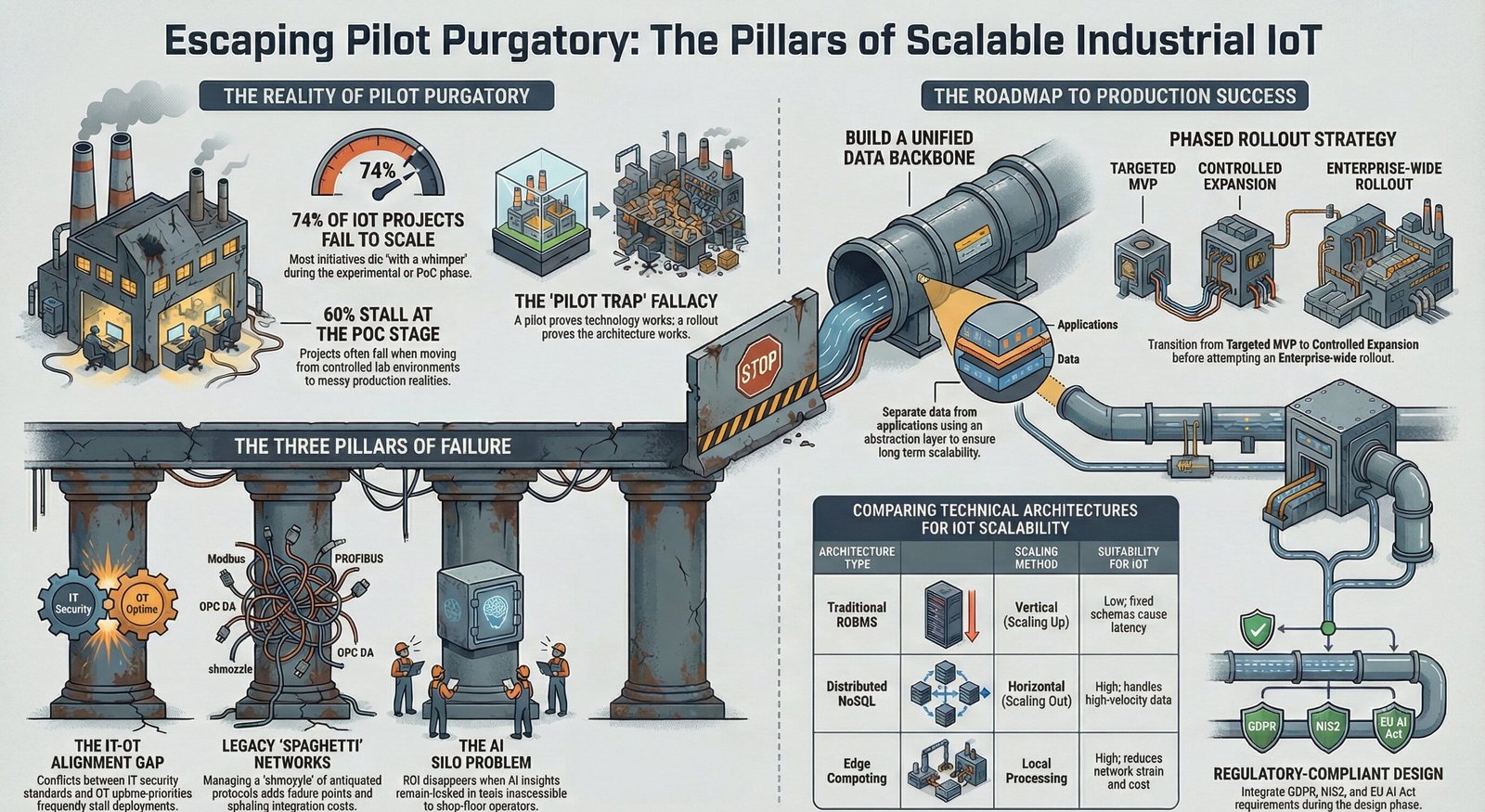
To escape Pilot Purgatory, organizations must stop buying disconnected tools and start building a data backbone. The critical design move is to separate the data layer from the application layer. Instead of hard-wiring each sensor to a specific dashboard or workflow, enterprises need an abstraction layer that makes data portable, reusable, and governed.
| Layer | What it must do | Why it matters for scale |
|---|---|---|
| Edge Layer | Filter noise, process signals near the machine, and forward events or anomalies rather than every raw datapoint. | Reduces bandwidth, latency, cloud cost, and alert fatigue while keeping analysis operationally relevant. |
| Unified Data Model | Translate Modbus, BACnet, OPC UA and other signals into a common semantic structure. | Prevents every use case from reinventing data mapping, making cross-site rollout and analytics repeatable. |
| Governance Layer | Define ownership, access rights, retention policies, and integration standards. | Ensures the company—not the vendor—controls the industrial data estate and its future optionality. |
| Application Layer | Enable dashboards, maintenance use cases, optimization workflows and AI models on top of stable data services. | Allows new value cases to be deployed faster because the underlying plumbing is already standardized. |
Why data gravity matters
Industrial data is generated at the edge by machines spinning at high speeds, producing a chaotic flow of signals. Shipping all raw telemetry to the cloud is expensive, slow, and often unnecessary. Scale depends on deciding what must stay local, what must move upstream, and what must be normalized before any analytics stack touches it.
Why rigid schemas break
Traditional enterprise databases like fixed schemas and predictable records. Machines do not. IoT streams are high-velocity, irregular, and often semi-structured. Without a flexible architecture layer in between, systems choke under the volume, velocity, and variety of industrial data.
The Four Failure Pillars Behind Most Scale Breakdowns
Most stalled initiatives trace back to a handful of structural mistakes. These are not minor implementation issues. They are foundational design failures that quietly undermine enterprise rollout.
1. The Pilot Trap
A custom-built pilot may impress stakeholders, but if it depends on unique code, manual steps, one-off connectors, or special vendor support, it becomes too fragile to replicate.
2. The Skill Gap
OT teams may not know Python, cloud orchestration, or API lifecycle management. IT teams may not understand PLC behavior, uptime realities, or how production lines actually fail. Scale requires translation across both worlds.
3. Vendor Lock-in
When the hardware or platform vendor controls the data model, export pathways, or application logic, the manufacturer loses strategic control. If you cannot freely move your data, you do not truly own your digital factory.
4. Security Nightmares
Deploying thousands of new endpoints without patching strategy, identity controls, encrypted transport, and lifecycle management is not transformation—it is attack surface expansion.
The European Context: Compliance Is an Architecture Constraint, Not a Legal Footnote
If you operate in Germany, Austria, Switzerland, or wider Europe, scale decisions are shaped by more than technology choices. Regulatory pressure changes how industrial systems must be designed from day one.
ROI Model: The Real Payback Is Repeatability, Not Just One Use Case
Boards often look for a direct cost-saving number tied to one pilot. That is too narrow. The real ROI of a scalable industrial data backbone is not just predictive maintenance savings on one machine. It is the ability to launch new use cases faster, reuse data across plants, reduce integration cost, and avoid architecture debt that compounds over time.
What weak architecture costs
- Rebuilding integrations for each new machine, line, or site
- Manual reconciliation across MES, ERP, SCADA and vendor apps
- Security remediation after large endpoint deployments
- Slow deployment cycles that kill executive confidence
- Inability to industrialize analytics because data is inconsistent
What a scalable backbone unlocks
- Reusable connectivity and data standards
- Faster rollout of additional use cases in weeks instead of years
- Cleaner governance for ownership, retention and access
- Higher confidence in compliance and cyber posture
- A platform for continuous optimization rather than isolated wins
Board-level ROI logic
- Efficiency: less downtime, lower bandwidth waste, fewer manual interventions.
- Agility: faster deployment of future digital use cases because the backbone already exists.
- Risk reduction: fewer security, compliance, and lock-in liabilities hiding in operational technology environments.
- Strategic optionality: the enterprise can adopt new tools without replatforming its entire data estate each time.
Executive Summary for Leadership Teams
What decision-makers need to know
- The problem: the organization is stuck in pilot mode because current initiatives are structured as isolated technical experiments rather than scalable infrastructure programs.
- The risk: inaction creates technical debt, fragmented integrations, and security or compliance weaknesses that become dramatically more expensive later.
- The solution: invest in Industrial Data Architecture—edge filtering, unified data models, governance, interoperability, and security by design.
- The payoff: a repeatable digital foundation that supports faster deployment of future use cases across assets, lines, and sites.
Implementation Steps: A Practical Checklist for Serious Manufacturers
Before signing the next purchase order for a “smart factory” solution, leadership teams should pressure-test the rollout model, not just the demo quality.
Architecture and interoperability
- Can all historical data be exported in standard formats such as SQL, CSV, or JSON without punitive fees or vendor dependency?
- If device count grows by 100x, is there evidence the data layer can handle the load?
- Can the system integrate with older PLCs and brownfield assets without requiring expensive custom work for every site?
Security and compliance
- Do devices support over-the-air firmware updates, identity management, and secure patching models?
- Can the architecture support pseudonymization, access control, and policy enforcement near the edge where required?
- Is security a core design element, or is it being deferred until after deployment pressure begins?
Final Thought
Industrial IoT is not magic. It is plumbing. It is architecture. It is the deliberately unglamorous work of ensuring that data can move securely and reliably from a dusty sensor to a decision-maker’s screen.
If your organization is tired of beautiful demos that never make it into stable operations, or if you are already trying to untangle a maze of fragmented pilots, then the next smart move is not another dashboard. It is a stronger foundation.
Real scalability is quiet. It just works. And for manufacturers under pressure to deliver transformation with control, that kind of boring success is exactly the point.
Enhanced Full Blog Text — Board-Ready Report Format
The “Pilot Purgatory” Survival Guide: Why Your Smart Factory is Stuck in the Lab (and How to Break It Out)
Executive summary: Industrial IoT initiatives routinely demonstrate promise in controlled pilots, yet fail when organizations attempt to scale them across production realities. The core reason is structural: leadership teams often validate a technology demonstration, while the enterprise challenge is actually one of architecture, governance, interoperability, and security at scale. The path out of Pilot Purgatory is not another isolated tool, but a robust industrial data backbone designed for repeatability, ownership, and compliance.
Let’s be honest for a moment. We’ve all been there.
You’re in the boardroom. The coffee is decent, the lighting is dim, and a vendor is showing you a dashboard that looks like it belongs on the bridge of the Starship Enterprise. There are spinning 3D turbines, real-time gauges, and a predictive maintenance alert that feels like magic. Everyone nods. The pilot gets approved.
Fast forward six months. That “magic” dashboard is currently tracking one machine in a corner of the factory, the data feed breaks every time the microwave in the breakroom runs, and IT and OT are no longer speaking to each other.
Welcome to Pilot Purgatory.
You aren’t alone. Depending on who you ask, and how honest they are, somewhere between 70% and 75% of IoT projects fail to scale beyond the proof-of-concept phase. They don’t die with a bang; they die with a whimper, usually buried under a pile of spreadsheet workarounds and unscalable custom code.
As a Senior Industrial Architect who has spent 15+ years crawling under machines in Bavarian factories and arguing with firewalls, I’m here to tell you why this happens—and how to fix it before your CFO asks about the ROI.
The Industrial Reality Check: It’s Not Just “Plug and Play”
The biggest lie in our industry is the phrase “seamless integration.” In a brownfield factory—where a machine from 1985 sits next to a robot from 2024—nothing is seamless. It is a “shmozzle” of different gateways, protocols, and conflicting standards.
Here is the typical scenario that kills scaling:
- The Shiny Object Syndrome: You buy a “smart sensor” solution that works perfectly on its own proprietary app.
- The Spaghetti Monster: You try to connect that data to your ERP. Then your MES. Then your SCADA. Suddenly, you have point-to-point connections everywhere.
- The “Oh No” Moment: You realize that to roll this out to your second factory, you have to rebuild the whole mess from scratch.
Real-world truth: A pilot proves a technology works. A rollout proves an architecture works. Most companies confuse the two.
Why the Problem Exists Structurally (The Boring Stuff That Matters)
If you treat Industrial IoT (IIoT) as an IT experiment, it will fail. Why? Because Data Gravity is real.
In a factory, data is heavy. It is generated at the “edge”—by machines vibrating at 10,000 RPM. Moving all that raw data to the cloud for analysis is expensive, slow, and frankly, unnecessary.
Furthermore, traditional databases, the ones IT loves, use fixed schemas. They want data to look like a neat Excel spreadsheet. But IoT devices are chaotic; they spit out unstructured streams at high velocity. When you try to shove that chaotic data into a rigid database without a flexible architectural layer, the system chokes. It cannot scale because the underlying structure wasn’t built for the volume, velocity, and variety of industrial data.
Architecture Deep Dive: Think Systems, Not Features
So, how do we escape purgatory? We stop buying “tools” and start building a data backbone.
Successful scaling requires an architecture that separates the data from the application. Instead of hard-wiring a sensor directly to a dashboard, you need an abstraction layer—a middleware or connectivity layer.
The Scalable Stack:
- Edge Layer: Filter the noise. Drop 90% of the raw telemetry locally and only send the meaningful anomalies up the chain. This solves your bandwidth and cost issues.
- Unified Data Model: Translate the “spaghetti” of Modbus, BACnet, and OPC UA signals into a single, standardized language before it hits your analytics tools.
- Governance Layer: Decide who owns the data. Is it IT? OT? The vendor? It should be you.
This is where a framework like Pragmatos comes in. It’s not just another pretty dashboard; it’s the structural plumbing that makes sure when you add machine #500, the system doesn’t collapse.
The European Context: GDPR, Cyber Resilience, and “Das Works Council”
If you are operating in the DACH region or wider Europe, you have hurdles our friends in Silicon Valley often forget.
- GDPR isn’t just for Facebook: If your smart building sensors track occupancy, you are processing personal data. You need privacy-by-design, not a “we’ll fix it later” attitude.
- The EU AI Act: where AI is used in or near critical infrastructure, transparency, oversight and logging expectations rise sharply. Model performance without governance is not enough.
- NIS2 Directive: operators of critical infrastructure and many industrial organizations must secure digital supply chains, device estates and operational resilience far more rigorously than before. A gateway shipping with a hard-coded password is exactly the kind of device-estate weakness that now has to be accounted for.
Architectural tip: Security cannot be bolted on later. It must be baked in—think identity management for every single device, encrypted data transit, and zero-trust networks.
Why Most Initiatives Fail to Scale (A Summary of Pain)
If you take nothing else away, remember these four scaling killers:
- The Pilot Trap: Building a custom solution for the pilot that is too fragile to replicate.
- The Skill Gap: Underestimating that your OT engineers don’t know Python, and your IT engineers don’t know what a PLC is.
- Vendor Lock-in: Letting a hardware vendor own your data format. If you can’t export your data easily, you don’t own your factory.
- Security Nightmares: Deploying thousands of new endpoints, sensors, without a plan to patch them. That’s just rolling out a red carpet for hackers.
Executive Summary (For the Board Meeting)
- The Problem: We are stuck in “pilot mode” because our current approach is a series of isolated science experiments, not a scalable infrastructure.
- The Risk: Continued inaction leads to technical debt and security vulnerabilities, including NIS2 and GDPR exposure, that cost materially more to fix the longer they are left.
- The Solution: Shift from buying “IoT gadgets” to investing in an Industrial Data Architecture. We need a unified platform, like Pragmatos, that standardizes data at the source, ensures compliance by design, and allows us to scale securely.
- The ROI: It’s not just about efficiency; it’s about agility. A scalable backbone allows us to deploy new use cases in weeks, not years.
A Practical Checklist for the “Serious” Manufacturer
Before you sign that next PO for a “Smart Factory” demo, ask these questions:
- Data Ownership: Can I export all my historical data in a standard format, SQL, CSV, or JSON, without paying a “ransom”?
- Scalability: If we multiply the device count by 100x tomorrow, will the database crash? Ask for load test data.
- Security: Does the device support over-the-air firmware updates, or do I have to send a technician with a USB stick to every machine?
- Compliance: Does the data architecture support GDPR-compliant pseudonymization at the edge?
- Interoperability: Can this system talk to my 20-year-old PLC without a $50,000 custom integration?
Final Thought
Industrial IoT isn’t magic. It’s plumbing. It’s architecture. It’s the boring, unsexy work of making sure data flows securely and reliably from a dusty sensor to a decision-maker’s screen.
If your organization is tired of “cool demos” that don’t deliver, or if you’re struggling to untangle a mess of fragmented data pilots, it might be time to stop looking for new tools and start looking at your foundation.
Real scalability is quiet. It just works. If that sounds like the kind of boring success you’re looking for, we should talk.
Raj updated on 13 Feb 2025, 09:05AM
We have been living this exact problem. One successful pilot became five disconnected mini-platforms, and now every new use case feels like a reinvention project instead of a rollout.Hannah updated on 13 Feb 2025, 11:18AM
That is the real hidden cost. The pilot itself looks affordable, but the replication model is missing, so the operating complexity multiplies faster than the business value.Lukas updated on 13 Feb 2025, 02:42PM
The line about a pilot proving technology while a rollout proves architecture is probably the strongest sentence in the article. Too many teams celebrate the dashboard before they validate the backbone.Meera updated on 14 Feb 2025, 08:16AM
The data ownership point deserves more attention. We had a vendor-specific setup where extracting historical machine data for our own analytics became a negotiation. That should never happen in an industrial environment.Felix updated on 14 Feb 2025, 10:03AM
Completely agree. If the commercial model punishes you for accessing your own operational data, the architecture is already compromised.Daniel updated on 14 Feb 2025, 01:27PM
What resonated for me was the skill gap between OT and IT. Our controls engineers understand the process deeply, but the cloud team often underestimates the realities of uptime, latency, and safety constraints on the plant floor.Priya updated on 15 Feb 2025, 09:11AM
The edge filtering recommendation is practical. We reduced bandwidth and noise significantly once we stopped forwarding every raw signal upstream and instead focused on anomalies, events, and context-enriched records.Matthias updated on 15 Feb 2025, 12:36PM
Yes, and it also improved trust. Operators stopped ignoring alerts once the stream became relevant to the process rather than technically impressive but operationally noisy.Oliver updated on 15 Feb 2025, 04:54PM
Excellent summary of the European reality as well. Many strategy decks still treat compliance as a final work package, when in reality GDPR, NIS2, and AI governance change the architecture decisions from day one.Ananya updated on 16 Feb 2025, 08:25AM
The checklist is useful because it turns a vague “smart factory ambition” into procurement questions. Asking about OTA updates and interoperability before buying hardware saves months later.Stefan updated on 16 Feb 2025, 03:14PM
We learned the hard way that scaling thousands of endpoints without a patching model creates an operational risk that cybersecurity teams cannot absorb afterwards. Security really has to be designed into the rollout.Neha updated on 17 Feb 2025, 10:07AM
The article balances technical depth with executive clarity very well. Especially the point that ROI is not only efficiency, but also agility and repeatability of new deployments.Jonas updated on 17 Feb 2025, 01:40PM
That is what boards often miss. The real value is not one predictive maintenance use case, but the ability to launch the next ten use cases on the same backbone.Tobias updated on 18 Feb 2025, 09:32AM
I would add one more failure mode: weak master data. Even with good connectivity, inconsistent asset naming across sites makes enterprise analytics nearly impossible.Kavya updated on 18 Feb 2025, 11:02AM
Absolutely. A unified data model is not just protocol translation; it is also semantic consistency so that the same machine type means the same thing across plants.