Forty-eight machines, four decades of controls, three sites. One record of what each spindle does, what it uses and what each part costs.
A family-owned contract machinist in its third generation turns and mills parts for hydraulics, medical and aerospace-adjacent buyers. Its machines were bought one at a time over thirty years, so the hall holds controls that speak OPC UA next to controls that speak through a serial port next to machines that speak only through their stack light. The IT team is two people. Buyers now ask for the price and the kilowatt-hours of each part. This route card shows how the group reads every machine the same way, whatever its age, and what that is worth in its own numbers.
Part families in this job
HydraulicsValve bodies and manifolds, lots of 200 to 600, steel and aluminium
MedicalTurned implant-adjacent components, lots of 50 to 200, titanium and stainless
Aerospace-adjacentMilled brackets and fittings under AS9100 and AS9102 first-article rules
Who reads this
The owner-manager who signs the energy contract and the IATF 16949 and AS9100 audit plans, and the head of production who is asked every Monday why the quoted hours and the booked hours differ.
Modelled, four results, no overlap
€253,400a year, at the group's own inputs on Sheet 7 · MODELLED
Modules on this record
Loomreads every machine, any age
Pragmatos Livethe hall board, OEE per shift
Pulseset-up time, tool life, spindle health
Orbis · Flow · Decisionsproposes, hands over, proves
Part familyContract machining · three sites
DrawnCrius Software Pragmatos case study
ReferenceCS-07 Anonymous · present tense
Sheet1 of 7
OpHEADER
123ABCD
OP 10
Set-up: the sites, generation by generation
Site A, the main hall
Twenty-four machines: five-axis centres and twin-spindle lathes from the last ten years with current controls, a row of 2000s lathes with enclosures and pendants, and the measuring room whose coordinate measuring machine writes a result file per part. The ERP runs here. Two people look after all of it, the network included.
Site B, forty kilometres away
Fourteen machines, taken over with a workshop in 2015 and kept on its own habits: its own shift calendar, its own route-card layout, controls a generation older. The owner visits on Thursdays and reads the whiteboard.
Site C, the old hall
Ten machines: six 1990s lathes whose controls have a serial port and nothing else, and four conventional machines with no electronics at all. The men who run them know every set-up by heart and three of them are over sixty.
What is in scope. Forty-four of the forty-eight machines carry a read path. The four conventional machines carry none and are counted as such, not estimated. The group uses about 6,200 MWh of electricity a year across the three sites, below the 7.5 GWh line at which EnEfG § 8 requires an energy or environmental management system (S6), and the line is where its growth is heading.
A spindle week today, by machine generation
Hours of the 80 planned per machine and week, as the counters say when they are read on Friday. The grey slice is the hours no one can place: the counter and the booking do not meet.
The newest machines are the least blind. The oldest hall has the most unknown hours and the lowest cutting share, and it is where the per-part cost question is hardest to answer.
What the group measures itself by
Quantity
Where it lives today
OEE per machine and shift
A spreadsheet per site, filled on Monday from counters
Spindle hours
Control counters, read by hand; none on the 1990s lathes
€ per part
Quoted from standard times; actual times rarely booked back
kWh per part
Not measured; the site meter divided by the parts sent out
Set-up time
On the route card, in handwriting, when it is written
First-pass yield
In the measuring-room files, per part, not per machine
Delivery reliability
In the ERP, after the fact
Monday, seven o'clock, today
The production head has three spreadsheets open, one per site. The counters were read on Friday afternoon, so the weekend shift is a guess. A buyer's purchasing department has asked, for the third time this quarter, for the kilowatt-hours behind a valve-body part number, and the controller has blocked Wednesday to assemble the answer from the ERP, the site meter and the route cards. Nobody in the building can say what the six lathes in the old hall did last week, other than the men who ran them.
Machine generations in scope
Generation
Count
What it exposes
Read through
Current controls, 2015 on
18 · A 16, B 2
OPC UA, umati or MTConnect
Direct door
2000s controls
20 · A 8, B 12
A serial port; four carry a control no standard door reads
Edge door 16, Wire door 4
1990s lathes
6 · C
A serial port, the stack-light contacts, a meter on the supply
Edge door, I/O box
Conventional
4 · C
Nothing
Not read, counted as unread
Part familyContract machining · three sites
DrawnCrius Software Pragmatos case study
ReferenceCS-07 Anonymous · present tense
Sheet2 of 7
OpOP 10
123ABCD
OP 20
First article: the findings, ballooned
Six characteristics are out of tolerance on the group's own first article. Each is a public, dated finding, ballooned the way an AS9102 inspector balloons a drawing, with the consequence it has on the shop floor.
No.
Characteristic
Finding
Consequence on the floor
Source
1
Skilled workers
In June 2026, in metal construction and machining, about two of three open posts cannot be filled on paper; 383,000 such posts nationally, 34.7 % of all vacancies for skilled workers.
The set-up knowledge of the group sits in a handful of heads. A set-up time that lives in a head is not a number the shop can plan with.
S1
2
Age structure
13.3 million people, 30 % of today's working-age population, reach retirement age by 2040; the 55-and-over share rises from 20.7 % to 27.0 %.
The gap is demographic, not a cycle to wait out. Whatever the three men in the old hall know has to be on a record before they leave.
S2
3
Electricity price
Non-household electricity costs 17.64 ct/kWh on average in the first half of 2026; a buyer in the 20 to 500 MWh band pays 23.66 ct.
At about 6,200 MWh a year, a single point of the price is tens of thousands of euros. The group knows its site meter and nothing finer.
S3
4
Per-part CO2 and cost requests
The machine-tool industry's own product category rule for cradle-to-gate footprints says buyers will pass the question straight down the supply chain; purchased energy is to be allocated to the machines that use it.
Purchasing departments ask for kWh and euros per part number, per order. Each request is a day or two of a controller's time, assembled from four files.
S4
5
Order swing
Machine-tool orders in Germany rise 12 % in the second quarter of 2026 while production falls 6 % in the half-year; the association says it is too early for an all-clear.
Capacity has to flex in both directions. Spindle hours are the only quantity that tells the owner whether a second shift pays.
S5
6
Energy law threshold
EnEfG § 8 obliges companies above 7.5 GWh a year (three-year average) to run an energy or environmental management system, record energy flows and waste heat, and value measures under DIN EN 17463.
At 6.2 GWh the group is below the line. One more hall and it is not. Meters per machine put in now are the same meters the system would need later.
S6
S1 KOFA Kompakt 09/2026, Institut der deutschen Wirtschaft, engineering and metal occupations, June 2026 · S2 Destatis, population projection to 2040, press release · S3 Destatis press release 345, 30 Sept 2026, electricity and gas prices H1 2026 · S4 VDW press release, 13 Jan 2025, product category rule for machine tools · S5 Produktion, 11 Sept 2026, VDW second-quarter figures · S6 Energieeffizienzgesetz § 8, as in force. Full passages are archived with the study.
Disposition. None of the six is a machine fault, and none goes away by buying a machine. Each asks the same thing of the group: a number per machine and per part that exists on the day it is asked for, not assembled the week after. Balloons 1 and 2 ask for set-up knowledge to leave the head and reach a record while the people are still there; 3, 4 and 6 ask for kilowatt-hours per machine, not per site; 5 asks for spindle hours a week, not a quarter. Op 30 is the route to that record for every machine on Sheet 2, the ones with a serial port included.
Part familyContract machining · three sites
DrawnCrius Software Pragmatos case study
ReferenceCS-07 Anonymous · present tense
Sheet3 of 7
OpOP 20
123ABCD
OP 30
One record: how forty-four machines are read
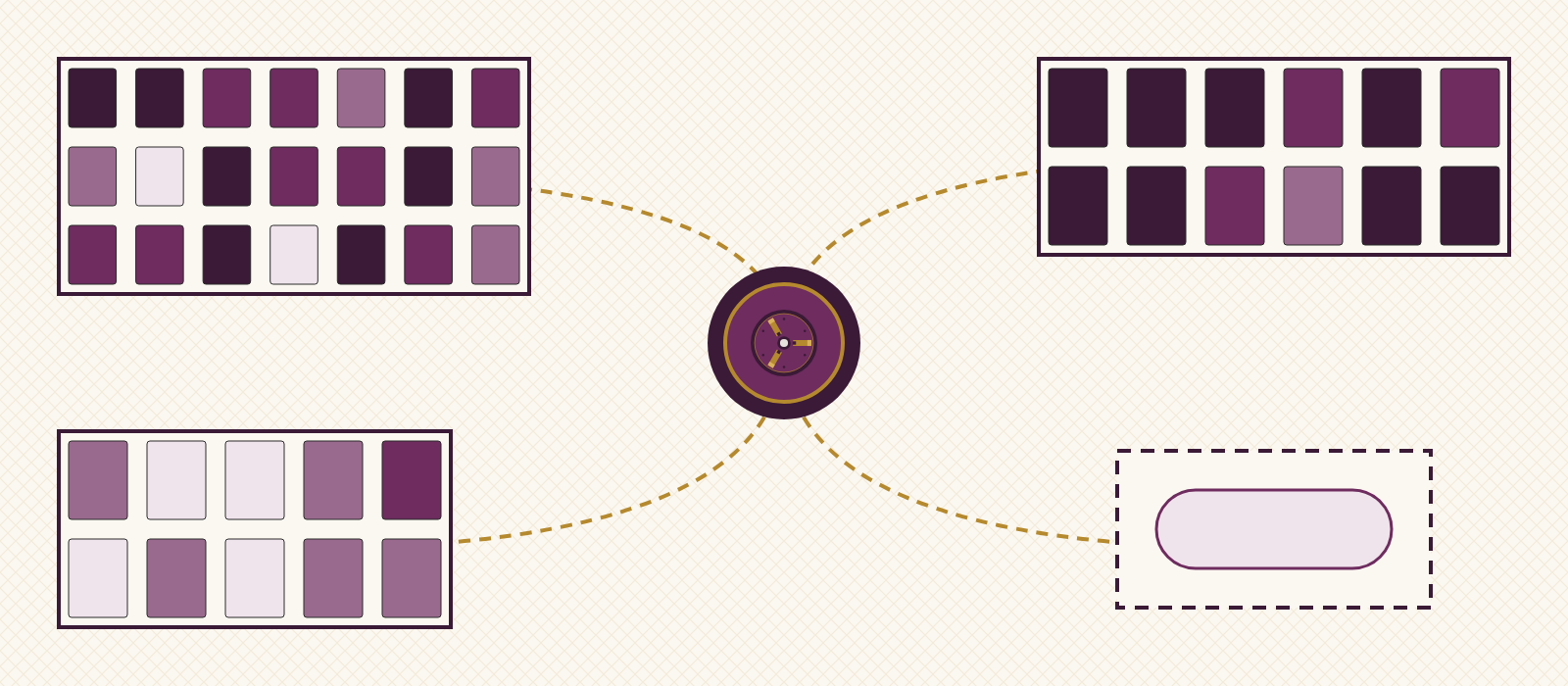
Three halls, the office with the ERP, one record. Each dashed line is one outbound path from an edge computer in that site's OT zone; nothing on the shop floor is reachable from outside it, in the sense of IEC 62443 zones.
Loom: four doors, one Datenpunktliste
Loom is software. It runs on an edge computer the group already owns in each hall and reads machines through four doors. Loom AI proposes which signals to record from what the control exposes; a person confirms each list, and a supervisor approves each connection before its first reading. Every commissioning leaves two documents behind: the Datenpunktliste and the Inbetriebnahme-Protokoll.
Direct18 machinesCurrent controls over OPC UA, umati or MTConnect. State, program, spindle load, part counter.
Edge22 machinesThe 1990s and 2000s controls over their serial port; machines with no network through an I/O box on the stack-light contacts and a meter on the supply. Polled every 60 seconds, meters every 900.
Integrationsfiles and systemsWork orders from the ERP, result files from the measuring room, the shift calendar of each site.
Wire4 machinesA connector a person writes for the one control none of the other doors reach, kept under the same approval.
Pragmatos Live: the hall board
Pragmatos Live shows each machine's state as it is, and OEE per machine, line and shift on that site's own shift calendar, counted to ISO 22400-2. When more than 10 % of a shift is unknown, the OEE is withheld rather than shown; the grey slice on Sheet 2 becomes a visible gap instead of a flattering number. A machine that misses three poll cycles is marked out of contact. A 1990s lathe through an I/O box is counted the same way as a five-axis centre over OPC UA.
Pulse: the quantities a machinist argues about
Pulse times every set-up from last good part to first good part, keeps tool life in parts and minutes per tool, holds spindle vibration against a per-spindle limit after ISO/TR 17243-2, and records axis drift from the ballbar test after ISO 230-4. Each figure carries how much data it rests on.
Orbis, Flow, Decisions, Fabric, Command
Orbis proposes: a changeover order for Thursday, a tool change before the lot and not during it, and shows the readings it used and what it cannot tell. Flow hands a confirmed proposal to the work order in the ERP over REST or as a CSV file. Decisions keeps one chain per part: which machine, which tool, which gauge, which person confirmed what, so that an AS9102 first-article file or an IATF 16949 audit question is answered from the record. Fabric is the CNC pack that gives the above its machine-specific vocabulary. Command puts the three sites in one view for the owner's Thursday.
Pragmatos reads, people act. Nothing writes to a control. The edge account is read-only, there is one outbound path per site, and every proposal waits for a person. Designed for the EU AI Act's human-oversight and logging requirements. The AI proposes, a person decides, and the decision is logged. Whether your use meets the Act is for you and your advisers to assess.
Deployment: on premise in your plant, in your own cloud, or both. Nine roles against the group's own identity provider. A software bill of materials comes with each release.
Part familyContract machining · three sites
DrawnCrius Software Pragmatos case study
ReferenceCS-07 Anonymous · present tense
Sheet4 of 7
OpOP 30
123ABCD
OP 40
Run-in: the rollout as a setup sheet
Five tool pockets, eighteen weeks. The plan is loaded like a turret: each pocket does one thing, and the next pocket is not called until the Inbetriebnahme-Protokoll of the last one is signed.
T
Pocket
Weeks
T1
Datenpunktliste, Site A. Loom proposes the signal list per machine from what each control exposes; the production head confirms it, the owner approves the connections. The three shift calendars are entered.
1 to 2
T2
Main hall on the record. Eighteen current controls through the Direct door, the 2000s lathes through the Edge door. Pragmatos Live board goes up by the tool crib. OEE appears per shift where the unknown share allows it.
3 to 6
T3
Sites B and C. Serial-port controls and I/O boxes on the old lathes; a meter on the supply of every machine in scope. Command shows three sites in one view. The four conventional machines are listed as unread.
7 to 10
T4
Pulse and the measuring room. Set-up timing on every machine, measuring-room result files through the Integrations door, so first-pass yield is per machine for the first time. Orbis makes its first proposals.
11 to 14
T5
Per-part sheet and Flow. The first euro-and-kilowatt-hour sheet per part number comes off the record for the valve-body family. Flow hands confirmed changeover orders to the ERP work order. Decisions holds the chain for one family end to end.
15 to 18
Weeks are the plan's. Each machine's Inbetriebnahme-Protokoll says the day its first reading is approved, and the record is incomplete until it does.
What changes for whom
The machinist presses nothing new. The set-up still ends when the first good part is measured; the time is now read from the machine, not written on the card.
The shift leader enters a reason for each stop longer than ten minutes on the board by the tool crib. A stop without a reason stays visibly grey.
The production head opens one board on Monday instead of three spreadsheets, and sees the slowest fifth of set-ups by machine and family.
The controller takes the euro-and-kilowatt-hour sheet per part number from the record and attaches the readings behind it.
The owner reads three sites on Thursday from the car park and sees which machine was out of contact and for how long.
What the group does itself. The reasons behind stops, the shift calendars, the machine-hour rate, the emission factor of its electricity contract: these are entered by people and the record shows who entered them and when. Pragmatos is not the control system, not the ERP and not a retrofit. It does not touch a program, an offset or a feed.
What the record cannot do
Read the four conventional machines. They stay as a named gap, not a guess.
Say why a stop happened. It says that it did, for how long, and waits for the reason.
Turn kilowatt-hours into CO2 without the emission factor a person enters.
What T1 leaves behind: rows of the Datenpunktliste for one 1990s lathe, Site C
Signal
Source on the machine
Door
Poll
Proposed by
Confirmed by
Connection approved by
Running / stopped / fault
Stack-light contacts, three lamps
Edge, I/O box
60 s
Loom
Head of production
Owner
Part counter
Serial port, counter register of the control
Edge, serial
60 s
Loom
Head of production
Owner
Electricity, kWh and kW
Meter on the machine's supply
Edge, I/O box
900 s
Loom
Head of production
Owner
Program number
Serial port
Edge, serial
60 s
Loom
Head of production
Owner
Every machine in scope carries such a list, and the Inbetriebnahme-Protokoll records the day its first reading is approved. The list is what the record rests on; a signal that is not on it is not read.
Part familyContract machining · three sites
DrawnCrius Software Pragmatos case study
ReferenceCS-07 Anonymous · present tense
Sheet5 of 7
OpOP 40
123ABCD
OP 50
Inspection report: four quantities, today and modelled
Read like a Messprotokoll: each band is drawn to scale from zero, the red point is the measured value today, the brass point is the value the model arrives at with the inputs on Sheet 7. The euro at the right is the difference, priced at the group's own rates. Every row is modelled, none is measured on a running plant.
Scale from zero today modelled
R1Set-up time per set-upPulse times every set-up; the slowest fifth gets a look
055 min today
modelled 50 min · deviation −5 min
€87,890a yearMODELLED · C-07 to C-11
R2Unplanned stop hours a yearEvery stop carries a recorded reason; the recurring ones are worked
011,581 h today
modelled 10,423 h · deviation −1,158 h
€98,430a yearMODELLED · C-12 to C-15
R3Engineer-days assembling per-part evidencekWh and euros per part come off the record, not out of a spreadsheet
080 d today
modelled 23 d · deviation −57 d
€41,040a yearMODELLED · C-16 to C-20
R4Machine electricity a yearMeters per machine beside machine state show what runs with the spindle stopped
04,340 MWh today
modelled 4,209.8 MWh · deviation −130.2 MWh
€26,040a yearMODELLED · C-21 to C-26
Four results, no overlap, machine cost only. No material, tooling or margin counted.€253,400 a year MODELLED
The weakest row
R2 rests on the shift leaders entering a reason for each stop and on someone working the recurring reasons. The record makes the stop visible; it does not remove it. Halve C-14 to 5 % and R2 is €49,215. R1 is the firmest: set-up time is measured on every machine from week 11, and five minutes on fifty-five is the slowest fifth brought to the middle, not a new method.
Shown, not counted
First-pass yield per machine, once the measuring-room files join the record. No euro is attached because the scrap rate is the group's to enter.
Delivery reliability: the ERP has it; the record adds the machine hours behind each late order.
CO2 per part: kWh per part times the emission factor of the contract. The kWh side is in R4; the factor is entered, so the tonnes are shown and not priced.
Spindle and ballbar trends: shown per machine, not priced, because a spindle that does not fail has no invoice.
Part familyContract machining · three sites
DrawnCrius Software Pragmatos case study
ReferenceCS-07 Anonymous · present tense
Sheet6 of 7
OpOP 50
123ABCD
OP 60
Calculation sheet: replace every ASSUMED with your own
Inputs
Row
Input
Value
Basis
C-01
Machines in scope (of 48; four conventional machines have no read path)
44
ASSUMED
C-02
Shift hours a day (two shifts)
16 h
ASSUMED
C-03
Production days a year
235 d
ASSUMED
C-04
Planned machine hours a year, C-01 × C-02 × C-03
165,440 h
derived
C-05
Set-ups per machine and week (high-mix, lots of 50 to 600)
6
ASSUMED
C-06
Production weeks a year
47 wk
ASSUMED
C-07
Set-ups a year, C-01 × C-05 × C-06
12,408
derived
C-08
Average set-up time today, from the route cards
55 min
ASSUMED
C-09
Minutes found per set-up once every set-up is timed and the slowest fifth is looked at
5 min
ASSUMED
C-10
Set-up hours found a year, C-07 × C-09 ÷ 60
1,034 h
derived
C-11
Machine-hour rate (the rate the hour is sold at)
85 €/h
ASSUMED
C-12
Unplanned stop share of planned hours today
7 %
ASSUMED
C-13
Unplanned stop hours a year, C-04 × C-12
11,581 h
derived
C-14
Share of stop hours back once each stop has a recorded reason and the recurring ones are worked
10 %
ASSUMED
C-15
Stop hours back a year, C-13 × C-14
1,158 h
derived
C-16
Per-part cost and CO2 requests from buyers a year
30
ASSUMED
C-17
Days per request today → on one record
2 → 0.5 d
ASSUMED
C-18
Days a year assembling per-part evidence for audits today → on one record
20 → 8 d
ASSUMED
C-19
Days found a year, C-16 × 1.5 + 12
57 d
derived
C-20
Controller or engineer day
720 €/d
ASSUMED
C-21
Group electricity a year, three sites (below the 7.5 GWh line of EnEfG § 8)
6,200 MWh
ASSUMED
C-22
Share drawn by the machines and their chillers, pumps and extraction
70 %
ASSUMED
C-23
Machine electricity a year, C-21 × C-22
4,340 MWh
derived
C-24
Share found idling (pumps, chillers and extraction running with the spindle stopped)
3 %
ASSUMED
C-25
Idle electricity found a year, C-23 × C-24
130.2 MWh
derived
C-26
Electricity price, inside the Destatis H1 2026 band for non-households (17.64 to 23.66 ct/kWh, S3)
200 €/MWh
ASSUMED
Results and sensitivity
Result
Arithmetic
€ a year
Input half
Input double
R1 Set-up time
C-10 × C-11 = 1,034 h × €85
87,890
43,945
175,780
R2 Unplanned stops
C-15 × C-11 = 1,158 h × €85
98,430
49,215
196,860
R3 Per-part evidence
C-19 × C-20 = 57 d × €720
41,040
20,520
82,080
R4 Idle electricity
C-25 × C-26 = 130.2 MWh × €200
26,040
13,020
52,080
Total
four results, no overlap
253,400
126,700
506,800
Half and double move the found quantity (C-09, C-14, C-19, C-24) with the rates held. Each result is MODELLED.
This is the sheet a controller sends back to a buyer with the readings behind it. Material, tooling, inspection and margin are added by the group. With the emission factor of the electricity contract entered, the CO2 line follows.
Counting rules
Planned hours (165,440) count two shifts on 235 days; a third shift raises C-04 and R2 with it.
R1 and R2 are both priced at the machine-hour rate and do not overlap: R1 is set-up minutes, R2 is unplanned stop hours.
R3 counts people's days, not machine hours. R4 counts kilowatt-hours and nothing in R1 to R3.
The Destatis price (S3) is a national average by band; the contract price replaces C-26.
Four results and no overlap means the total is a sum, not a saving on a saving; a result the group does not recognise is struck out, and the others stand.