

Predictive Maintenance in 2026: Most of What Works Is Not Prediction
Two surveys published a year apart describe the same market. One says predictive maintenance adoption doubled. The other says it went backwards. Both can be true, and the reason they can is the most useful thing a maintenance manager can understand about the category before signing anything.
This article is about the difference between preventive, condition-based and predictive maintenance; why much of what is sold as "predictive" is really the middle one; and how to choose the few machines where a real prediction pays for itself.
Industrial Reality Check
Picture a typical pilot. It is set up on the most important machine in the plant. That is the obvious choice. It is the asset whose stoppage costs the most, so it is the asset whose prediction would be worth the most. Sensors go on, data flows, a model is trained, and a dashboard shows a health score in green.
A year and a half later the score is still green and the project is quietly being wound down. Nothing went wrong, which is exactly the problem. The machine did not fail, so the model never predicted a failure, so nobody can show what the project saved.
It did not fail because it is the most important machine in the plant. It has the shortest service interval, the most experienced technician, the spare parts on the shelf and the operator who notices a change in sound before any sensor does. The asset with the most attention is the asset with the fewest failures to learn from. The pilot was placed exactly where prediction had the least to add.
Meanwhile a coolant pump on a line nobody worries about fails every few months, usually on a weekend, and is noticed through Monday's scrap rate.
This is not a story about a bad model. It is a story about what a model needs and where those conditions exist.
Why the Problem Exists Structurally
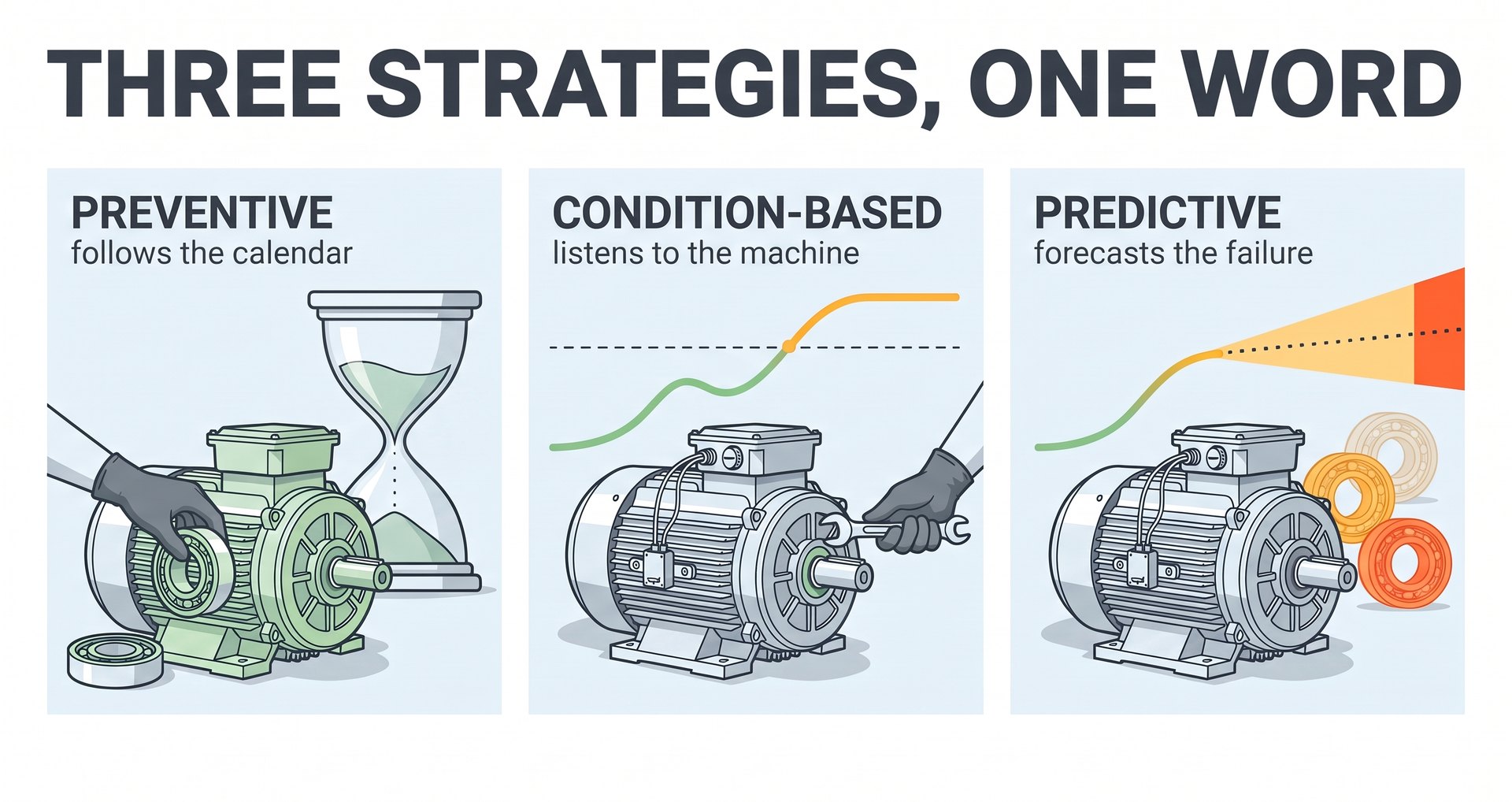
Three strategies that the English word blurs into one
German maintenance practice has a vocabulary that keeps these apart, and it is worth borrowing. DIN 31051 divides Instandhaltung into four basic measures — Wartung, Inspektion, Instandsetzung and Verbesserung — and German practitioners name the strategies separately: zeitbasierte (time-based), zustandsorientierte (condition-based) and vorausschauende (predictive) Instandhaltung. In English, the last two are routinely sold under one name.
- Preventive (time-based): replace or service on a calendar or a counter. After a set number of operating hours, every quarter, after a set number of cycles. Simple, plannable, and blind to the actual condition of the part.
- Condition-based: measure something that changes as the part degrades — vibration, temperature, current draw, pressure, particle count — and act when it crosses a limit you set. No model required. A threshold and a person who responds to it.
- Predictive: forecast when the part will reach its limit. The simplest version extrapolates the trend of a condition signal. A model trained on how similar parts have degraded and failed is the version that needs a recorded failure history — and it is the version most often sold.
Many success stories in the category turn out, on inspection, to be condition-based maintenance with deliberately set thresholds. Calling them predictive is a marketing decision, not an engineering one.
Most failures do not follow the calendar
The case against pure calendar maintenance is older than any software in this market. In 1978, F. Stanley Nowlan and Howard Heap published their study of civil aircraft components for the US Department of Defense, the report that founded reliability-centred maintenance. They plotted how the probability of failure changes with age, and found that only a small minority of the items they analysed showed a wear-out zone in which an age limit would help. Some 89 percent showed no wear-out zone at all. For those, replacing the part on schedule did not reduce failures, and replacing it too early could add the failures that come with a freshly installed component.
Aircraft are not machine tools, and the exact shares should not be carried over to a factory. The principle carries over well: a fixed interval only helps parts that age predictably. For everything else, the calendar is guessing.
Prediction needs failures, and plants fix failures without recording them
A predictive model learns the difference between a healthy machine and one that is about to fail by seeing examples of both. Healthy data is plentiful. Failure data is rare by design, because a well-run plant prevents failures and repairs the ones that happen quickly.
Worse, the repairs are rarely recorded in a form a model can use. A downtime entry says the machine stopped for four hours. It seldom says which component failed, in what mode, and what the signals looked like in the weeks before. Ten years of sensor history with no labelled failures is not a training set for a failure model. No modelling technique manufactures the examples the plant never captured.
A warning is only worth something if someone can act on it
A prediction that arrives six weeks early is valuable only if the part is available in six weeks, the stoppage can be planned, and someone is rostered to plan it. If the spare takes longer to arrive than the warning gives you, or the warning lands in a mailbox that nobody owns, the prediction was correct and the failure happens anyway.
Why Now
The market is sending contradictory signals, and that contradiction is the reason to write this now.
In May 2026, a survey commissioned by a maker of measurement equipment, among some 600 senior decision-makers and maintenance professionals in four manufacturing industries in Germany, the UK and the US, reported predictive maintenance adoption doubling year on year, from 9 to 18 percent. Proactive maintenance fell from 55 to 45 percent, and reactive maintenance stayed flat at 36 percent. The same research found that skills-related challenges accounted for about 78 percent of the obstacles respondents reported.
A year earlier, The 2025 State of Industrial Maintenance, an annual report from a maintenance-software vendor, recorded predictive maintenance adoption slipping from 30 percent in 2024 to 27 percent in 2025 — while 65 percent of maintenance teams said they expected to adopt AI within twelve months, and 71 percent named preventive maintenance as their primary strategy.
Put the starting points side by side: one survey began from 9 percent, the other from 30 percent a year before it slipped to 27. Whatever the exact survey windows, a roughly threefold gap over the same period means the two surveys are not counting the same thing. Each is commissioned by a company that sells into maintenance, and neither publishes its question wording in the summaries quoted here. The word "predictive" now covers everything from a vibration alarm to a remaining-useful-life model, and surveys measure whatever their respondents believe it means.
For a buyer, that ambiguity matters more than either number. If a supplier's definition of predictive includes a threshold alarm, the demonstration will look convincing and the business case will be built on something else.
Architecture Deep Dive
Start with the failure mode, not the sensor
The productive question is not "which sensors should we add?" It is "how does this machine actually fail, and does that failure announce itself?"
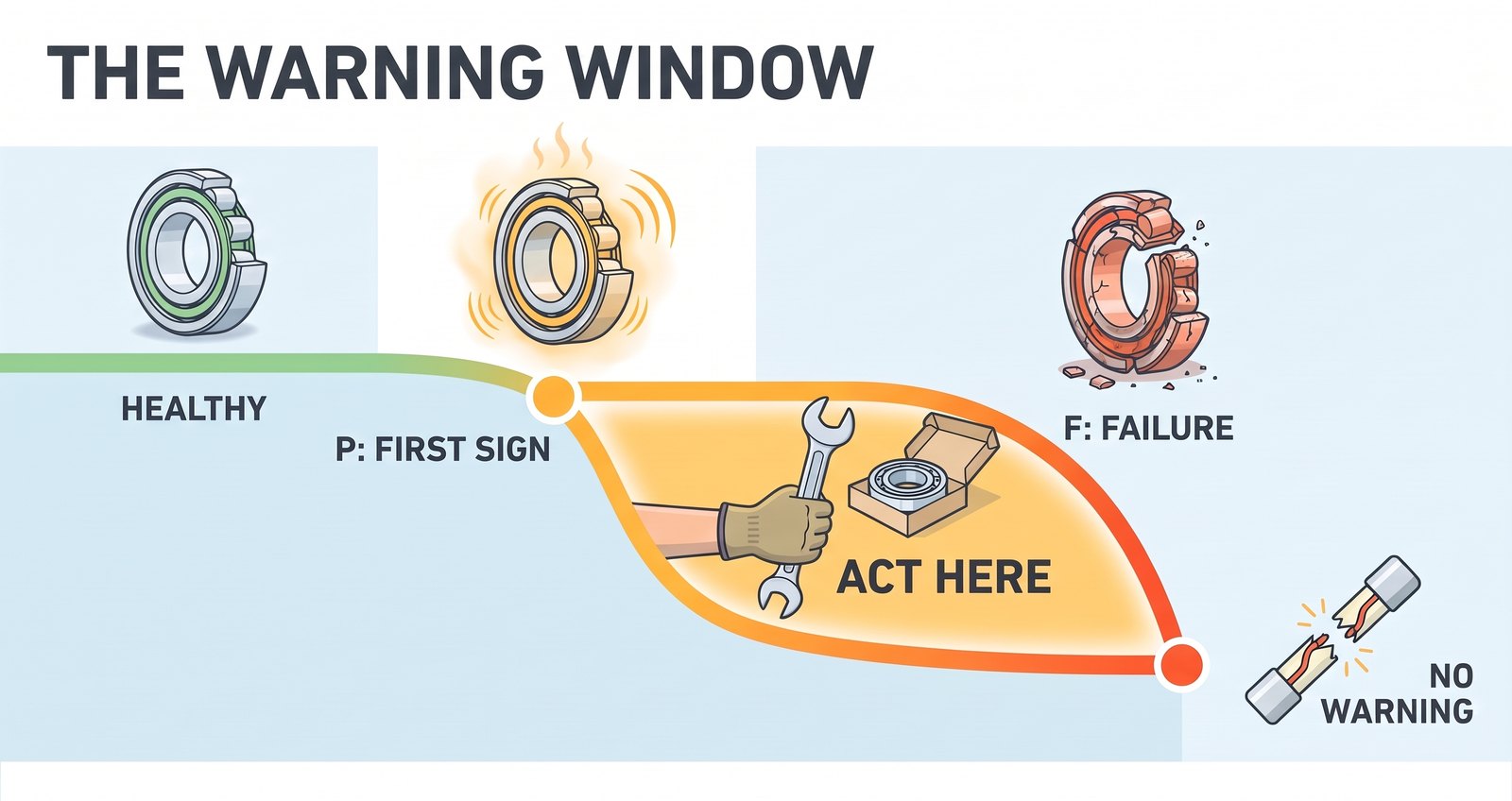
Reliability engineers describe this with the P–F interval: the time between the point where a developing failure becomes detectable (P) and the point of functional failure (F). A bearing that wears gradually gives weeks of rising vibration before it seizes. A fuse, a software fault or a crash into a fixture gives nothing. Only failures with a usable P–F interval can be caught by condition monitoring or predicted by a model — and the interval must be longer than your inspection interval plus the spare-part lead time, or the warning arrives too late to use. Everything else needs a different answer: redundancy, a spare on the shelf, or acceptance.
Match the signal to the failure
Each progressive failure mode has signals that tend to show it:
- Rotating parts — bearings, spindles, gearboxes, pumps, fans: vibration, and often temperature later in the degradation.
- Drives and motors: current draw and its pattern over a cycle.
- Hydraulics and pneumatics: pressure, flow, leakage, cycle time of an actuator.
- Lubrication and fluids: particle count, contamination, temperature.
- Cutting tools: spindle load, and the tool data the machine control already keeps.
Many machines already measure some of this for their own protection. Before buying a sensor, find out what the machine control and the drives already expose. Our article on IoT sensor types covers what each class of sensor can and cannot tell you.
A threshold with an owner beats a model without one
For most progressive failure modes, the place to start is a simple setup: one signal, a baseline taken when the machine is known to be healthy, a warning limit and an action limit, and a named person who receives the warning and decides what happens. That is condition-based maintenance, and it requires no failure history at all. Where no healthy baseline exists yet, the vibration severity zones in ISO 20816 are the usual general starting point until the machine's own baseline replaces them.
Set the limits deliberately and write them down. Review them after the first month: a limit that fires daily will be muted within a week, and a limit that never fires is not protecting anything.
When a model earns its place
A predictive model starts to add value over a threshold when three things are true: the plant has many similar assets, so failures across the fleet add up to a usable history; the failures have been recorded with their mode and cause; and the decision the model supports is worth more with an estimated date than with a simple warning — for example, because a stoppage must be booked weeks ahead or a spare must be ordered.
Where those conditions hold, ask for a range, not a number. A remaining useful life given as a window of weeks, with the confidence stated, can be planned against. A single figure will eventually be visibly wrong, and the second time it is wrong the planner stops reading it.
The pattern that works
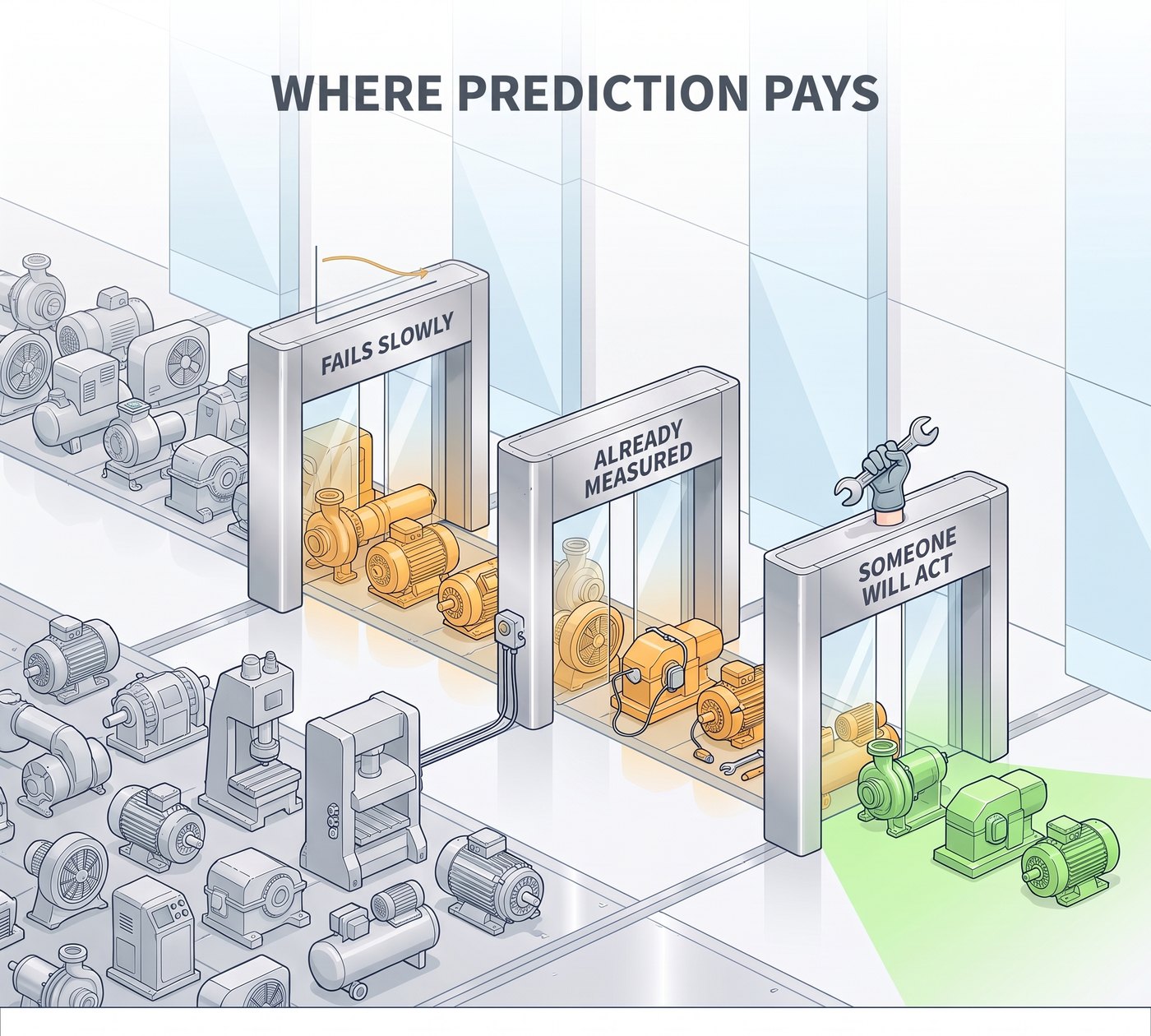
Choose the machines by the intersection test, not by criticality alone: the machine fails progressively, the signal is already measured or cheap to add, and someone will act on a warning in time.
Write down the failure modes you are watching for, and how each one shows in the data, before installing anything.
Start with thresholds, a healthy baseline and a named owner for every warning.
Record every failure properly from today: component, mode, cause, and the time the first signal appeared. This is the training set you will need in two years.
Measure success as stoppages avoided or shortened, compared with the previous year on the same machines — not as model accuracy.
Add a model only where the threshold has proved the signal and the fleet has produced the history. Our article on why AI without context fails explains why the model is the last layer, not the first.
Why Most Predictive Maintenance Projects Fail to Scale
The pilot on the most critical asset. It has the most redundancy, the most attention and therefore the fewest failures. The project cannot prove anything, and is ended for not proving anything.
The unlabelled history. Years of data and no record of what broke, when or why. The model has nothing to learn the failure from, so it learns what normal looks like and calls every unusual week an anomaly.
Alert fatigue. Limits set to catch everything. The maintenance team receives dozens of warnings a week, finds most of them harmless, and mutes the system. It stays technically live and is practically off.
Remaining useful life as a single number. A confident countdown on an asset whose failure behaviour nobody has characterised. It is wrong in a way the planner can see, and trust does not come back.
The warning nobody is rostered to act on. The prediction is right, arrives on a Friday, and the part has a long lead time. The failure happens on schedule.
Success defined as model accuracy. On a machine that rarely fails, a model that always says "healthy" is right almost every day and catches nothing. Accuracy is the wrong scoreboard; avoided stoppages are the right one.
Several of these are the same gap our article on dashboards describes: a signal can be correct and still change nothing, because no person and no process was waiting for it.
Governance, Security and Co-determination
The works council. Condition data is about machines, but it is recorded alongside shifts, and maintenance response times are recorded against people. In Germany, a technical system capable of monitoring employees' behaviour or performance is a co-determination matter, to be agreed with the Betriebsrat before it is introduced. Keep the unit of analysis the asset and the failure mode, show the data model early, and agree in writing what the data will not be used for.
Monitoring only reads. Watching condition requires reading signals. It never requires writing to a machine control. Decide that before any connection is made, and enforce it at the connection, not by policy alone.
Network placement. Sensors and gateways on the shop floor sit on or near the control network. Decide which segment they live on, who administers them, and whether they can be reached from outside. For most plants the answer to the last question should be no.
Your data, your history. The failure records you start keeping are the most valuable maintenance asset you will build in the next few years. Make sure they stay in a form you own and can export, whatever tool you use to collect them.
Decision Framework for Platform Evaluation
- What does the supplier mean by "predictive"? A threshold alarm, a trend extrapolation, or a model trained on failures? Ask them to show which one their reference result used.
- What failure history does their approach need, and do you have it? If it needs labelled failures, how many, of which mode?
- Can you set and own the limits yourself, and see why a warning fired?
- Is remaining useful life given as a range with its uncertainty, or as one number?
- Where does the warning go, and how is the response recorded? A warning without a work order is a notification, not maintenance.
- Can you export the raw signals and your failure records without a services engagement?
Executive Summary — Board-Level Interpretation
One. "Predictive maintenance" is used for three different things. Much of what is sold under that name is condition-based maintenance — a measured signal, a deliberate limit and a named owner — which needs no failure history and no model.
Two. True prediction needs failure examples, recorded with their cause. Most plants have years of sensor data and few such records, so the investment with the longest payback is to start recording failures properly now.
Three. The right first machines are not the most critical ones. They are the ones that fail progressively, are already measured, and have someone ready to act. Judge the programme by stoppages avoided or shortened, not by model accuracy, and expect the first evidence from a handful of machines within months, not from a plant-wide platform.
The failure to guard against at board level is buying the word. Ask what is being predicted, from what history, and who acts on the answer.
Practical Implementation Checklist
Before buying anything
- List the ten machines whose failures cost you most last year. For each, write down how it failed and whether there was any warning.
- Mark which of those failure modes are progressive and which are sudden. Only the progressive ones are candidates.
- Check what each candidate machine already measures — control, drives, existing sensors.
- Count how many past failures on those machines have a recorded component and cause. If the answer is close to zero, start there.
Three months on a handful of machines
- Take a healthy baseline for one signal per failure mode.
- Set a warning and an action limit, and name the person who receives each warning.
- Log every warning and what was done about it. Review the limits after four weeks.
- Record every failure with component, mode, cause and the date the first signal appeared.
Before scaling or adding a model
- Compare stoppages on these machines with the same period last year.
- Only where a signal has proved itself and the fleet has produced a failure history, test a model, and insist on a range.
A note on where we stand
We make software in this space, so we are not a neutral party, and it would be odd to pretend otherwise. This article deliberately does not describe what our software does. Everything above can be started on a small scale with the signals your machines already expose, a notebook of failure records and a spreadsheet, and it should be judged on that basis.
If you want a quick view of whether your machine data is in a state to support this, we publish a free self-assessment at criussoftware.com/res/kits/readiness/. It asks for a work email and your consent to be contacted, and returns a scored result on screen; add a phone number and it emails you the full report. It is a self-check, not an audit.
Questions worth asking in your next review
- For the machine you would pilot on, how many recorded failures do you have with a cause attached, not only a downtime entry?
- Does that machine fail gradually or suddenly? Only one of those can be caught early.
- If a warning arrived six weeks before a failure, is the part available in six weeks, and who would plan the stoppage?
- How many warnings per week would your maintenance team read before they stopped reading them?
- Is your measure of success avoided stoppages, or a model accuracy figure?
- What would you need to start recording today to make a real prediction possible in two years — and is anyone recording it?
- When a supplier gives you a remaining-useful-life figure, what range do they put around it?
The part that matters
Most machines do not fail on a schedule, so a calendar alone cannot keep them running. Most plants do not have the failure history a prediction needs, so a model alone cannot either.
What works in between is not glamorous: know how each machine fails, watch the signal that shows it, set a limit, and give the warning to a person who will act. Record every failure as if someone will learn from it, because in two years a model might.
The calendar guesses. The machine tells you — if someone is listening.
Sources
- Fluke Corporation / Censuswide, press release of 7 May 2026, Fluke Survey Finds Predictive Maintenance Adoption Doubles as Manufacturers Boost Digital Investment — some 600 senior decision-makers and maintenance professionals in four manufacturing industries, Germany, UK and US; predictive 9% to 18%, proactive 55% to 45%, reactive flat at 36%; skills-related challenges about 78% of reported obstacles. https://www.finanznachrichten.de/nachrichten-2026-05/68425047-fluke-corporation-fluke-survey-finds-predictive-maintenance-adoption-doubles-as-manufacturers-boost-digital-investment-399.htm (accessed 2026-10-12)
- The Manufacturer, 7 May 2026, UK breakout of the same Fluke survey. https://www.themanufacturer.com/articles/fluke-survey-finds-predictive-maintenance-adoption-doubles-as-uk-manufacturers-boost-digital-investment/ (accessed 2026-10-12)
- MaintainX, Maintenance statistics and trends, citing The 2025 State of Industrial Maintenance — predictive adoption 30% (2024) to 27% (2025); 65% expect to adopt AI within twelve months; 71% name preventive maintenance as primary strategy. https://www.getmaintainx.com/blog/maintenance-stats-trends-and-insights (accessed 2026-10-12)
- F. Stanley Nowlan and Howard F. Heap, Reliability-Centered Maintenance, United Airlines for the US Department of Defense, 1978 (DTIC AD-A066579); summary of the six failure patterns and the share of items with no wear-out zone: https://reliamag.com/?p=266257 (accessed 2026-10-12)
- DIN 31051, Grundlagen der Instandhaltung — cited for its vocabulary only.
- ISO 20816, Mechanical vibration — Measurement and evaluation of machine vibration — cited as the usual general reference for vibration severity zones.
Take the machine you would pilot on and count its recorded failures that have a cause attached. If the count is close to zero, the first project is not a model. It is a better failure record, started this week.
Read next
- Exploring IoT Sensor Types — what each class of sensor can and cannot tell you about a machine.
- Why AI Without Context Fails in Manufacturing — why the model is the last layer, not the first.
- Why Your Dashboard Did Not Change Anything — a correct signal still changes nothing without an owner.
- Micro-Stops: The Losses That Never Reach a Report — the losses that look like maintenance and are not.
Full blog text — board-ready report format
Predictive Maintenance in 2026: Most of What Works Is Not Prediction
Two surveys published a year apart describe the same market. One says predictive maintenance adoption doubled. The other says it went backwards. Both can be true, and the reason they can is the most useful thing a maintenance manager can understand about the category before signing anything.
This article is about the difference between preventive, condition-based and predictive maintenance; why much of what is sold as "predictive" is really the middle one; and how to choose the few machines where a real prediction pays for itself.
Industrial Reality Check
Picture a typical pilot. It is set up on the most important machine in the plant. That is the obvious choice. It is the asset whose stoppage costs the most, so it is the asset whose prediction would be worth the most. Sensors go on, data flows, a model is trained, and a dashboard shows a health score in green.
A year and a half later the score is still green and the project is quietly being wound down. Nothing went wrong, which is exactly the problem. The machine did not fail, so the model never predicted a failure, so nobody can show what the project saved.
It did not fail because it is the most important machine in the plant. It has the shortest service interval, the most experienced technician, the spare parts on the shelf and the operator who notices a change in sound before any sensor does. The asset with the most attention is the asset with the fewest failures to learn from. The pilot was placed exactly where prediction had the least to add.
Meanwhile a coolant pump on a line nobody worries about fails every few months, usually on a weekend, and is noticed through Monday's scrap rate.
This is not a story about a bad model. It is a story about what a model needs and where those conditions exist.
Why the Problem Exists Structurally
Three strategies that the English word blurs into one
German maintenance practice has a vocabulary that keeps these apart, and it is worth borrowing. DIN 31051 divides Instandhaltung into four basic measures — Wartung, Inspektion, Instandsetzung and Verbesserung — and German practitioners name the strategies separately: zeitbasierte (time-based), zustandsorientierte (condition-based) and vorausschauende (predictive) Instandhaltung. In English, the last two are routinely sold under one name.
- Preventive (time-based): replace or service on a calendar or a counter. After a set number of operating hours, every quarter, after a set number of cycles. Simple, plannable, and blind to the actual condition of the part.
- Condition-based: measure something that changes as the part degrades — vibration, temperature, current draw, pressure, particle count — and act when it crosses a limit you set. No model required. A threshold and a person who responds to it.
- Predictive: forecast when the part will reach its limit. The simplest version extrapolates the trend of a condition signal. A model trained on how similar parts have degraded and failed is the version that needs a recorded failure history — and it is the version most often sold.
Many success stories in the category turn out, on inspection, to be condition-based maintenance with deliberately set thresholds. Calling them predictive is a marketing decision, not an engineering one.
Most failures do not follow the calendar
The case against pure calendar maintenance is older than any software in this market. In 1978, F. Stanley Nowlan and Howard Heap published their study of civil aircraft components for the US Department of Defense, the report that founded reliability-centred maintenance. They plotted how the probability of failure changes with age, and found that only a small minority of the items they analysed showed a wear-out zone in which an age limit would help. Some 89 percent showed no wear-out zone at all. For those, replacing the part on schedule did not reduce failures, and replacing it too early could add the failures that come with a freshly installed component.
Aircraft are not machine tools, and the exact shares should not be carried over to a factory. The principle carries over well: a fixed interval only helps parts that age predictably. For everything else, the calendar is guessing.
Prediction needs failures, and plants fix failures without recording them
A predictive model learns the difference between a healthy machine and one that is about to fail by seeing examples of both. Healthy data is plentiful. Failure data is rare by design, because a well-run plant prevents failures and repairs the ones that happen quickly.
Worse, the repairs are rarely recorded in a form a model can use. A downtime entry says the machine stopped for four hours. It seldom says which component failed, in what mode, and what the signals looked like in the weeks before. Ten years of sensor history with no labelled failures is not a training set for a failure model. No modelling technique manufactures the examples the plant never captured.
A warning is only worth something if someone can act on it
A prediction that arrives six weeks early is valuable only if the part is available in six weeks, the stoppage can be planned, and someone is rostered to plan it. If the spare takes longer to arrive than the warning gives you, or the warning lands in a mailbox that nobody owns, the prediction was correct and the failure happens anyway.
Why Now
The market is sending contradictory signals, and that contradiction is the reason to write this now.
In May 2026, a survey commissioned by a maker of measurement equipment, among some 600 senior decision-makers and maintenance professionals in four manufacturing industries in Germany, the UK and the US, reported predictive maintenance adoption doubling year on year, from 9 to 18 percent. Proactive maintenance fell from 55 to 45 percent, and reactive maintenance stayed flat at 36 percent. The same research found that skills-related challenges accounted for about 78 percent of the obstacles respondents reported.
A year earlier, The 2025 State of Industrial Maintenance, an annual report from a maintenance-software vendor, recorded predictive maintenance adoption slipping from 30 percent in 2024 to 27 percent in 2025 — while 65 percent of maintenance teams said they expected to adopt AI within twelve months, and 71 percent named preventive maintenance as their primary strategy.
Put the starting points side by side: one survey began from 9 percent, the other from 30 percent a year before it slipped to 27. Whatever the exact survey windows, a roughly threefold gap over the same period means the two surveys are not counting the same thing. Each is commissioned by a company that sells into maintenance, and neither publishes its question wording in the summaries quoted here. The word "predictive" now covers everything from a vibration alarm to a remaining-useful-life model, and surveys measure whatever their respondents believe it means.
For a buyer, that ambiguity matters more than either number. If a supplier's definition of predictive includes a threshold alarm, the demonstration will look convincing and the business case will be built on something else.
Architecture Deep Dive
Start with the failure mode, not the sensor
The productive question is not "which sensors should we add?" It is "how does this machine actually fail, and does that failure announce itself?"
Reliability engineers describe this with the P–F interval: the time between the point where a developing failure becomes detectable (P) and the point of functional failure (F). A bearing that wears gradually gives weeks of rising vibration before it seizes. A fuse, a software fault or a crash into a fixture gives nothing. Only failures with a usable P–F interval can be caught by condition monitoring or predicted by a model — and the interval must be longer than your inspection interval plus the spare-part lead time, or the warning arrives too late to use. Everything else needs a different answer: redundancy, a spare on the shelf, or acceptance.
Match the signal to the failure
Each progressive failure mode has signals that tend to show it:
- Rotating parts — bearings, spindles, gearboxes, pumps, fans: vibration, and often temperature later in the degradation.
- Drives and motors: current draw and its pattern over a cycle.
- Hydraulics and pneumatics: pressure, flow, leakage, cycle time of an actuator.
- Lubrication and fluids: particle count, contamination, temperature.
- Cutting tools: spindle load, and the tool data the machine control already keeps.
Many machines already measure some of this for their own protection. Before buying a sensor, find out what the machine control and the drives already expose. Our article on IoT sensor types covers what each class of sensor can and cannot tell you.
A threshold with an owner beats a model without one
For most progressive failure modes, the place to start is a simple setup: one signal, a baseline taken when the machine is known to be healthy, a warning limit and an action limit, and a named person who receives the warning and decides what happens. That is condition-based maintenance, and it requires no failure history at all. Where no healthy baseline exists yet, the vibration severity zones in ISO 20816 are the usual general starting point until the machine's own baseline replaces them.
Set the limits deliberately and write them down. Review them after the first month: a limit that fires daily will be muted within a week, and a limit that never fires is not protecting anything.
When a model earns its place
A predictive model starts to add value over a threshold when three things are true: the plant has many similar assets, so failures across the fleet add up to a usable history; the failures have been recorded with their mode and cause; and the decision the model supports is worth more with an estimated date than with a simple warning — for example, because a stoppage must be booked weeks ahead or a spare must be ordered.
Where those conditions hold, ask for a range, not a number. A remaining useful life given as a window of weeks, with the confidence stated, can be planned against. A single figure will eventually be visibly wrong, and the second time it is wrong the planner stops reading it.
The pattern that works
Choose the machines by the intersection test, not by criticality alone: the machine fails progressively, the signal is already measured or cheap to add, and someone will act on a warning in time.
Write down the failure modes you are watching for, and how each one shows in the data, before installing anything.
Start with thresholds, a healthy baseline and a named owner for every warning.
Record every failure properly from today: component, mode, cause, and the time the first signal appeared. This is the training set you will need in two years.
Measure success as stoppages avoided or shortened, compared with the previous year on the same machines — not as model accuracy.
Add a model only where the threshold has proved the signal and the fleet has produced the history. Our article on why AI without context fails explains why the model is the last layer, not the first.
Why Most Predictive Maintenance Projects Fail to Scale
The pilot on the most critical asset. It has the most redundancy, the most attention and therefore the fewest failures. The project cannot prove anything, and is ended for not proving anything.
The unlabelled history. Years of data and no record of what broke, when or why. The model has nothing to learn the failure from, so it learns what normal looks like and calls every unusual week an anomaly.
Alert fatigue. Limits set to catch everything. The maintenance team receives dozens of warnings a week, finds most of them harmless, and mutes the system. It stays technically live and is practically off.
Remaining useful life as a single number. A confident countdown on an asset whose failure behaviour nobody has characterised. It is wrong in a way the planner can see, and trust does not come back.
The warning nobody is rostered to act on. The prediction is right, arrives on a Friday, and the part has a long lead time. The failure happens on schedule.
Success defined as model accuracy. On a machine that rarely fails, a model that always says "healthy" is right almost every day and catches nothing. Accuracy is the wrong scoreboard; avoided stoppages are the right one.
Several of these are the same gap our article on dashboards describes: a signal can be correct and still change nothing, because no person and no process was waiting for it.
Governance, Security and Co-determination
The works council. Condition data is about machines, but it is recorded alongside shifts, and maintenance response times are recorded against people. In Germany, a technical system capable of monitoring employees' behaviour or performance is a co-determination matter, to be agreed with the Betriebsrat before it is introduced. Keep the unit of analysis the asset and the failure mode, show the data model early, and agree in writing what the data will not be used for.
Monitoring only reads. Watching condition requires reading signals. It never requires writing to a machine control. Decide that before any connection is made, and enforce it at the connection, not by policy alone.
Network placement. Sensors and gateways on the shop floor sit on or near the control network. Decide which segment they live on, who administers them, and whether they can be reached from outside. For most plants the answer to the last question should be no.
Your data, your history. The failure records you start keeping are the most valuable maintenance asset you will build in the next few years. Make sure they stay in a form you own and can export, whatever tool you use to collect them.
Decision Framework for Platform Evaluation
- What does the supplier mean by "predictive"? A threshold alarm, a trend extrapolation, or a model trained on failures? Ask them to show which one their reference result used.
- What failure history does their approach need, and do you have it? If it needs labelled failures, how many, of which mode?
- Can you set and own the limits yourself, and see why a warning fired?
- Is remaining useful life given as a range with its uncertainty, or as one number?
- Where does the warning go, and how is the response recorded? A warning without a work order is a notification, not maintenance.
- Can you export the raw signals and your failure records without a services engagement?
Executive Summary — Board-Level Interpretation
One. "Predictive maintenance" is used for three different things. Much of what is sold under that name is condition-based maintenance — a measured signal, a deliberate limit and a named owner — which needs no failure history and no model.
Two. True prediction needs failure examples, recorded with their cause. Most plants have years of sensor data and few such records, so the investment with the longest payback is to start recording failures properly now.
Three. The right first machines are not the most critical ones. They are the ones that fail progressively, are already measured, and have someone ready to act. Judge the programme by stoppages avoided or shortened, not by model accuracy, and expect the first evidence from a handful of machines within months, not from a plant-wide platform.
The failure to guard against at board level is buying the word. Ask what is being predicted, from what history, and who acts on the answer.
Practical Implementation Checklist
Before buying anything
- List the ten machines whose failures cost you most last year. For each, write down how it failed and whether there was any warning.
- Mark which of those failure modes are progressive and which are sudden. Only the progressive ones are candidates.
- Check what each candidate machine already measures — control, drives, existing sensors.
- Count how many past failures on those machines have a recorded component and cause. If the answer is close to zero, start there.
Three months on a handful of machines
- Take a healthy baseline for one signal per failure mode.
- Set a warning and an action limit, and name the person who receives each warning.
- Log every warning and what was done about it. Review the limits after four weeks.
- Record every failure with component, mode, cause and the date the first signal appeared.
Before scaling or adding a model
- Compare stoppages on these machines with the same period last year.
- Only where a signal has proved itself and the fleet has produced a failure history, test a model, and insist on a range.
A note on where we stand
We make software in this space, so we are not a neutral party, and it would be odd to pretend otherwise. This article deliberately does not describe what our software does. Everything above can be started on a small scale with the signals your machines already expose, a notebook of failure records and a spreadsheet, and it should be judged on that basis.
If you want a quick view of whether your machine data is in a state to support this, we publish a free self-assessment at criussoftware.com/res/kits/readiness/. It asks for a work email and your consent to be contacted, and returns a scored result on screen; add a phone number and it emails you the full report. It is a self-check, not an audit.
Questions worth asking in your next review
- For the machine you would pilot on, how many recorded failures do you have with a cause attached, not only a downtime entry?
- Does that machine fail gradually or suddenly? Only one of those can be caught early.
- If a warning arrived six weeks before a failure, is the part available in six weeks, and who would plan the stoppage?
- How many warnings per week would your maintenance team read before they stopped reading them?
- Is your measure of success avoided stoppages, or a model accuracy figure?
- What would you need to start recording today to make a real prediction possible in two years — and is anyone recording it?
- When a supplier gives you a remaining-useful-life figure, what range do they put around it?
The part that matters
Most machines do not fail on a schedule, so a calendar alone cannot keep them running. Most plants do not have the failure history a prediction needs, so a model alone cannot either.
What works in between is not glamorous: know how each machine fails, watch the signal that shows it, set a limit, and give the warning to a person who will act. Record every failure as if someone will learn from it, because in two years a model might.
The calendar guesses. The machine tells you — if someone is listening.
Sources
- Fluke Corporation / Censuswide, press release of 7 May 2026, Fluke Survey Finds Predictive Maintenance Adoption Doubles as Manufacturers Boost Digital Investment — some 600 senior decision-makers and maintenance professionals in four manufacturing industries, Germany, UK and US; predictive 9% to 18%, proactive 55% to 45%, reactive flat at 36%; skills-related challenges about 78% of reported obstacles. https://www.finanznachrichten.de/nachrichten-2026-05/68425047-fluke-corporation-fluke-survey-finds-predictive-maintenance-adoption-doubles-as-manufacturers-boost-digital-investment-399.htm (accessed 2026-10-12)
- The Manufacturer, 7 May 2026, UK breakout of the same Fluke survey. https://www.themanufacturer.com/articles/fluke-survey-finds-predictive-maintenance-adoption-doubles-as-uk-manufacturers-boost-digital-investment/ (accessed 2026-10-12)
- MaintainX, Maintenance statistics and trends, citing The 2025 State of Industrial Maintenance — predictive adoption 30% (2024) to 27% (2025); 65% expect to adopt AI within twelve months; 71% name preventive maintenance as primary strategy. https://www.getmaintainx.com/blog/maintenance-stats-trends-and-insights (accessed 2026-10-12)
- F. Stanley Nowlan and Howard F. Heap, Reliability-Centered Maintenance, United Airlines for the US Department of Defense, 1978 (DTIC AD-A066579); summary of the six failure patterns and the share of items with no wear-out zone: https://reliamag.com/?p=266257 (accessed 2026-10-12)
- DIN 31051, Grundlagen der Instandhaltung — cited for its vocabulary only.
- ISO 20816, Mechanical vibration — Measurement and evaluation of machine vibration — cited as the usual general reference for vibration severity zones.
No comments yet. Be the first to comment.