

Why AI Without Context Fails in Manufacturing
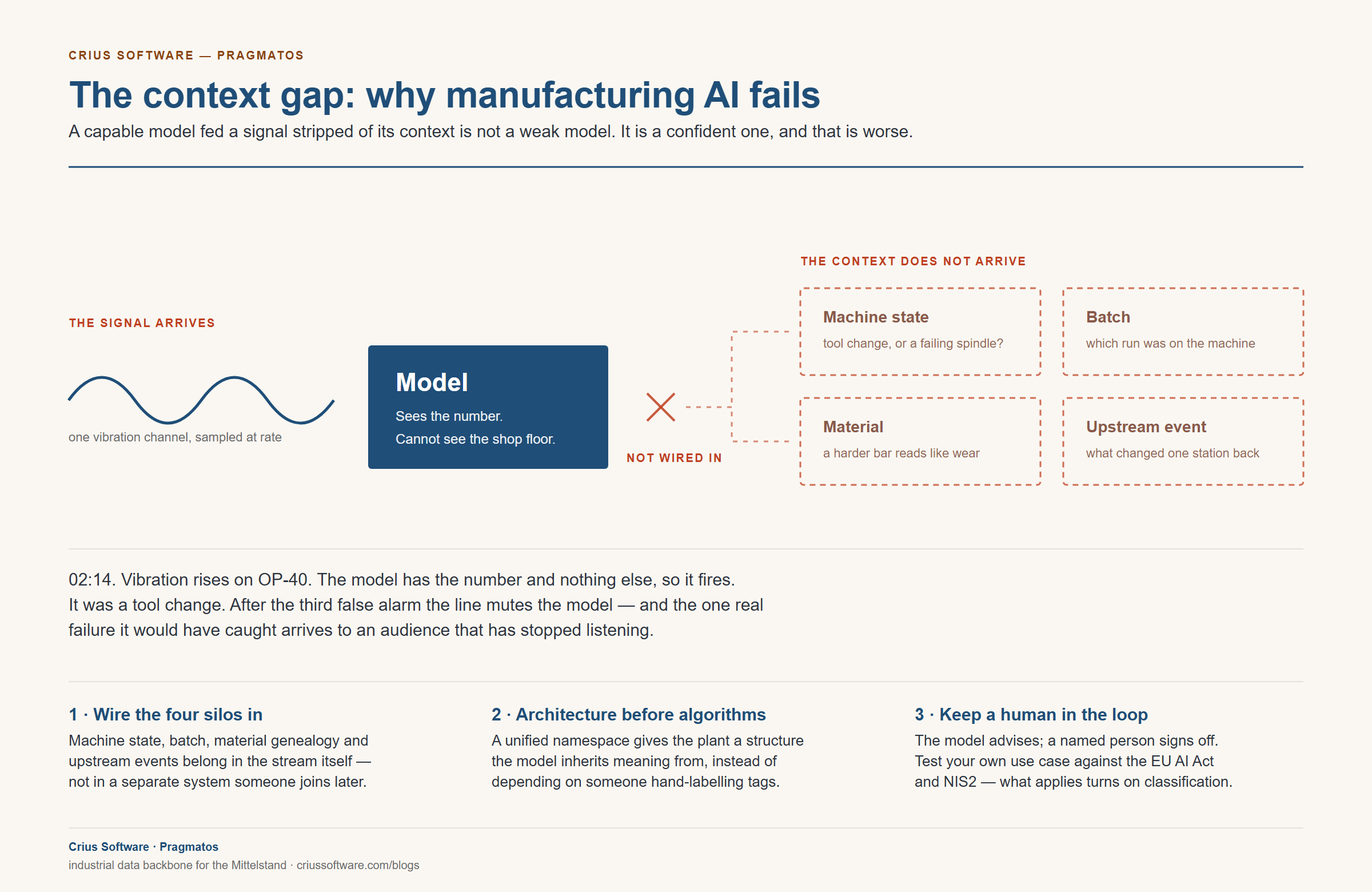
At 02:14 on a Sunday, a predictive-maintenance model on a five-axis machining centre declared a critical spindle-bearing failure. The night shift did the responsible thing. They stopped the machine, called the on-call reliability engineer, and waited. The engineer drove in, pulled the bearing data, and found nothing wrong. The vibration signature the model had flagged was a tool change. The machine had swapped a worn end mill for a fresh one, exactly as programmed, exactly as it had done four hundred times that month.
The model was not broken. It had seen a real vibration event and classified it faithfully. The problem was that nobody had told it what the machine was doing at 02:14. It did not know a tool change from a bearing spalling because it had never been given the one thing that separates the two: context.
This is the quiet failure mode of manufacturing AI in 2026. Not that the models are weak. They are, in fact, better than most factories deserve. The failure is that we keep feeding sophisticated models a stream of numbers stripped of the world those numbers came from — no machine state, no batch, no material, no shift, no upstream event — and then we act surprised when the model is confidently wrong. An AI without context is not intelligent. It is a fast way to be confidently wrong at scale.
Listen — critique audio overview
1. Industrial Reality Check
Walk the floor of any mid-sized manufacturer that has "done AI" and you will find the same graveyard. A predictive-maintenance pilot that ran beautifully on one CNC for three months and was never rolled out to the other forty. A quality-vision model that hit 94 percent in the lab and 61 percent on the line. An energy-optimisation dashboard that recommends throttling a compressor that, it turns out, feeds a safety system. Each of these was sold as an intelligence problem. Each of them is a context problem.
Here is what actually happens. The vendor connects to your historian — the process historian that has faithfully logged tag values for a decade. They pull two years of time-series, train a model, and show you a curve. The curve is persuasive. The demo lands. Then the model meets a Tuesday.
On that Tuesday, the same tag value means three different things depending on whether the machine is warming up, cutting, or idling — and the model has no idea which. The alert fires. The reliability engineer investigates. It is nothing. The alert fires again. It is nothing again. By the fourth false positive, the engineer has learned the most expensive lesson in industrial AI: the model cries wolf, so the model gets muted. And a muted model is worse than no model, because now you are paying for a licence and still walking the floor with a clipboard.
Data-rich, decision-poor was the disease of the dashboard era. The AI era has a sharper version: model-rich, context-poor. You have bought the sprinter. You forgot to build the track.
2. Why the Problem Exists Structurally
The reason is not that engineers are careless. It is that the historian was never designed to hold context, and almost every manufacturing AI stack is built on top of a historian.
A historian stores tag values against time. `SPINDLE_1_VIB_RMS = 2.3 mm/s @ 02:14:07`. That is a fact, and it is a useless fact in isolation. To make it meaningful, a human — or a model — has to answer a set of questions the historian cannot: which physical asset is `SPINDLE_1`, and is it the same asset it was before last month's rebuild? What program was running? Was the machine in cut or in a tool change? What material, what tool, what feed and speed? What happened upstream ninety seconds ago? The historian holds none of this. It holds the number.
In most factories, that context lives in four places that do not talk to each other. The machine state lives in the PLC. The program and part live in the MES, if there is an MES. The material genealogy lives in the ERP. And the tacit knowledge — that this machine always runs hot after a weekend cold start — lives in the head of a maintenance technician who retires in three years. A model trained on the historian sees the number and none of the four. It is diagnosing a patient through a keyhole.
There is a second structural failure underneath the first: sampling without state. Industrial signals are only interpretable relative to the operating regime that produced them. A bearing at 2.3 mm/s RMS is healthy at 800 rpm and alarming at 200 rpm. A temperature curve that climbs during ramp-up is normal; the identical curve during steady-state is a cooling fault. Strip the regime and every threshold you set is either too loose to be useful or too tight to be trusted. Most pilots quietly hand-label the regime for the one machine in the pilot — an engineer sits with the data and tags the states by hand. It works. It also does not scale past one machine, and that is precisely why the pilot never leaves the lab.
The uncomfortable truth is that the intelligence was never the scarce resource. The context was. And context is an architecture problem, not a modelling problem.
3. Architecture Deep Dive
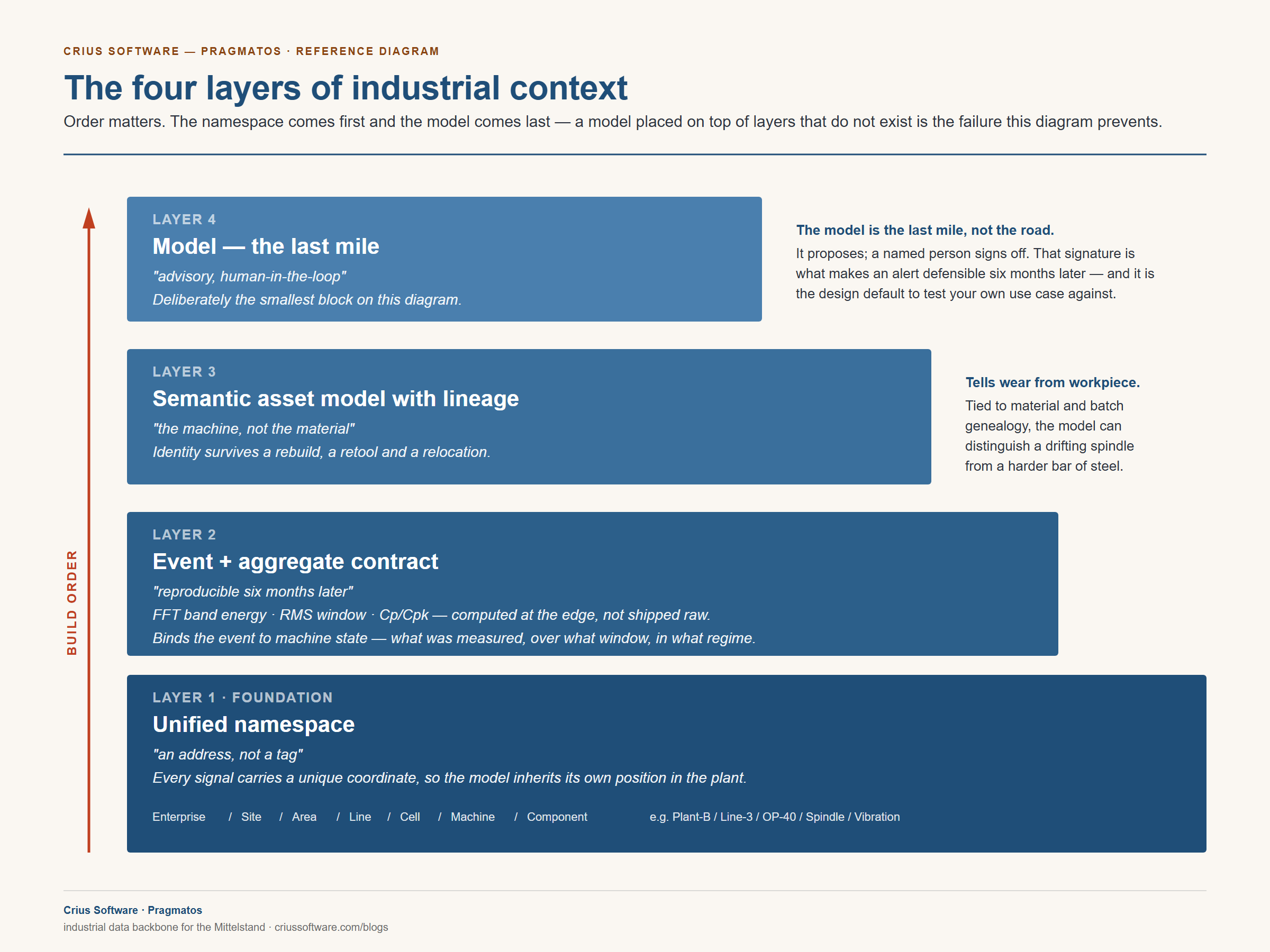
If context is the missing layer, then the work is to build a layer that manufactures context before the model ever sees a number. This is what an industrial data backbone is for, and it has four load-bearing parts.
A unified namespace, not a tag list. The first move is to stop treating data as a flat list of tags and start treating it as a structured model of the plant. A unified namespace organises every signal under the physical and logical hierarchy it belongs to — Enterprise / Site / Area / Line / Cell / Machine / Component — so that `SPINDLE_1_VIB_RMS` becomes `Plant-B/Line-3/OP-40/Spindle/Vibration`, an address that carries meaning. When a model subscribes to that address, it inherits the hierarchy. It knows which line, which operation, which component. The namespace is the difference between a number and a coordinate.
An event and aggregate contract. Raw telemetry is the wrong thing to hand a model, and it is certainly the wrong thing to send across a plant network fifty times over. The pattern that scales is to compute features at the edge — an FFT band-energy, an RMS over a defined window, a Cp/Cpk over a batch — and to publish two coupled things: the event (something happened, at this time, on this asset, in this state) and the aggregate (the summarised evidence). The contract is what makes the event reproducible. It says: this alarm was computed this way, over this window, with the machine in this regime. Six months later, when someone asks why the model fired, the contract answers. Without it, every alert is unfalsifiable, and unfalsifiable alerts are the reason models get muted.
A semantic asset model with lineage. A machine is not a static thing. It gets rebuilt, retooled, relocated. The context layer has to track the asset as an identity through those changes, so that the model knows the spindle it is watching today is — or is not — the spindle it learned from last quarter. Tie that to material and batch genealogy and the model can finally distinguish a signal caused by the machine from a signal caused by the steel. This is the layer that turns "the vibration went up" into "the vibration went up on this component, running this part, in this material, during this operation, ninety seconds after an upstream load change."
The model as the last mile, explicitly advisory. Only now does a model belong in the picture, and it belongs in a specific place: downstream of context, upstream of a human. In our own testing, Pragmatos Pulse runs anomaly detection and statistical process control on the modelled process — X-bar/R and I-MR charts, Cp/Cpk and Pp/Ppk, Western Electric and Nelson run rules, with predictive work built on regression, ARIMA, Fourier decomposition, and machine-learning ensembles. Every disposition it proposes through the Orbis rule-set is advisory. A human signs. Scrap is never dispositioned automatically; it moves only through an explicit human scrap-route. The confidence figure it reports is a coverage indicator — how well the situation matches known patterns — not a probability that a part is defective. We want to be precise about the maturity here: this is built and in testing, validated end-to-end against simulated equipment on modelled process conditions — not running on a customer line, and not a claim about autonomous decision-making on your line tomorrow. That discipline is not a limitation we apologise for. It is the only honest way to run a model on a factory floor, and it is the difference between an assistant your engineers trust and an oracle they learn to mute.
The order matters more than any single component. Namespace, then contract, then asset model, then the model. Reverse it — start with the model and bolt context on afterwards — and you have built the pilot that dies with a whimper in month nine.
4. Why Most AI Initiatives Fail to Scale
The pilot succeeds for a reason that guarantees it will not scale: it succeeds because a human supplied the context by hand.
On one machine, an engineer can label the operating states, curate the training window, and sanity-check every alert. That human is a walking context layer. The model looks brilliant because a person is doing the unglamorous work the architecture should be doing. Then the mandate arrives — roll this out to forty machines across three sites — and the human does not come with it. There is no engineer to hand-label forty machines, and there is certainly not one to re-label them every time a line is reconfigured. The context that made the pilot work was never captured in a system. It lived in a person, and people do not replicate.
The second scaling failure is drift without lineage. A model trained on a machine before a spindle rebuild is a model trained on a machine that no longer exists. Without an asset model that records the rebuild, the model keeps scoring against a ghost. Its accuracy decays, quietly, and by the time anyone notices, trust is already gone.
The third is the ownership vacuum. An alert that means "someone should look at this" scales to nobody. An alert that means "this event, on this asset, in this state, opens this task in the CMMS with this threshold and this escalation" scales because it is wired to a decision with an owner. The model is not the deliverable. The event-to-decision-to-action contract is the deliverable. Most AI initiatives ship the model and skip the contract, which is why they generate insight and no outcome.
None of these three is a data-science problem. All three are architecture problems wearing a data-science costume.
5. Governance, Security and EU Compliance Considerations
For a Mittelstand manufacturer, the context layer is also where governance either happens or fails to, and 2026 has raised the stakes on all three fronts.
NIS2 and the security of the feed. A model is only as trustworthy as the data path feeding it. Under NIS2, the question is no longer whether your OT network is monitored but who is accountable for the segment that carries your telemetry, and what happens when it is compromised. A model consuming a spoofed or degraded feed will produce confident output from corrupted input — a failure that looks like a model error and is actually a segmentation error. The context layer must sit behind IT/OT segmentation aligned to IEC 62443, with the data path auditable end to end. Who signs off when the segment feeding your model is breached is a governance question you answer before deployment, not during an incident.
GDPR, the works council, and what the model watches. The moment a model observes a machine, someone will ask what else it observes. In a co-determined German plant, the Betriebsrat is right to ask. A context layer that ties signals to operators — even inadvertently, through shift patterns or manual-station timing — creates worker-performance data, and that is co-determination territory. The disciplined design keeps asset data and operator data apart by default: the model watches the machine, not the person. Person-linkage is a policy switch that ships off and needs a works-council agreement on file before it can be enabled at all, so in our own testing the quality lot-hold and genealogy records carry no operator-linked data. Stating that plainly to the works council early is the difference between a rollout that has their support and one that stalls in a co-determination dispute for two quarters.
The EU AI Act and the end of the black box. As the AI Act's obligations phase in, a model that influences safety-relevant or quality-relevant decisions cannot be an unexplainable black box. This is where the event and aggregate contract stops being good engineering and becomes compliance evidence. A system that can show, for any alert, exactly what was measured, over what window, in what machine state, with a human in the decision loop, is a system that can survive an audit. Explainability is not a feature you add to the model. It is a property of the architecture underneath it. Advisory-by-design, human-in-the-loop, and fully traceable is not the cautious option — under the AI Act, for anything touching safety or quality, it is the only defensible one.
6. Decision Framework for Platform Evaluation
When a vendor demonstrates manufacturing AI, the temptation is to interrogate the model — the algorithm, the accuracy, the training set. Those are the wrong questions, because the model is the part least likely to fail. Interrogate the context layer instead.
Ask how the platform represents machine state, and whether a model can subscribe to state, not to raw tags alone. If the answer is a tag list, the demo is a lab result, not a production system.
Ask how an alert is made reproducible six months later. If there is no event-and-aggregate contract — no record of what was measured, over what window, in what regime — then every alert is a matter of faith, and faith does not survive the fourth false positive.
Ask what happens to the model when a machine is rebuilt or relocated. If the asset has no identity and no lineage, the model is scoring against a ghost the day maintenance touches the machine.
Ask where the human sits in the decision loop, and whether any model action can execute without a human signature. For anything touching safety or quality, the honest answer in 2026 is that it cannot, and a vendor who promises autonomous action on your line is selling you an AI Act liability.
Ask how operator privacy is preserved, and whether asset data and person data are structurally separated. If the vendor has not thought about the Betriebsrat, they have not thought about deployment.
Ask, finally, who operates and retrains this at 3 a.m. on a Sunday. Every architecture looks elegant in a slide deck. The one that matters is the one your own team can run at two in the morning when the line is down.
7. Executive Summary — Board-Level Interpretation
For a board, the strategic reframe is simple and expensive to ignore. Manufacturing AI does not fail because you bought the wrong model. It fails because you invested in the model and not in the context layer that makes any model trustworthy. The spend on the model is visible and small. The missing spend on the architecture is invisible and large, and it is the reason the pilot never became a rollout.
The competitive consequence is that the manufacturers who win with AI over the next five years will not be the ones with the cleverest algorithms. They will be the ones who built a structured industrial data backbone first — a unified namespace, an event and aggregate contract, an asset model with lineage — so that every model they deploy, now and in ten years, inherits context by default. The model is a five-year asset. The context layer is a fifteen-year one. A conservative, margin-disciplined manufacturer should recognise that the durable investment is the boring one.
The claim discipline cuts both ways here. A vendor telling you their AI will autonomously run your factory is telling you they have not read the AI Act or met your works council. The trustworthy posture — advisory, human-in-the-loop, fully traceable — is not the timid choice. It is the only one that scales past the pilot and survives an audit.
8. Practical Implementation Checklist
For a team ready to move past the muted-model stage, the sequence is deliberately unglamorous.
First, model the plant before you model the data. Stand up a unified namespace that mirrors your physical hierarchy — Site, Area, Line, Cell, Machine, Component — and migrate signals onto structured addresses. This is the foundation everything else inherits.
Second, capture machine state as a first-class signal. Get operating regime — warming, cutting, idle, tool-change, fault — out of the PLC and into the namespace, so that every downstream feature is state-aware from the start.
Third, define the event and aggregate contract before you train anything. Decide what is computed at the edge, over what windows, and how each event records the state it was computed in. Write it down. It is your explainability evidence and your NIS2 audit trail.
Fourth, give assets identity and lineage. Track each asset through rebuilds and relocations, and tie signals to material and batch genealogy so a model can separate the machine from the material.
Fifth, wire alerts to decisions, not to inboxes. Every model output should open a defined task with a threshold, an owner, and an escalation path. An alert without an owner is noise with a licence fee.
Sixth, keep the human in the loop and the operator out of the data. Advisory dispositions, human signature before action, no operator-linked performance data. Bring the works council in early, not after the dispute.
Only then, seventh, deploy the model — and treat it as the last mile of an architecture, not the first purchase of a project.
The false alarm at 02:14 was never a story about a model. It was a story about a machine that could not tell anyone what it was doing, feeding a model that had no way to ask. The model did its job. The architecture failed to do its own.
Manufacturing AI in 2026 is not short of intelligence. It is short of context. The factories that understand this will spend the next year building the unglamorous layer underneath the model — the namespace, the contract, the asset lineage — and the factories that do not will spend it muting alerts and wondering why the pilot never scaled. The model is the last mile. The context is the road. Most of the industry is still buying sprinters and forgetting to build the track.
A few questions worth asking in your next platform review:
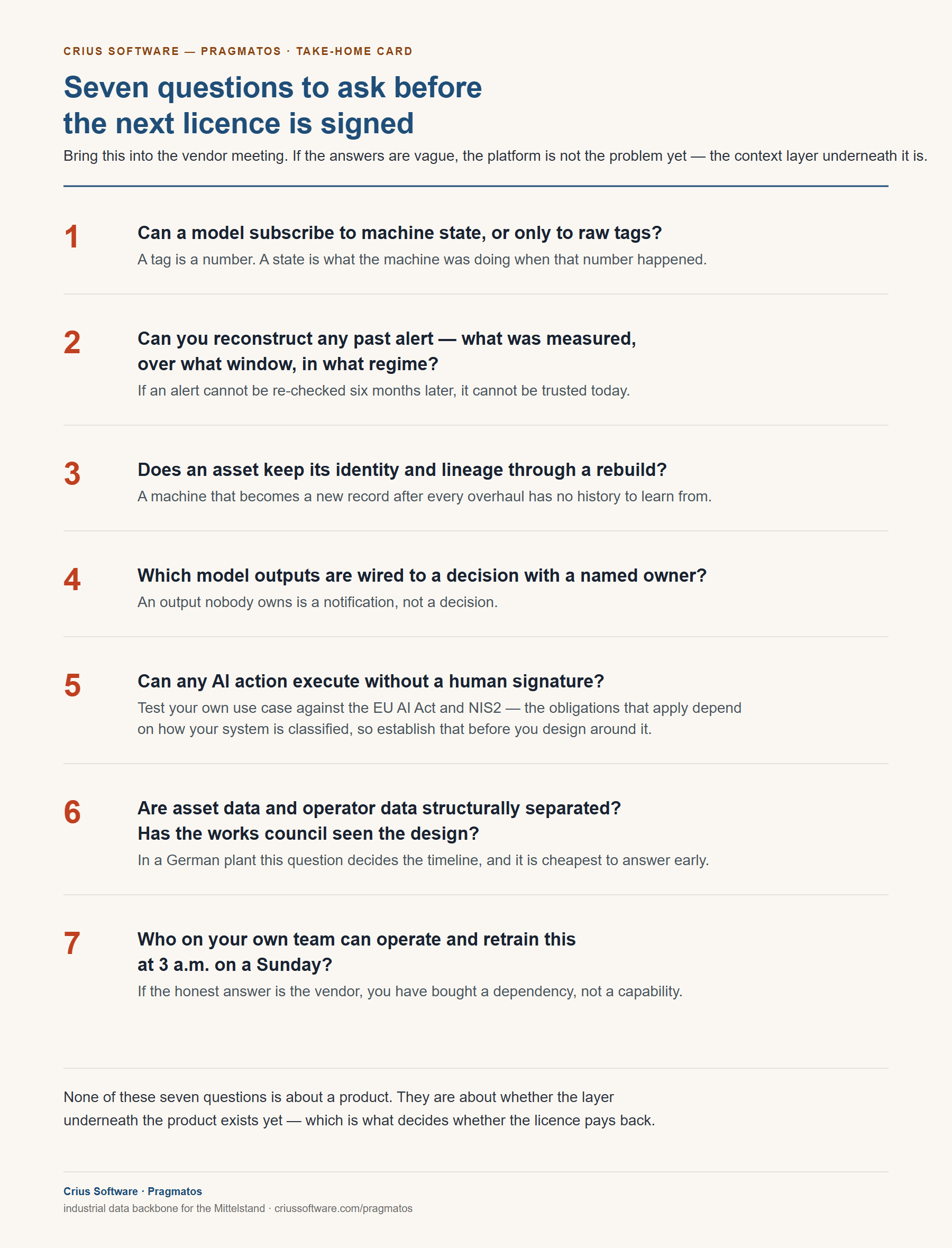
- Can a model in your stack subscribe to machine state, or only to raw tags?
- For any alert your system raised last month, can you reconstruct exactly what was measured, over what window, in what operating regime?
- What happens to your models the day a machine is rebuilt — does the asset keep its identity and lineage, or does the model start scoring against a ghost?
- Which of your model outputs are wired to a decision with a named owner, and which land in an inbox with none?
- Can any AI action execute on your line without a human signature — and if so, have you tested that against the AI Act and your NIS2 obligations?
- Does your context layer keep asset data and operator data structurally separate, and has the works council seen the design?
- Who, on your own team, can operate and retrain this at 3 a.m. on a Sunday when the line is down?
If your organisation is evaluating how to move manufacturing AI beyond isolated pilots, or wondering why a model that shone in the lab went quiet on the line, the foundational decision is not which model to buy. It is whether the architecture underneath it manufactures context by default. That decision deserves careful reassessment before the next licence is signed.
Enhanced full blog text — board-ready report format
Why AI Without Context Fails in Manufacturing
At 02:14 on a Sunday, a predictive-maintenance model on a five-axis machining centre declared a critical spindle-bearing failure. The night shift did the responsible thing. They stopped the machine, called the on-call reliability engineer, and waited. The engineer drove in, pulled the bearing data, and found nothing wrong. The vibration signature the model had flagged was a tool change. The machine had swapped a worn end mill for a fresh one, exactly as programmed, exactly as it had done four hundred times that month.
The model was not broken. It had seen a real vibration event and classified it faithfully. The problem was that nobody had told it what the machine was doing at 02:14. It did not know a tool change from a bearing spalling because it had never been given the one thing that separates the two: context.
This is the quiet failure mode of manufacturing AI in 2026. Not that the models are weak. They are, in fact, better than most factories deserve. The failure is that we keep feeding sophisticated models a stream of numbers stripped of the world those numbers came from — no machine state, no batch, no material, no shift, no upstream event — and then we act surprised when the model is confidently wrong. An AI without context is not intelligent. It is a fast way to be confidently wrong at scale.
Industrial Reality Check
Walk the floor of any mid-sized manufacturer that has "done AI" and you will find the same graveyard. A predictive-maintenance pilot that ran beautifully on one CNC for three months and was never rolled out to the other forty. A quality-vision model that hit 94 percent in the lab and 61 percent on the line. An energy-optimisation dashboard that recommends throttling a compressor that, it turns out, feeds a safety system. Each of these was sold as an intelligence problem. Each of them is a context problem.
Here is what actually happens. The vendor connects to your historian — the process historian that has faithfully logged tag values for a decade. They pull two years of time-series, train a model, and show you a curve. The curve is persuasive. The demo lands. Then the model meets a Tuesday.
On that Tuesday, the same tag value means three different things depending on whether the machine is warming up, cutting, or idling — and the model has no idea which. The alert fires. The reliability engineer investigates. It is nothing. The alert fires again. It is nothing again. By the fourth false positive, the engineer has learned the most expensive lesson in industrial AI: the model cries wolf, so the model gets muted. And a muted model is worse than no model, because now you are paying for a licence and still walking the floor with a clipboard.
Data-rich, decision-poor was the disease of the dashboard era. The AI era has a sharper version: model-rich, context-poor. You have bought the sprinter. You forgot to build the track.
Why the Problem Exists Structurally
The reason is not that engineers are careless. It is that the historian was never designed to hold context, and almost every manufacturing AI stack is built on top of a historian.
A historian stores tag values against time. `SPINDLE_1_VIB_RMS = 2.3 mm/s @ 02:14:07`. That is a fact, and it is a useless fact in isolation. To make it meaningful, a human — or a model — has to answer a set of questions the historian cannot: which physical asset is `SPINDLE_1`, and is it the same asset it was before last month's rebuild? What program was running? Was the machine in cut or in a tool change? What material, what tool, what feed and speed? What happened upstream ninety seconds ago? The historian holds none of this. It holds the number.
In most factories, that context lives in four places that do not talk to each other. The machine state lives in the PLC. The program and part live in the MES, if there is an MES. The material genealogy lives in the ERP. And the tacit knowledge — that this machine always runs hot after a weekend cold start — lives in the head of a maintenance technician who retires in three years. A model trained on the historian sees the number and none of the four. It is diagnosing a patient through a keyhole.
There is a second structural failure underneath the first: sampling without state. Industrial signals are only interpretable relative to the operating regime that produced them. A bearing at 2.3 mm/s RMS is healthy at 800 rpm and alarming at 200 rpm. A temperature curve that climbs during ramp-up is normal; the identical curve during steady-state is a cooling fault. Strip the regime and every threshold you set is either too loose to be useful or too tight to be trusted. Most pilots quietly hand-label the regime for the one machine in the pilot — an engineer sits with the data and tags the states by hand. It works. It also does not scale past one machine, and that is precisely why the pilot never leaves the lab.
The uncomfortable truth is that the intelligence was never the scarce resource. The context was. And context is an architecture problem, not a modelling problem.
Architecture Deep Dive
If context is the missing layer, then the work is to build a layer that manufactures context before the model ever sees a number. This is what an industrial data backbone is for, and it has four load-bearing parts.
A unified namespace, not a tag list. The first move is to stop treating data as a flat list of tags and start treating it as a structured model of the plant. A unified namespace organises every signal under the physical and logical hierarchy it belongs to — Enterprise / Site / Area / Line / Cell / Machine / Component — so that `SPINDLE_1_VIB_RMS` becomes `Plant-B/Line-3/OP-40/Spindle/Vibration`, an address that carries meaning. When a model subscribes to that address, it inherits the hierarchy. It knows which line, which operation, which component. The namespace is the difference between a number and a coordinate.
An event and aggregate contract. Raw telemetry is the wrong thing to hand a model, and it is certainly the wrong thing to send across a plant network fifty times over. The pattern that scales is to compute features at the edge — an FFT band-energy, an RMS over a defined window, a Cp/Cpk over a batch — and to publish two coupled things: the event (something happened, at this time, on this asset, in this state) and the aggregate (the summarised evidence). The contract is what makes the event reproducible. It says: this alarm was computed this way, over this window, with the machine in this regime. Six months later, when someone asks why the model fired, the contract answers. Without it, every alert is unfalsifiable, and unfalsifiable alerts are the reason models get muted.
A semantic asset model with lineage. A machine is not a static thing. It gets rebuilt, retooled, relocated. The context layer has to track the asset as an identity through those changes, so that the model knows the spindle it is watching today is — or is not — the spindle it learned from last quarter. Tie that to material and batch genealogy and the model can finally distinguish a signal caused by the machine from a signal caused by the steel. This is the layer that turns "the vibration went up" into "the vibration went up on this component, running this part, in this material, during this operation, ninety seconds after an upstream load change."
The model as the last mile, explicitly advisory. Only now does a model belong in the picture, and it belongs in a specific place: downstream of context, upstream of a human. In our own testing, Pragmatos Pulse runs anomaly detection and statistical process control on the modelled process — X-bar/R and I-MR charts, Cp/Cpk and Pp/Ppk, Western Electric and Nelson run rules, with predictive work built on regression, ARIMA, Fourier decomposition, and machine-learning ensembles. Every disposition it proposes through the Orbis rule-set is advisory. A human signs. Scrap is never dispositioned automatically; it moves only through an explicit human scrap-route. The confidence figure it reports is a coverage indicator — how well the situation matches known patterns — not a probability that a part is defective. We want to be precise about the maturity here: this is built and in testing, validated end-to-end against simulated equipment on modelled process conditions — not running on a customer line, and not a claim about autonomous decision-making on your line tomorrow. That discipline is not a limitation we apologise for. It is the only honest way to run a model on a factory floor, and it is the difference between an assistant your engineers trust and an oracle they learn to mute.
The order matters more than any single component. Namespace, then contract, then asset model, then the model. Reverse it — start with the model and bolt context on afterwards — and you have built the pilot that dies with a whimper in month nine.
Why Most AI Initiatives Fail to Scale
The pilot succeeds for a reason that guarantees it will not scale: it succeeds because a human supplied the context by hand.
On one machine, an engineer can label the operating states, curate the training window, and sanity-check every alert. That human is a walking context layer. The model looks brilliant because a person is doing the unglamorous work the architecture should be doing. Then the mandate arrives — roll this out to forty machines across three sites — and the human does not come with it. There is no engineer to hand-label forty machines, and there is certainly not one to re-label them every time a line is reconfigured. The context that made the pilot work was never captured in a system. It lived in a person, and people do not replicate.
The second scaling failure is drift without lineage. A model trained on a machine before a spindle rebuild is a model trained on a machine that no longer exists. Without an asset model that records the rebuild, the model keeps scoring against a ghost. Its accuracy decays, quietly, and by the time anyone notices, trust is already gone.
The third is the ownership vacuum. An alert that means "someone should look at this" scales to nobody. An alert that means "this event, on this asset, in this state, opens this task in the CMMS with this threshold and this escalation" scales because it is wired to a decision with an owner. The model is not the deliverable. The event-to-decision-to-action contract is the deliverable. Most AI initiatives ship the model and skip the contract, which is why they generate insight and no outcome.
None of these three is a data-science problem. All three are architecture problems wearing a data-science costume.
Governance, Security and EU Compliance Considerations
For a Mittelstand manufacturer, the context layer is also where governance either happens or fails to, and 2026 has raised the stakes on all three fronts.
NIS2 and the security of the feed. A model is only as trustworthy as the data path feeding it. Under NIS2, the question is no longer whether your OT network is monitored but who is accountable for the segment that carries your telemetry, and what happens when it is compromised. A model consuming a spoofed or degraded feed will produce confident output from corrupted input — a failure that looks like a model error and is actually a segmentation error. The context layer must sit behind IT/OT segmentation aligned to IEC 62443, with the data path auditable end to end. Who signs off when the segment feeding your model is breached is a governance question you answer before deployment, not during an incident.
GDPR, the works council, and what the model watches. The moment a model observes a machine, someone will ask what else it observes. In a co-determined German plant, the Betriebsrat is right to ask. A context layer that ties signals to operators — even inadvertently, through shift patterns or manual-station timing — creates worker-performance data, and that is co-determination territory. The disciplined design keeps asset data and operator data apart by default: the model watches the machine, not the person. Person-linkage is a policy switch that ships off and needs a works-council agreement on file before it can be enabled at all, so in our own testing the quality lot-hold and genealogy records carry no operator-linked data. Stating that plainly to the works council early is the difference between a rollout that has their support and one that stalls in a co-determination dispute for two quarters.
The EU AI Act and the end of the black box. As the AI Act's obligations phase in, a model that influences safety-relevant or quality-relevant decisions cannot be an unexplainable black box. This is where the event and aggregate contract stops being good engineering and becomes compliance evidence. A system that can show, for any alert, exactly what was measured, over what window, in what machine state, with a human in the decision loop, is a system that can survive an audit. Explainability is not a feature you add to the model. It is a property of the architecture underneath it. Advisory-by-design, human-in-the-loop, and fully traceable is not the cautious option — under the AI Act, for anything touching safety or quality, it is the only defensible one.
Decision Framework for Platform Evaluation
When a vendor demonstrates manufacturing AI, the temptation is to interrogate the model — the algorithm, the accuracy, the training set. Those are the wrong questions, because the model is the part least likely to fail. Interrogate the context layer instead.
Ask how the platform represents machine state, and whether a model can subscribe to state, not to raw tags alone. If the answer is a tag list, the demo is a lab result, not a production system.
Ask how an alert is made reproducible six months later. If there is no event-and-aggregate contract — no record of what was measured, over what window, in what regime — then every alert is a matter of faith, and faith does not survive the fourth false positive.
Ask what happens to the model when a machine is rebuilt or relocated. If the asset has no identity and no lineage, the model is scoring against a ghost the day maintenance touches the machine.
Ask where the human sits in the decision loop, and whether any model action can execute without a human signature. For anything touching safety or quality, the honest answer in 2026 is that it cannot, and a vendor who promises autonomous action on your line is selling you an AI Act liability.
Ask how operator privacy is preserved, and whether asset data and person data are structurally separated. If the vendor has not thought about the Betriebsrat, they have not thought about deployment.
Ask, finally, who operates and retrains this at 3 a.m. on a Sunday. Every architecture looks elegant in a slide deck. The one that matters is the one your own team can run at two in the morning when the line is down.
Executive Summary — Board-Level Interpretation
For a board, the strategic reframe is simple and expensive to ignore. Manufacturing AI does not fail because you bought the wrong model. It fails because you invested in the model and not in the context layer that makes any model trustworthy. The spend on the model is visible and small. The missing spend on the architecture is invisible and large, and it is the reason the pilot never became a rollout.
The competitive consequence is that the manufacturers who win with AI over the next five years will not be the ones with the cleverest algorithms. They will be the ones who built a structured industrial data backbone first — a unified namespace, an event and aggregate contract, an asset model with lineage — so that every model they deploy, now and in ten years, inherits context by default. The model is a five-year asset. The context layer is a fifteen-year one. A conservative, margin-disciplined manufacturer should recognise that the durable investment is the boring one.
The claim discipline cuts both ways here. A vendor telling you their AI will autonomously run your factory is telling you they have not read the AI Act or met your works council. The trustworthy posture — advisory, human-in-the-loop, fully traceable — is not the timid choice. It is the only one that scales past the pilot and survives an audit.
Practical Implementation Checklist
For a team ready to move past the muted-model stage, the sequence is deliberately unglamorous.
First, model the plant before you model the data. Stand up a unified namespace that mirrors your physical hierarchy — Site, Area, Line, Cell, Machine, Component — and migrate signals onto structured addresses. This is the foundation everything else inherits.
Second, capture machine state as a first-class signal. Get operating regime — warming, cutting, idle, tool-change, fault — out of the PLC and into the namespace, so that every downstream feature is state-aware from the start.
Third, define the event and aggregate contract before you train anything. Decide what is computed at the edge, over what windows, and how each event records the state it was computed in. Write it down. It is your explainability evidence and your NIS2 audit trail.
Fourth, give assets identity and lineage. Track each asset through rebuilds and relocations, and tie signals to material and batch genealogy so a model can separate the machine from the material.
Fifth, wire alerts to decisions, not to inboxes. Every model output should open a defined task with a threshold, an owner, and an escalation path. An alert without an owner is noise with a licence fee.
Sixth, keep the human in the loop and the operator out of the data. Advisory dispositions, human signature before action, no operator-linked performance data. Bring the works council in early, not after the dispute.
Only then, seventh, deploy the model — and treat it as the last mile of an architecture, not the first purchase of a project.
The false alarm at 02:14 was never a story about a model. It was a story about a machine that could not tell anyone what it was doing, feeding a model that had no way to ask. The model did its job. The architecture failed to do its own.
Manufacturing AI in 2026 is not short of intelligence. It is short of context. The factories that understand this will spend the next year building the unglamorous layer underneath the model — the namespace, the contract, the asset lineage — and the factories that do not will spend it muting alerts and wondering why the pilot never scaled. The model is the last mile. The context is the road. Most of the industry is still buying sprinters and forgetting to build the track.
A few questions worth asking in your next platform review:
- Can a model in your stack subscribe to machine state, or only to raw tags?
- For any alert your system raised last month, can you reconstruct exactly what was measured, over what window, in what operating regime?
- What happens to your models the day a machine is rebuilt — does the asset keep its identity and lineage, or does the model start scoring against a ghost?
- Which of your model outputs are wired to a decision with a named owner, and which land in an inbox with none?
- Can any AI action execute on your line without a human signature — and if so, have you tested that against the AI Act and your NIS2 obligations?
- Does your context layer keep asset data and operator data structurally separate, and has the works council seen the design?
- Who, on your own team, can operate and retrain this at 3 a.m. on a Sunday when the line is down?
If your organisation is evaluating how to move manufacturing AI beyond isolated pilots, or wondering why a model that shone in the lab went quiet on the line, the foundational decision is not which model to buy. It is whether the architecture underneath it manufactures context by default. That decision deserves careful reassessment before the next licence is signed.
Thomas Reinartz updated on 21 Jul 2026, 08:52AM
The 02:14 tool-change example is painfully familiar. We had a vibration model muted within six weeks for exactly this reason — it could not see spindle state, so every ATC cycle read as an anomaly. The point that a muted model is worse than no model is the part I will be quoting to my steering committee.Priya Nair updated on 21 Jul 2026, 10:15AM
Same pattern on our side, except it was thermal. Ramp-up curves flagged as cooling faults. Once we published machine state into the namespace and made features state-aware, the false-positive rate dropped enough that operators stopped ignoring the alerts. The order in the article — namespace before model — is the lesson we learned the expensive way.Dr. Andrea Voß updated on 22 Jul 2026, 09:07AM
The AI Act framing is the part most vendors are still avoiding in their pitches. Treating the event/aggregate contract as compliance evidence rather than just good engineering is a useful reframe for the conversation we are about to have with our legal and quality functions.Michael Grbić updated on 22 Jul 2026, 11:40AM
Agreed. We asked two shortlisted vendors last month how they reconstruct an alert six months later and neither had a clean answer. The seven-question framework is the RFI section we should have written from the start.Rajesh Iyer updated on 22 Jul 2026, 01:22PM
The "human as a walking context layer" line explains our pilot-to-rollout cliff better than the three consultant decks we paid for. One reliability engineer hand-labelling states does not become forty engineers, and nobody budgeted for the system that would replace him.Sabine Kortmann updated on 23 Jul 2026, 07:48AM
As someone who sits on the works-council side of these projects: thank you for naming the operator-data separation explicitly. Most vendor material treats the Betriebsrat as an obstacle to route around. Designing the model to watch the machine and not the person is exactly the conversation that gets a rollout approved instead of stalled.Thomas Reinartz updated on 23 Jul 2026, 09:30AM
This matches our experience. We brought the works council in at the design stage, showed them the asset-data/person-data separation, and the co-determination sign-off took two meetings instead of two quarters.Lukas Berger updated on 24 Jul 2026, 08:15AM
One question — where does the asset lineage actually live in practice? We have machine identity in the CMMS, batch genealogy in the ERP, and neither reconciles cleanly. Is the expectation that the context layer becomes the reconciliation point, or does it federate and reference both?Priya Nair updated on 24 Jul 2026, 12:05PM
In our case the context layer holds the identity and lineage as first-class records and references ERP/CMMS by key rather than duplicating them. The reconciliation discipline is the hard part, not the storage. Getting a single asset ID that survives a rebuild was three months of unglamorous work and worth every week.Henrik Sørensen updated on 25 Jul 2026, 10:40AM
The five-year model versus fifteen-year context-layer distinction is the argument I needed for a capex conversation. The board keeps asking about the model spend, which is the small and visible number. The durable investment is the boring one, as the article puts it.Meera Krishnan updated on 26 Jul 2026, 09:18AM
Good piece. The one thing I would add for readers is that the state signal in point two is often not cleanly available in the PLC either — older controllers do not expose a tidy regime tag, so part of the work is deriving state from the signals themselves before you can make anything else state-aware. Worth scoping early.