Pragmatos Decisions
Every decision on the record: who, on what evidence, and what happened next.
Holds, releases, re-measures and approvals land on one tamper-evident ledger, with the evidence attached and the outcome checked later. Orbis proposes, a person decides, Decisions keeps the proof.
The last step of the loop: the proof
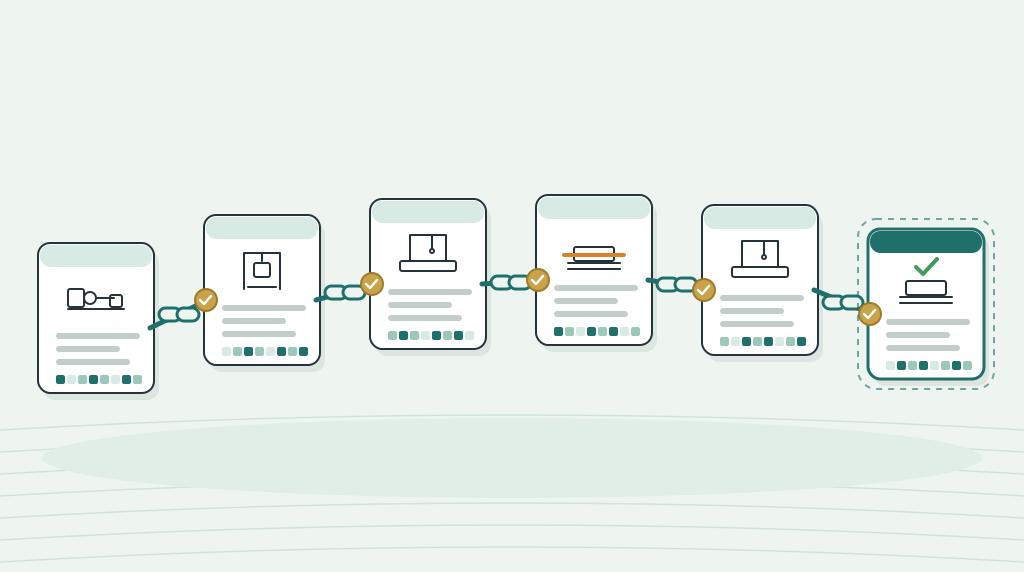
Loom connects the machines, Pragmatos Live shows them, Pulse reads their condition, Orbis proposes what to do and Flow turns an approved decision into work. Decisions keeps the record of all of it: who decided, on which evidence, and what happened after. What it learns goes back to the start.
Confirmed outcomes return to Orbis, so the next proposal starts from what worked.
The ledger: every decision, its evidence and its signature
DecisionsEach decision is one row: what was decided, the evidence it rests on, the role that signed, the time, and whether a model proposed it and with what confidence. Each row is hashed together with the row before it. The database role the application uses can add rows and cannot change them, so the ledger is tamper-evident: change a row anywhere else and the chain shows it.
Evidence attaches when the proposal is made, not after the decision. Approving a proposal raises its work order; rejecting it closes the proposal, and both go on the record.
| Time | Decision | Evidence | Role | Origin | Seal |
|---|---|---|---|---|---|
| 06:14 | Hold lot 4471 (Sperren) | Bore drift on lathe 3, trend attached | Qualitätssicherung | Orbis proposal | 41c7 → 9f3a |
| 07:30 | Re-measure twenty parts (Nachmessen) | Sample plan for the measuring machine | Qualitätssicherung | Person | 9f3a → b20e |
| 07:52 | Rework 2, release 238 (Freigeben) | Measuring results: 18 inside, 2 near the limit | Qualitätssicherung and Schichtleiter | Person | b20e → 6d14 |
| 08:05 | Change the insert on lathe 3 | Approved proposal, work order raised in Flow | Instandhaltung | Orbis proposal | 6d14 → c58b |
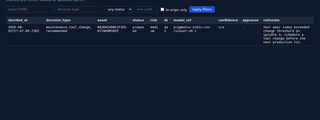
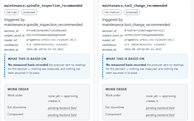
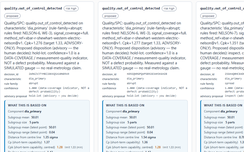
No measured basis recorded. When a proposal has no measurement behind it, it says so in those words, and the person deciding sees the gap before signing.
Each role opens Decisions on its own day screen: what waits for its signature, what it held, what is overdue. The screens run in 28 languages.
Containment: hold, re-measure, release
DecisionsWhen a lot is in doubt, one role holds it. The parts go back to the measuring room, and the results attach to the hold. Two people sign the release. Every step is a row on the chain, so the question of which sheet belongs to which pallet has one answer.
A quality approval asks for an explicit disposition. Orbis proposes one, and the person signing picks it:
- Adjust the offset
- Hold
- Rework
- Inspect
- Route to scrap
Routing parts to scrap is only ever a person's choice.
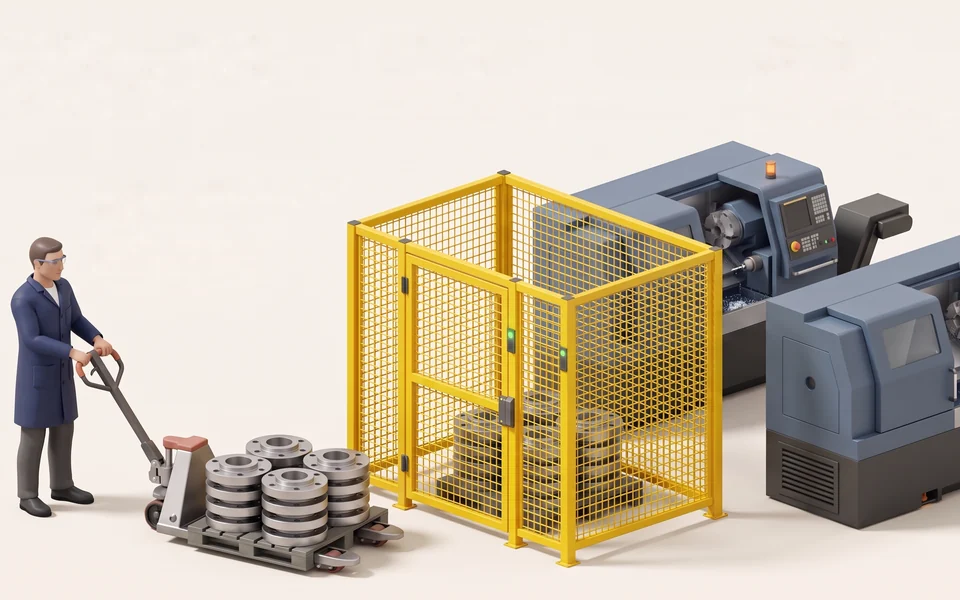
- 1Hold (Sperren)One role holds the lot. The hold, its reason and its evidence go on the ledger at once.
- 2Re-measure (Nachmessen)The parts go back to the measuring room. The results attach to the same decision.
- 3Release (Freigeben)Two people sign the release. Each signature is its own row on the chain.
Outcomes: what happened after the decision
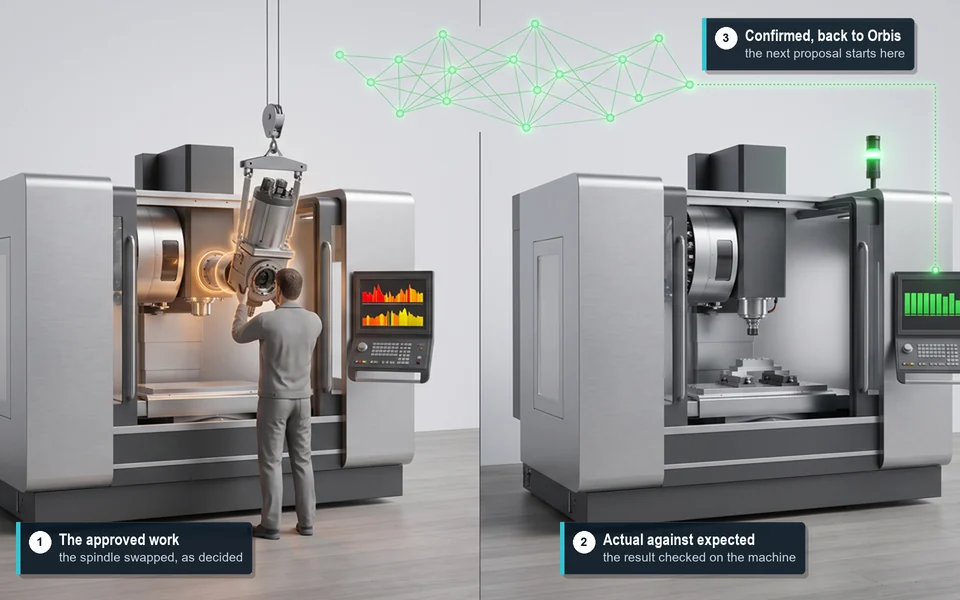
DecisionsA decision is not finished when it is signed. Decisions follows it: the effect screen (Wirksamkeit) sets what was expected against what happened, machine by machine.
A person confirms the outcome. Confirmed outcomes go back to Orbis, so its next proposal for that machine starts from what worked and what did not.
The model never decides. Orbis proposes, a person with the right role decides, and Fabric sends only work a person approved to your ERP.
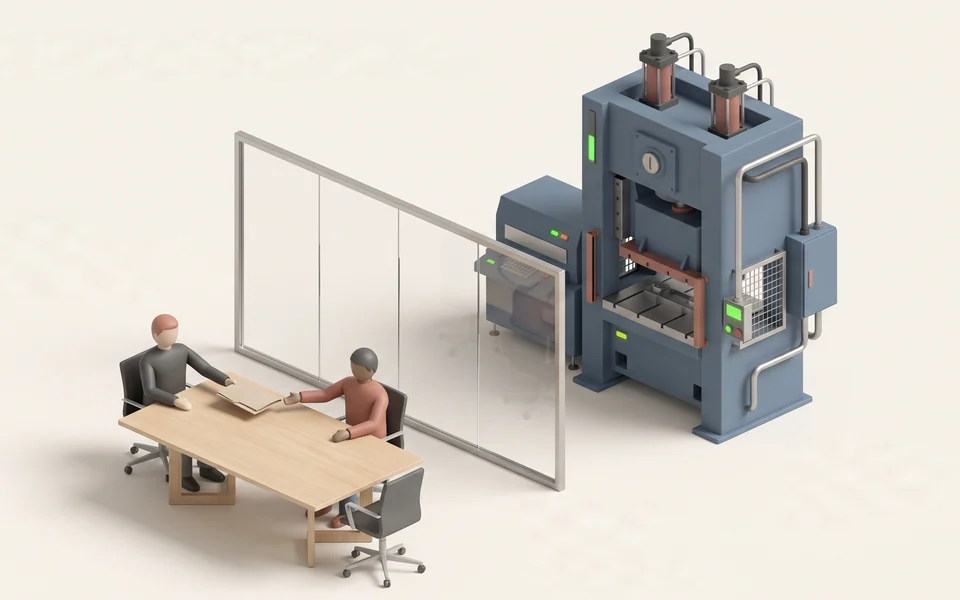
The works council: a read-only view of what is recorded
DecisionsUnder §87(1) No. 6 BetrVG the works council (Betriebsrat) has a say in systems that can watch performance. Decisions gives it its own read-only view: which personal data the system holds, every switch of the person-linkage mode, the role assignments and the list of reports.
Groups smaller than five people are not shown by default, and people appear under pseudonyms. There is no ranking of named individuals, and alarm mails never name who acknowledged them.
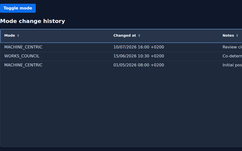
Linking records to a person stays off until a works agreement (Betriebsvereinbarung) reference is entered. The works council is notified first, and the switch itself goes on the ledger. Your works agreement sets the rules; Decisions records which rules are in force.
Audit: export the record, check the chain
DecisionsAn auditor asks for one machine, one period or one company, and gets that export with its chain head. The verify screen recomputes the chain from the first row, and the badge reads Chain verified with the number of rows checked.
The audit query answers the two questions an AI audit starts with: which decisions did a model influence, and which role approved them.
Decisions keeps the record, designed for the EU AI Act's human-oversight and logging requirements. Part records follow your retention policy, aligned with IATF 16949: the life of the part plus one year, up to fifteen years.
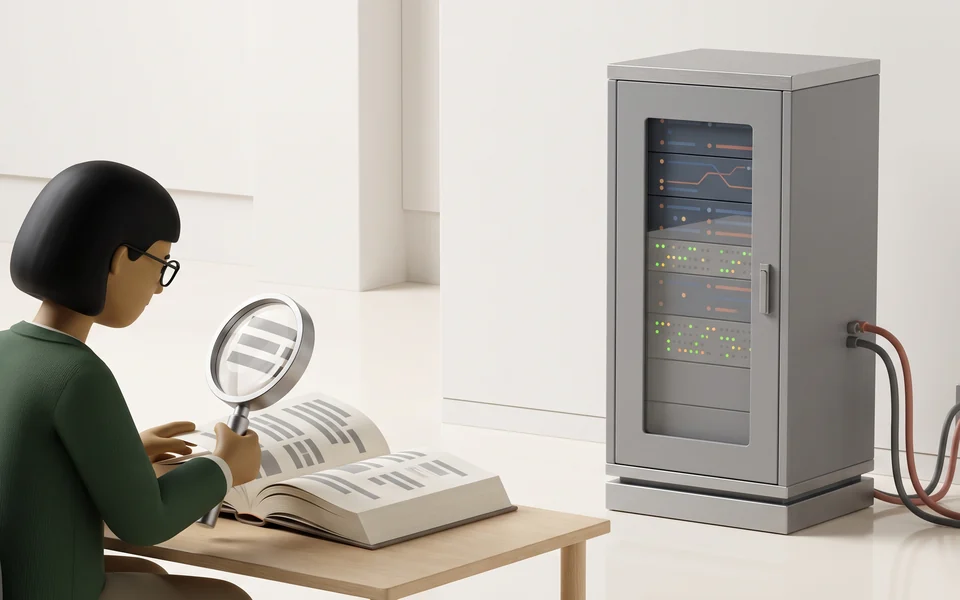
One morning on the record: a hold, start to finish
DecisionsAn example of how one drift on one lathe moves through Pragmatos, and what the ledger holds at the end of it.
- Pulse flags a driftThe bore on lathe 3 is drifting toward its limit. Lot 4471, 240 flanges, is on the pallet.
- Orbis proposesHold the lot, re-measure twenty parts, adjust the offset. The proposal carries the trend it rests on.
- The head of quality holds the lotOne signature, one row. The pallet is held on screen and on the floor.
- Twenty parts re-measuredEighteen inside the tolerance, two near the limit. The results attach to the hold.
- Rework two, release 238The head of quality signs, the shift lead (Schichtleiter) signs second. Two signatures, two rows, one decision.
- Maintenance changes the insertThe approved proposal becomes a work order in Flow. Maintenance (Instandhaltung) closes it at the machine.
- The outcome is confirmedThe bore holds its size. Expected and actual sit side by side, and the confirmed outcome goes back to Orbis.
- The auditor asksA period export for lathe 3 goes out with its chain head. The verify screen reads Chain verified.
Who it's for: what changes on Monday
DecisionsPick a role to see what changes on Monday. The plant manager is open to start.
Plant manager (Werkleiter)
If you run the plant and answer for what leaves it:
- Every hold, release and re-measure sits on one screen, with who signed it and when.
- An open decision does not wait for a person on leave: it moves to the deputy.
- When a customer asks about a lot, the answer is a link, not a search through binders.
Quality (Qualitätssicherung)
If you sign off holds and releases:
- The hold, the measuring results and both signatures belong to one decision.
- A quality approval asks for an explicit disposition, and scrap is only ever a person's choice.
- The period export for an audit comes from the ledger, not from a spreadsheet built for the day.
Works council (Betriebsrat)
If you represent the people on the floor:
- You get a read-only view of which personal data the system holds and every switch of the person-linkage mode.
- Groups smaller than five stay hidden by default, and people appear under pseudonyms.
- Person-linkage stays off until your works agreement reference is entered, and you hear first.
Owner and CFO (Geschäftsführung)
If you own the plant and carry its liability:
- Every call on the floor has a role, a signature and its evidence, so a claim is answered from the record.
- Outcomes are checked against what was expected, so you see which decisions paid off.
- The record stays in your installation, under your own retention policy.
IT and auditors (IT und Auditoren)
If you look after the systems or check them:
- The ledger is append-only and hashed row by row, and the verify screen recomputes the chain.
- The audit query answers which decisions a model influenced and which role approved them.
- Exports go out by machine, by period or by company, with the chain head to check them against.
Maintenance (Instandhaltung)
If you keep the machines running:
- A work order arrives with the decision behind it and the evidence it rests on.
- When the job is done, the outcome is checked, so the next proposal for that machine starts from what worked.
- No order starts from a model alone: a person approved it first.
Shift lead (Schichtleiter)
If you run the shift:
- Your day screen shows what waits for your signature, and nothing else.
- A second signature on a release is two taps, with the first signer's evidence in front of you.
- The next shift sees what was held, why, and who held it.
Bring IT, quality and the works council. We walk them through the ledger.
Pragmatos reads, people act. Orbis proposes, a person with the right role decides, and Decisions keeps the proof.
A walkthrough for the people who sign off: the ledger, the containment flow, the works council view and an audit export.
Book a walkthroughWhere Decisions connects
- Act: FlowApproved decisions become work orders.
- Decide: OrbisProposals with their evidence attached.
- Connect: LoomLoom AI reads your machines, old and new, and never writes to them.
- See: Pragmatos LiveOne screen for the whole shop.
- Analyze: PulseCondition and trends, machine by machine.
- PragmatosThe whole platform on one page.
- Platform and trustWhere it runs and who sees what.
Get new articles by email
Questions quality, IT and the works council ask