

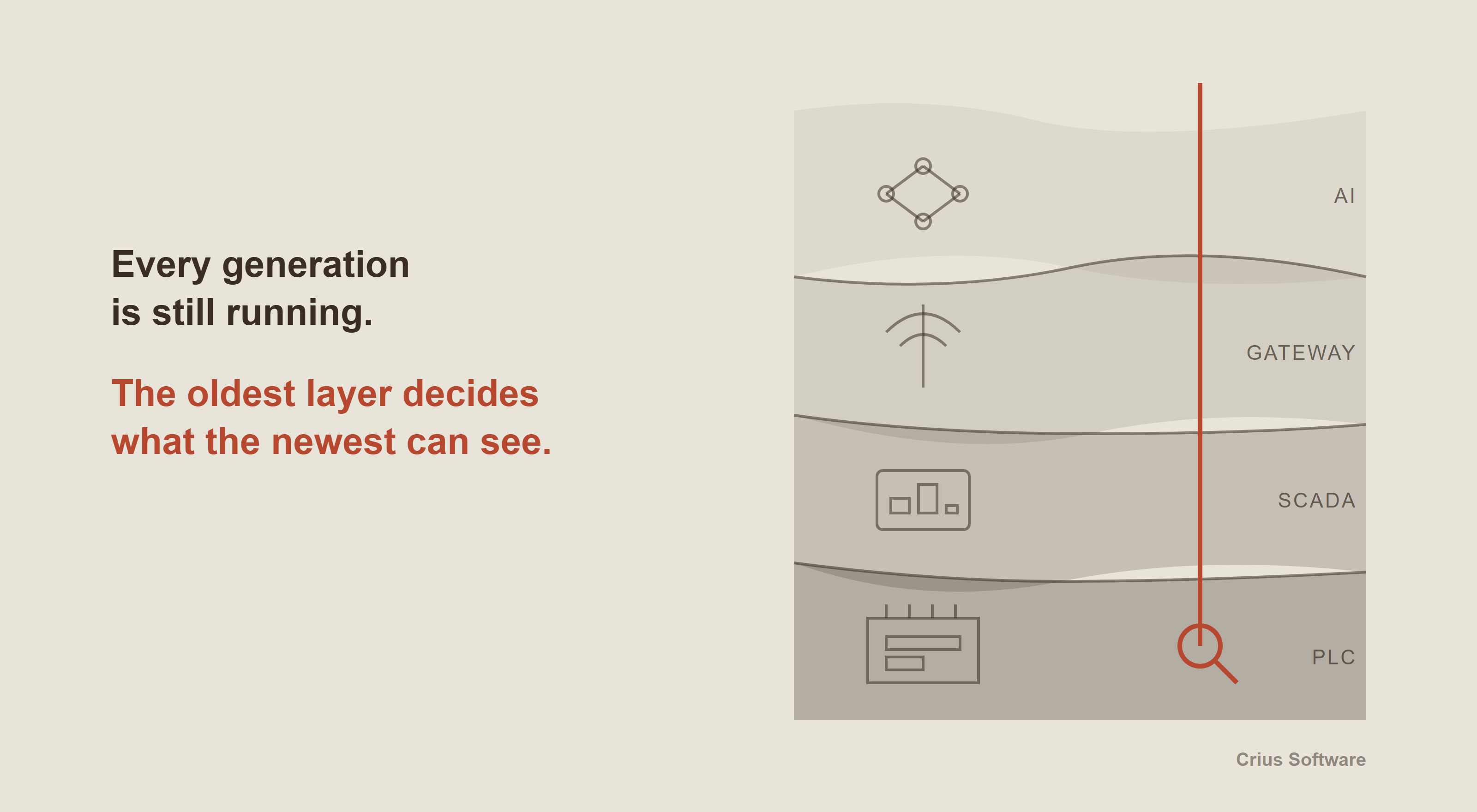
Open a control cabinet on almost any mid-sized plant floor and you will find automation history laid out in front of you, not behind you. A deterministic controller from a design lineage that traces back to 1968 sits next to a gateway installed eighteen months ago. A terminal-block wiring scheme drawn up by an integrator who has since retired still defines what every tag downstream is allowed to mean. Somewhere in a server room, a historian is quietly discarding most of the raw signal it receives, on purpose, because someone decided years ago that disk space mattered more than texture.
None of this is failure. It is accumulation. And it is the reason the standard story of industrial automation — a tidy five-rung ladder from programmable logic controllers to autonomous factories — is a story vendors tell to sell the next rung, not a description of any plant we have ever walked into.
This is the honest version: what each generation of automation actually left behind, why it is still load-bearing, and what that means for the AI and IoT initiative you are about to fund on top of it.
Industrial Reality Check: A Plant Is Sediment, Not a Staircase
Walk the floor with an OT engineer instead of a slide deck and the ladder metaphor stops holding. The scan-cycle logic controlling a press is not a relic waiting to be modernized — it is doing exactly the job it was built for, at a determinism the newer layers above it cannot match and were never designed to match. The SCADA historian nobody has opened the configuration screen on in years is not dead weight either; it is the single place every tag name in the plant was ever defined, and every dashboard, MES integration, and AI pilot since has quietly inherited its naming choices.
What you are looking at is not a staircase with a top step called "autonomous." It is sediment: each layer laid down by the technology and the economics available at the time, compacted by the layer above it, still structurally present, still doing work. A controller is not "Phase 1." It is the deterministic floor everything else stands on. A historian is not "Phase 2, superseded." It is the schema every later system either respects or silently corrupts.
The practical consequence is that "how mature is our automation" is the wrong question. It assumes a single number on a single ladder. The question that actually predicts whether your next initiative will work is narrower and far more testable: when a signal changes at the machine, how far does it travel — through how many undocumented translations, past how many people who have to be paged to explain it — before a system or a person downstream can act on it without guessing. We call that distance addressability, and it is the throughline for everything that follows in this article.
Why the Problem Exists Structurally
Programmable logic controllers emerged in the late 1960s to replace racks of relay logic on automotive assembly lines, and the design brief has not changed since: execute a fixed scan cycle, deterministically, with no tolerance for a missed cycle because a network packet was late. That constraint is not a limitation automation has been "evolving past." It is a physical requirement of closed-loop motor and safety control, and it is why the control layer still runs on protocols built for determinism over a trusted local segment rather than for openness — the Modbus protocol, for instance, predates commercial Ethernet standardization and was built around exactly that trade-off: simple, fast, and blind to anything outside its own wire.
Supervisory control and data acquisition systems arrived to solve a different problem: give a human operator visibility across many controllers at once. They succeeded, and in succeeding they created a dependency nobody budgeted for. Every tag in a SCADA historian carries a name an integrator chose at commissioning — often under deadline pressure, rarely with a data-governance mandate, and never with today's AI initiative in mind. That naming scheme becomes the plant's tag namespace by accident, and every system built afterward either conforms to it or builds a translation layer around it. Twenty years later, nobody remembers it was a choice at all; it reads as the plant's native vocabulary.
Historians made a second, more consequential choice: deadband compression. Storing every raw sample from every sensor was not economical for decades, so historians were built to discard readings that had not moved beyond a configured threshold. That was the correct engineering trade-off for its era — disk and bandwidth were expensive, and trend charts do not need every sample. But it means the texture a condition-monitoring or predictive model needs — the subtle drift before a threshold is crossed — was thrown away by design, years before anyone was training models on the data. You cannot recover from a historian what a historian was built to discard.
Transport protocols solved a narrower problem than people credit them for: moving bytes reliably from one point to another. OPC UA, introduced by the OPC Foundation as the platform-independent successor to the earlier Windows-COM-based OPC Classic specifications, solved transport and typed data modeling. It did not solve semantic agreement between two integrators who named the same physical sensor two different things. That last problem — what a signal means, not how it moves — is still manual reconciliation on most pilots, and it is the layer that does not scale linearly with machine count. It scales with the number of people who have to be in a room agreeing on a name.
Put together, this is why "why hasn't the factory automated itself yet" is the wrong frame. Each layer solved a real problem, with the tools and economics of its moment, and each solution became a constraint the next layer had to build around. The architecture deep dive below is about designing for that reality instead of pretending it away.
Architecture Deep Dive
The modern industrial stack is usefully described in three operational layers, and the honest version of each layer includes what it inherited from the sediment beneath it.
Edge layer. Real-time data acquisition and preprocessing at the machine. This is where the deterministic control logic lives and where protocol diversity is unavoidable — the edge speaks whatever the installed base of controllers and drives speaks, not what an architecture diagram wishes it spoke. Read-only access at this boundary matters for a reason beyond convenience: a control-layer write path is a safety and liability surface, and most factory-data initiatives have no legitimate reason to touch it. The honest trade-offs between the protocols actually running at this layer — and the layered pattern for translating them cleanly rather than fighting each device individually — are set out in MQTT vs OPC UA vs Modbus: A 2026 Architect's Honest Trade-Off Guide, including the five-layer device-to-consumer pattern that this section summarizes rather than repeats.
Platform layer. Centralized structuring, contextualization, and orchestration — the layer that takes a raw tag and attaches the order, shift, batch, and maintenance context that turns a number into an operational fact. This is also where the tag-namespace inheritance problem from the previous section either gets addressed once, centrally, or gets re-solved badly by every downstream consumer that touches the data. The seven-layer treatment of this backbone — ingestion, contextualization, governance, and the layers above them — is the subject of its own dedicated piece: The Smart Factory Data Blueprint.
Enterprise layer. Business integration — ERP, MES, quality systems, and the decision-support surfaces a plant head or a board actually reads. The honest failure mode at this layer is not lack of dashboards; most plants we have reviewed have more dashboards than anyone reads on a Tuesday. It is the absence of a path from "a dashboard shows a deviation" to "a system or a person takes a specific, accountable action." A layer that only displays is not an architecture decision; it is a very expensive window. The shift this implies — from passive display to a governed decision path, and eventually to an agentic layer that can propose or take bounded action above a real-time contextual data layer — is the argument of Beyond the Dashboard: Why 2026 Is the Year of Agentic AI and the Unified Namespace.
The reason to draw the three layers this way, rather than as sequential phases of maturity, is that a plant is usually strong in one and weak in another simultaneously — a site can have excellent edge-layer read access and a platform layer that still cannot answer "which batch was this part from" without a phone call. Architecture work is diagnosing which layer is the actual bottleneck, not assuming the plant needs to climb a ladder it may have already partly climbed in a different order than the diagram suggests.
Watch the Evolution
Listen to the Insights
Why Most IIoT Initiatives Fail to Scale
The failure pattern is consistent enough to name: the pilot works cleanly on one machine, and the project dies quietly somewhere between machine three and machine thirty. Not from a single dramatic outage — from an accumulation of small, structural frictions that a one-machine pilot never surfaces. We call this machine-one failure, and the mechanics of why global rollouts stall exactly there, not earlier and not later, are covered in detail in The Death of Pilot Purgatory: How to Escape Machine-One Failure in Global Industrial Rollouts.
Three of those frictions trace directly back to the sediment argument above, rather than to anything specific to IoT tooling.
Tag-namespace drift. Machine one's tags were named by whoever configured it, on whatever convention was locally obvious at the time. Machine two, commissioned by a different integrator or a different era of the same integrator's house style, names the same physical measurement differently. A pilot built against machine one's naming convention hard-codes an assumption that machine two quietly violates. Nobody notices until machine two's dashboard shows nonsense, and by then the reconciliation is a manual project, not a configuration change.
Gateway sprawl. Each new machine that cannot speak the platform's native protocol gets its own point-to-point gateway, configured by whoever was available that week. Ownership of that gateway — who patches it, who gets paged when it silently stops forwarding data — is rarely assigned to anyone. A year in, a plant can have a dozen gateways with no shared operational model, each a single point of failure nobody is watching.
Deadband and sampling-rate mismatch. The historian sediment described earlier resurfaces here. A pilot proves value on high-resolution, uncompressed data from a purpose-installed sensor. Scaling means pulling the same signal class from the existing historian instead, at whatever resolution decades-old compression settings left it — and the model that worked in the pilot degrades in ways that are hard to diagnose because the data still looks superficially like data.
None of these three are exotic. They are the direct, predictable consequence of building on sediment without first mapping what each layer actually contains. Scaling past machine one is an architecture discipline, not a deployment-speed problem — which is why "deploy faster" is usually the wrong response to a stalled rollout.
Governance, Security & EU Compliance
The governance question that matters most at the architecture stage is a narrow one: who, or what, is allowed to write to the control layer, and can that be proven after the fact. Read-only access at the edge — pulling telemetry without ever holding a write path into a controller — removes an entire category of governance and safety risk before a single policy document is written. It is the cheapest governance decision available, and it is a decision made in architecture, not in a policy binder.
Above the edge, the governance conversation is mostly about who owns a tag's meaning once it leaves the machine. A platform layer that lets every consuming team define its own version of "line 3 output" produces the same reconciliation debt described in the failure-mode section above, except spread across compliance reporting rather than a stalled pilot. Naming and context ownership belongs to one accountable function, not to whichever team asked first.
On the regulatory landscape itself, we will describe the terrain rather than tell you what it obliges you to do, because that determination sits with your counsel and your specific installation, not with a blog post. European manufacturers are operating through a period where network-and-information-security obligations under NIS2 are being transposed into national law at different speeds across member states, where the EU AI Act's risk-tiered obligations are phasing in on a multi-year schedule, and where the EU Data Act and GDPR continue to shape what industrial data can be moved, shared, and retained and under what basis. What we can say plainly, because it is an architecture property rather than a legal opinion: a system built with person-scrubbed, role-only machine data by default, with any per-person attribution as an explicit, separately governed, opt-in mode rather than the baseline, is simpler to defend under any of those frameworks than a system where that boundary was never designed in and has to be retrofitted under audit pressure. Traceability that falls out of good data architecture — a per-part record that already exists because your context layer captured order, batch, and process state at the time — is a byproduct worth wanting for its own sake, independent of which compliance deadline currently has your attention. Where that traceability discussion connects to product-passport-style regulatory thinking in Europe, we cover it in Beyond the Dashboard.
Security posture follows the same logic as governance: certificate-based authentication on any modern transport is only as good as the discipline behind it. A team that stands up encrypted sessions and then configures every client to trust everything has paid the performance cost of security without buying any of its benefit — a pattern common enough on real plant floors that it deserves naming rather than assuming it will not happen to you.
Decision Framework
Before approving the next stage of an automation investment, five questions do more diagnostic work than a maturity survey.
1. What does the edge layer actually expose, verified, not assumed? Not what the original commissioning documentation claims, and not what a vendor data sheet lists as supported. What a live read against the actual installed controller returns today, on this specific firmware.
2. Who owns the tag namespace, by name? If the honest answer is "whoever the original integrator was, and nobody since," that ownership gap is the single highest-leverage fix available, and it is organizational before it is technical.
3. What does your historian actually retain, at what resolution, after compression? A model or an AI initiative built against an assumption of raw-resolution data that the historian has never stored will underperform in ways that look like a modeling problem and are actually a data-retention problem inherited from a decade-old storage decision.
4. Where does a detected deviation currently stop — at a screen, or at an action? If every anomaly your system surfaces still requires a person to notice it, interpret it, and manually decide and execute a response, you have built visibility, not decision architecture. That gap, and what closing it responsibly requires, is set out at length in Smart Factories Aren't Smart Yet.
5. What is the true economic exposure of leaving this as-is? Ranges vary by plant and product, but a useful anchor: unplanned downtime commonly runs €5,000–€20,000 per hour, scrap losses commonly run 5–15% of output, and energy inefficiency commonly runs 10–25%, with the derivation and the caveats behind those ranges set out in the same piece. A specific plant's numbers may sit anywhere in or outside that band — the point of the question is forcing the estimate to be made explicitly, with a number attached, rather than left as an assumed justification nobody has actually calculated.
These five questions matter more than a maturity score because each one is falsifiable on your own floor within a week, without a vendor in the room. A maturity score tells you where you rank. These tell you what to fix first.
Executive Summary: Board-Level Interpretation
Industrial automation did not arrive in phases that later phases replaced. It arrived in layers that later layers had to be built on top of, and every layer is still doing real work somewhere on a production floor today. Treating automation maturity as a ladder to climb misdiagnoses the actual constraint, which is addressability: how far a signal travels, through how many undocumented hand-offs, before it can be acted on without a person having to explain it first.
The board-relevant consequence is that the highest-leverage investment is rarely the newest visible layer — another dashboard, another AI pilot — and is almost always the least visible one: naming discipline in the platform layer, ownership of the tag namespace, and an honest audit of what the historian has actually preserved. Initiatives that skip this and build directly on unexamined sediment are the ones that work at machine one and stall by machine five, at a cost that compounds with every additional site added before the underlying architecture question is resolved.
Practical Implementation Checklist
- Audit the edge layer against live reads, not documentation — protocol by protocol, controller by controller.
- Name a single accountable owner for the tag namespace before any new integration is approved.
- Pull the historian's actual compression and deadband settings and confirm what resolution is genuinely retained, per signal class.
- Map every existing point-to-point gateway, assign an owner to each, and retire the ones nobody can name an owner for.
- Restrict any new integration to read-only access at the control boundary unless a specific, documented reason requires write access.
- Trace at least one deviation end-to-end, from detection to the specific action or non-action it currently triggers, before funding a new detection layer.
- Attach an explicit euro estimate to the cost of leaving the current gap unaddressed, using your own downtime, scrap, and energy figures rather than an industry average.
- Sequence the rollout past machine one deliberately — plan for tag-namespace drift and gateway ownership at machine two through machine thirty before the pilot is declared a success.
Questions Worth Asking Before You Approve the Next Automation Investment
- If a signal changes at a machine right now, how many undocumented translations does it pass through before someone can act on it — and can anyone in the room actually name them?
- Who owns our tag namespace today, in practice, not on an org chart drawn up years ago?
- What has our historian's compression setting quietly discarded, and have we ever checked?
- When our monitoring flags a deviation, does it stop at a screen, or does it reach a specific accountable action?
- Which of our point-to-point gateways has no named owner, and what happens the day it silently stops forwarding data?
- If we scaled our current pilot to the next thirty machines exactly as it stands today, which of those machines would break it first, and why?
- What would it cost us, in euros, to leave the current gap exactly as it is for another year — and have we actually calculated that number, or assumed it?
None of this requires new technology to answer. It requires someone willing to open the cabinet, read the historian's actual settings, and ask who has been quietly deciding what a tag means for the last decade. The plants that scale past machine one are not the ones with the newest AI layer. They are the ones that did that audit first.
Enhanced Full Blog Text — Board-Ready Report Format
Executive Summary
Automation history is sediment, not a staircase. The familiar ladder — PLC, then SCADA, then IoT, then AI, then autonomy — describes a vendor roadmap, not a working plant. Every generation since the late 1960s is still present and still load-bearing on most floors today. The metric that actually predicts whether an AI or IoT initiative will scale is addressability: how far a signal travels, through how many undocumented hand-offs, before it can be acted on without a person explaining it.
What Each Layer Actually Left Behind
Control layer: deterministic scan-cycle logic built for a fixed-cycle, trusted-segment world — not legacy, still the correct engineering answer for closed-loop and safety control, and the reason protocols built for that constraint are still the majority of what a plant floor actually speaks.
SCADA / historian layer: the tag namespace, chosen by an integrator at commissioning under deadline pressure, inherited unexamined by every system built since; and deadband compression, a rational storage trade-off decades ago that quietly discarded the signal texture a condition-monitoring model now needs.
Transport layer: a mostly solved problem — moving bytes reliably — routinely mistaken for the harder, still-unsolved problem of two systems agreeing on what a signal means.
Why Rollouts Stall Between Machine One and Machine Thirty
Pilots built on machine one silently encode that machine's naming and sampling assumptions. Machine two, three, and beyond violate those assumptions in small, structural ways: different tag conventions, unowned point-to-point gateways, historian resolution that does not match what the pilot was proven on. None of this is an IoT tooling failure. It is what happens when scaling is treated as a deployment-speed problem instead of an architecture-mapping discipline.
Governance and the European Regulatory Landscape
Read-only access at the control boundary removes an entire category of governance and safety risk before a policy is written. Tag-namespace ownership belongs to one accountable function. On NIS2, the EU AI Act, the EU Data Act, and GDPR: this report describes the terrain — phased and staged obligations, transposed differently across member states and phasing in on multi-year schedules — without asserting what any specific installation is required to do; that determination is counsel's, not marketing's. What is an architecture property, not a legal opinion, is that person-scrubbed, role-only data by default with per-person attribution as an explicit opt-in mode is structurally easier to defend under any of those frameworks than a system that never drew that boundary.
Decision Framework
Five questions before the next investment: (1) what does the edge layer verifiably expose today, not on paper; (2) who owns the tag namespace, by name; (3) what resolution does the historian actually retain after compression; (4) does a detected deviation reach an action or stop at a screen; (5) what is the calculated, not assumed, euro exposure of leaving the gap as-is — anchored against typical ranges of €5,000–€20,000 per hour of downtime, 5–15% scrap, and 10–25% energy inefficiency, sourced and derived in Smart Factories Aren't Smart Yet.
Practical Implementation Checklist
Audit the edge layer against live reads. Name a tag-namespace owner. Check the historian's real compression settings. Map and assign ownership to every point-to-point gateway. Default new integrations to read-only at the control boundary. Trace one deviation end-to-end before funding new detection. Attach a real euro figure to inaction. Plan explicitly for machine two through machine thirty before declaring the pilot a success.
Closing
The plants that scale past machine one are not the ones with the newest AI layer. They are the ones that audited the sediment first.
Ankit updated on 19 Nov 2024, 10:15AM
This breakdown of automation maturity is extremely practical. We’re currently between SCADA and IoT layers and struggling with integration gaps.Jonas updated on 19 Nov 2024, 12:05PM
Same here. The biggest issue for us is contextualizing machine data with production orders. Without that, analytics feels disconnected.Priya updated on 20 Nov 2024, 08:30AM
The shift from reactive to predictive systems is where real ROI lies. We saw downtime reduction once we integrated edge analytics.Markus updated on 21 Nov 2024, 02:10PM
The architecture diagram clarified a lot. Especially the separation between edge, platform, and enterprise layers—this is often misunderstood internally.Elena updated on 21 Nov 2024, 03:45PM
Yes, and governance becomes much easier once responsibilities are split across layers instead of a monolithic system.Ravi updated on 22 Nov 2024, 11:20AM
Interesting point on autonomous factories. But realistically, how many companies are actually achieving that level today?Thomas updated on 22 Nov 2024, 01:05PM
Very few. But the roadmap matters more than the destination. Incremental autonomy—like self-adjusting processes—is already happening.Sophie updated on 23 Nov 2024, 09:55AM
The inclusion of audio/video is great. Makes it easier to consume depending on time constraints.Arjun updated on 24 Nov 2024, 04:25PM
Would love a follow-up on implementation cost models and ROI benchmarks across industries.