
You are staring at a slide with three logos — MQTT, OPC UA, Modbus — and a vendor is about to tell you which one is "the future." Stop. Close the laptop. Pour another coffee.
Because here is what nobody in the room will admit out loud: in almost every real factory floor in 2026, you will run all three. The only serious question is which one carries which kind of traffic, and why.
This is the guide we wished we had five years ago. It will not tell you that MQTT "wins." It will not tell you that OPC UA is "industrial-grade" and everything else is a toy. It will not pretend Modbus is dying — it isn't, and the next CNC controller you unbox next month will speak it by default, whether you like it or not.
What this guide will do is give you the trade-offs, the honest failure modes, and the decision framework we use when we architect a brownfield factory that actually has to scale past the pilot phase.
If you are an OT engineer, a manufacturing architect, or the person about to sign a quarter-million-euro platform contract — this one is for you.
Why This Decision Matters More Than You Think
There is a specific class of smart-factory project that dies eighteen months in. The symptoms are always the same: the pilot ran fine on one machine, the second machine needed "a little adaptation," the third machine needed a custom gateway, and by the time you hit machine five, you have three different data-model standards, two MQTT brokers that nobody owns, and an OPC UA server running on a Windows box in a cabinet that nobody has keys to.
The root cause is almost never the platform. It is the protocol architecture — or rather, the absence of one.
Protocol choice is not a technical detail you delegate to the integrator. It is the load-bearing decision that determines whether your data plane can be scaled, governed, secured, and eventually replaced without rewriting your entire stack. Get this wrong at the first plant, and by the third plant you are paying down architecture debt that compounds faster than interest.
So let us look at the three honestly.
Modbus: The One That Refuses to Die
Modbus has been around since 1979. It was designed by Modicon for a world of programmable logic controllers talking over serial cables. It is, by any modern standard, primitive. No authentication. No encryption. No time synchronization. Register-based addressing that forces the client to know the exact memory layout of the server. Polling-only — no events, no publish-subscribe.
And yet, in 2026, Modbus is still the default protocol on:
- Almost every low-cost PLC, VFD, and servo drive shipped out of Asia.
- The majority of legacy CNC controllers from the pre-2015 era (and plenty of new ones).
- Most industrial power meters, energy analyzers, and HVAC controllers.
- Vibration sensors, temperature controllers, pH meters — the long tail of single-purpose industrial instruments.
The reason is brutal and simple: Modbus TCP is four pages of specification. Any embedded engineer can implement a server in a weekend. That economic reality has not changed, and it will not change. When you buy a sensor that costs €80, the margin cannot support a protocol stack that takes a month to certify.
Where Modbus Actually Fits
If you treat Modbus for what it is — a read-only brownfield protocol for retrieving numeric telemetry from devices that cannot speak anything better — it does its job. Our working rule:
- Use Modbus TCP when: the device already speaks it, you are reading fewer than 100 registers per second per device, and the data is going through a trusted gateway that will translate it to something modern within the same cabinet.
- Do not use Modbus for: writing setpoints from a remote supervisory system (no authentication = no audit trail), real-time control, event-driven signalling, or as the primary backbone of a new factory build.
The Failure Modes We See
Modbus deployments fail in three predictable ways.
First, register map drift. A machine vendor ships you a Modbus map document with version 1.2. Six months in, they push a firmware update that silently renumbers five registers. Your data stops making sense. Nobody notices for three weeks.
Second, polling storms. Every client polls its own device list, no coordination, no deduplication. When you hit about fifty devices per subnet, you start seeing packet loss. We have walked into factories with Modbus read failures in the 15% range because nobody owned the polling schedule.
Third, network topology assumptions. Modbus TCP was designed for a flat, trusted LAN. The moment you route it across VLANs, through firewalls, or over a VPN, latency goes unpredictable and timeouts start cascading. We have seen an entire OEE dashboard freeze at 6 a.m. every day because an overnight backup job was saturating the link.
None of these are Modbus's fault. They are architecture failures. But if you pick Modbus as your primary plant backbone, you are signing up for them.
OPC UA: The Standard Everyone Cites, Few Deploy Fully
OPC UA — Unified Architecture, from the OPC Foundation — is the protocol that every major automation vendor will tell you is the industrial standard. Practically every modern controller ships with an OPC UA server.
The pitch is compelling. OPC UA gives you:
- A typed, hierarchical information model — not just raw registers, but objects with properties, methods, and metadata.
- Built-in security — X.509 certificates, signed and encrypted sessions, user authentication.
- Platform independence — C, C++, .NET, Java, Python clients, all speaking the same wire protocol.
- Companion specifications — standardized information models for CNC machines (OPC 40502), injection moulding machines (OPC 40077 Euromap 77), packaging machines (PackML-over-OPC-UA), energy metering (OPC 30140).
On paper, OPC UA is what you want for every new greenfield installation.
Where OPC UA Actually Fits
OPC UA works when:
- You are integrating modern industrial controllers from a tier-1 vendor (post-2018 firmware).
- You need a typed information model, not just raw values — meaning your downstream consumers need to understand "Axis.Position" as a structured concept, not just register 40010.
- You are willing to invest in certificate management — every server, every client, rotated on a schedule.
- Latency requirements are in the 20–200 ms range. OPC UA is not a low-latency protocol in its classic client-server form.
The Two Flavours — And Why It Matters
OPC UA has two transports that are often confused.
Classic OPC UA (Client-Server) is the original — a stateful TCP session between a client and a server, with subscriptions for data change notifications. This is what you find in most industrial controllers today. It works well for one-to-few relationships (a SCADA connecting to twenty machines) and poorly for one-to-many (a data lake trying to ingest from a thousand devices).
OPC UA PubSub — the newer specification, released in 2018 and maturing through 2023–2025 — decouples publishers from subscribers using either UDP multicast, MQTT, or AMQP as the transport. This is the mode that plays well with cloud platforms, unified namespaces, and data-lake architectures. It is also the mode that most installed controllers do not yet support.
If a vendor tells you their device "supports OPC UA" in 2026, your first question must be: which transport? Because OPC UA Classic and OPC UA PubSub look very different from an architect's point of view.
The Failure Modes We See
Certificate theatre. Teams stand up OPC UA with self-signed certificates, configure every client to "trust all," and call it secure. This is worse than Modbus, because now you have the performance overhead of encryption without any of the security benefits.
Information model bloat. Vendors ship OPC UA servers with five thousand nodes exposed by default. Your client tries to browse the address space at startup and the connection times out. You never actually discover the ten nodes you need. Nobody prunes the model because nobody wants to touch the PLC configuration.
Latency on machine control tasks. Teams try to use OPC UA for sub-10 ms control loops. It wasn't designed for that, and it falls over. The result is a hybrid system where OPC UA reads telemetry but the real control happens over a parallel deterministic bus (PROFINET, EtherCAT, EtherNet/IP) that the OT team forgot to mention to the IT team.
Session storms during firmware reboots. Each machine reboot tears down its OPC UA sessions, and every subscribed client tries to reconnect simultaneously. If you have 200 clients subscribed to one server, the server can crash trying to re-establish sessions. We have seen this take down plant-wide SCADA for twenty minutes at a time.
MQTT: The One That Actually Scales
MQTT — Message Queuing Telemetry Transport — comes from outside the industrial world. It was designed in 1999 by IBM for oil-field SCADA over satellite links with intermittent connectivity and tight bandwidth budgets. It is a lightweight publish-subscribe protocol, centred on a broker, with three quality-of-service levels and a compact binary wire format.
MQTT has been the dominant protocol in consumer IoT for a decade. In industrial contexts, the 2018–2023 period saw serious adoption, driven by three things: the arrival of Sparkplug B as an industrial payload specification, the maturation of production-grade brokers (HiveMQ, EMQX, VerneMQ, Mosquitto clustered), and the rise of the Unified Namespace pattern.
Where MQTT Actually Fits
MQTT works when:
- You need to decouple hundreds or thousands of publishers from hundreds or thousands of subscribers.
- Your data flow is event-driven — publish on change, not poll on schedule.
- You need to span unreliable networks — cellular, satellite, spotty WiFi — with graceful reconnection semantics.
- You have the operational maturity to run a broker as a first-class piece of infrastructure, with clustering, monitoring, and a defined retention policy.
The Sparkplug B Question
Raw MQTT is a transport. It does not define what the payload means. If you connect ten vendors to an MQTT broker without an agreed payload standard, you will get ten different JSON dialects, none of which your downstream consumers can parse uniformly.
Sparkplug B is the specification that fixes this for industrial use. It defines:
- A topic namespace with roles (edge-of-network node, device, host application).
- A binary payload format based on Google Protocol Buffers, with typed values and timestamps.
- Birth/death certificates — when a device comes online, it publishes its full data model; when it disconnects, its last-will message notifies subscribers.
- State management — every consumer knows exactly which devices are online and their current values, without polling.
If you are running MQTT for industrial telemetry in 2026 without Sparkplug B, you are reinventing the wheel and your wheel will be worse.
The Failure Modes We See
Broker-as-pet. A team spins up Mosquitto on a single VM, points everything at it, and never plans for clustering or failover. When the VM reboots for a patch, the plant goes silent for an hour. MQTT is a backbone — treat it like one.
Retained-message graveyards. Misconfigured clients publish with the retain flag on every message. The broker accumulates hundreds of megabytes of retained messages that nobody reads and nobody can prune. Restart takes fifteen minutes as the broker rehydrates its retained-message store.
QoS misunderstanding. QoS 2 — "exactly once" — sounds appealing until you realize it requires four round-trips and quadruples the broker's per-message overhead. For industrial telemetry, QoS 1 ("at least once") is almost always correct. Teams default to QoS 2 "to be safe" and then wonder why their broker CPU hits 90% at one thousand messages per second.
Topic-tree chaos. MQTT topics are hierarchical strings. If every team invents its own topic naming, you end up with plant1/line3/machineA/temp, factory-1/line_3/machA/temperature_sensor, and p1/l3/mA/t all meaning the same thing. Sparkplug B fixes this; bare MQTT does not.
The Honest Trade-Off Matrix
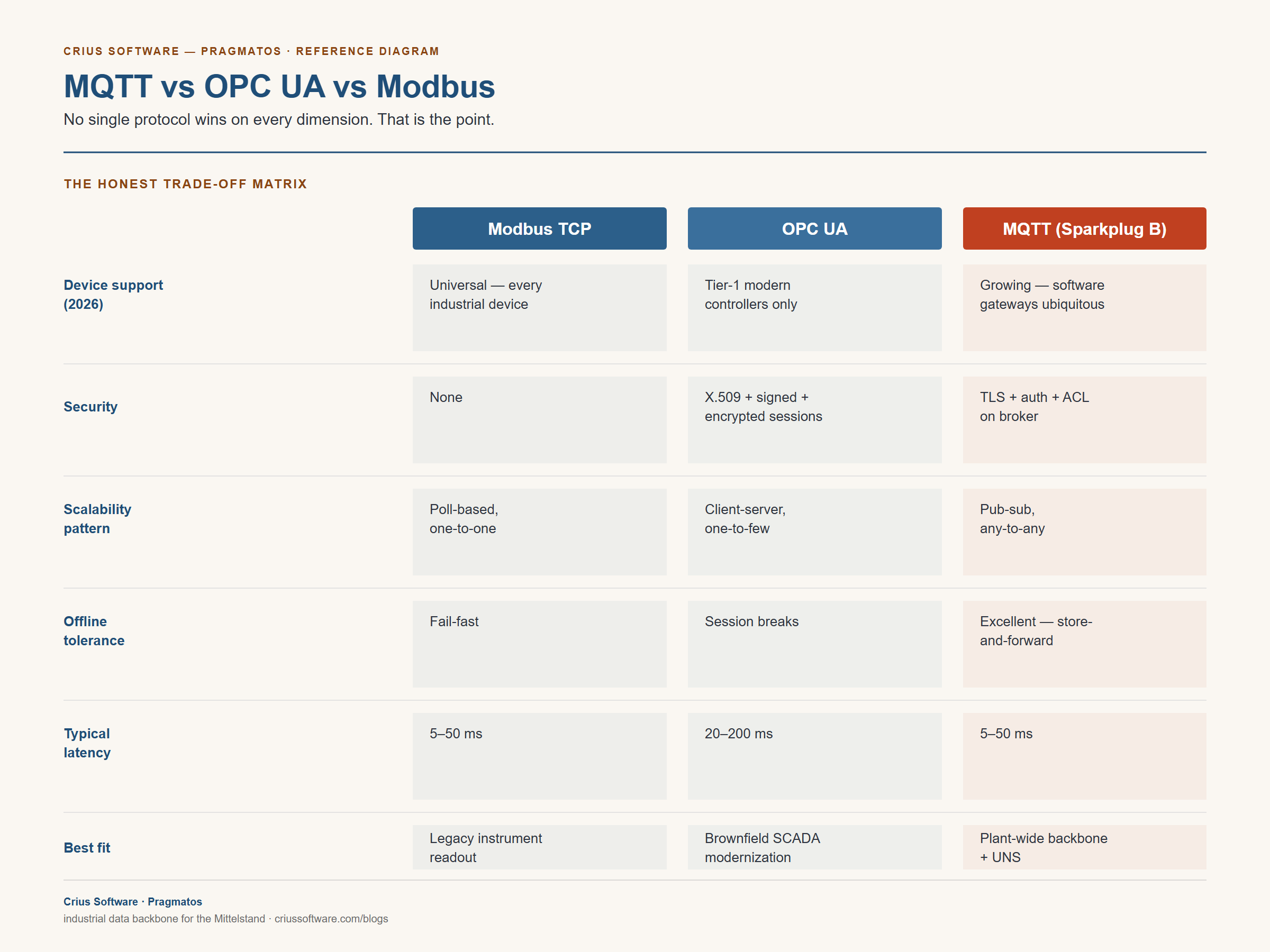
Here is the table nobody wants to print, because every row has an exception. But if you want a starting point, this is ours.
| Dimension | Modbus TCP | OPC UA Classic | OPC UA PubSub | MQTT (w/ Sparkplug B) |
|---|---|---|---|---|
| Device support (2026) | Universal — every industrial device | Tier-1 modern controllers only | Very limited installed base | Growing — software gateways ubiquitous |
| Information model | None (raw registers) | Rich, typed, hierarchical | Rich, typed, hierarchical | Protobuf-typed via Sparkplug |
| Security | None | X.509 + signed + encrypted sessions | Same as Classic plus PubSub encryption | TLS + auth + ACL on broker |
| Scalability pattern | Poll-based, one-to-one | Client-server, one-to-few | Pub-sub, one-to-many | Pub-sub, any-to-any |
| Event-driven | No | Subscriptions yes, but session-bound | Native | Native |
| Offline tolerance | Fail-fast | Session breaks | Depends on transport | Excellent — store-and-forward |
| Certificate management | N/A | Mandatory | Mandatory | Optional but recommended |
| Typical latency | 5–50 ms | 20–200 ms | 10–100 ms | 5–50 ms |
| Best fit | Legacy instrument readout | Brownfield SCADA modernization | Greenfield edge-to-cloud | Plant-wide backbone + UNS |
| Worst fit | Secure writes, remote networks | High-scale fanout, unreliable links | Installed base < 2020 | Sub-10 ms deterministic control |
No single protocol wins on every dimension. That is the point.
↓ The same matrix, but explorable. Click a row to see the rationale. Filter by device class. Drag the QoS slider to see how MQTT's latency profile shifts.
The Five-Layer Pattern We Actually Deploy
In the factories where Pragmatos architects the data plane, we do not pick one protocol. We pick a layered stack where each protocol carries the traffic it is best at, and we translate cleanly at defined boundaries.
Layer 1 — Device Layer (What the Machine Speaks)
This is what you inherit. Modbus from old servo drives, OPC UA from modern CNC controllers, PROFINET and EtherNet/IP from PLCs of different makes, proprietary protocols like Melsec from others. You do not get to choose. You get to integrate.
Rule: do not fight the device. Read it in its native protocol using a gateway that sits in the same cabinet.
Layer 2 — Edge Gateway (The Translation Point)
An edge gateway — whether it is an industrial PC, a Moxa box, a Sparkplug edge node on a Linux device, or a containerized stack on a Kubernetes-at-the-edge cluster — takes in the native device protocols and publishes outward in a single canonical format.
Rule: one gateway per cell, not one per device. Gateways are where you enforce schema, authentication, and rate limits.
Layer 3 — Plant Backbone (MQTT + Sparkplug B)
This is where MQTT earns its place. A clustered broker (typically HiveMQ or EMQX in production deployments) becomes the single publish-subscribe fabric for the plant. Every edge gateway publishes to it. Every downstream consumer — MES, historian, quality system, dashboard, AI model — subscribes from it.
This is the unified namespace in concrete form.
Rule: the broker is infrastructure. Cluster it, monitor it, alert on it, version its ACL and topic scheme in Git.
Layer 4 — Plant-to-Enterprise (OPC UA PubSub or Bridged MQTT)
For cross-plant and plant-to-enterprise traffic, you have two reasonable options. Bridge your MQTT broker outward (broker-to-broker replication, with filtering and policy enforcement) for flexibility. Or use OPC UA PubSub-over-MQTT as the wire format when you need strong typing across the enterprise boundary.
Rule: never expose the plant MQTT broker directly to the corporate network. Bridge with policy.
Layer 5 — Consumers (Where the Protocol Choice No Longer Matters)
At this point, your MES, data lake, dashboards, and AI workloads all consume from a single, typed, governed pub-sub fabric. They do not know about Modbus. They do not need to. If you have to swap a CNC vendor in three years, you change the edge gateway config; you do not change anything upstream.
This is what "architecture" looks like when it is working.
A Concrete Decision Framework
Next time you are in the room with a vendor and three logos on the slide, ask these six questions in order.
1. What does the device actually speak natively? Not what it can speak with a plugin. Not what the brochure says. What does the controller emit when you connect a sniffer to the cable.
2. Is the data plane one-to-one, one-to-few, or one-to-many? Modbus is fine for one-to-one. OPC UA Classic handles one-to-few. Anything one-to-many needs a pub-sub fabric — MQTT or OPC UA PubSub.
3. Does the use case require a typed information model? If your downstream consumer needs to understand "Axis.Position.Actual" as a semantic concept, you need OPC UA or Sparkplug B. If it just needs a numeric timeseries, raw MQTT or Modbus suffices.
4. What is the latency budget? Sub-10 ms control loops do not belong on any of these protocols — they need a deterministic fieldbus (EtherCAT, PROFINET IRT). Everything above 10 ms is fair game for the protocol choice.
5. What is the network reliability profile? Intermittent connectivity — cellular, satellite, edge-to-cloud links — demands MQTT's store-and-forward semantics. Stable LAN connections can tolerate session-oriented protocols.
6. Who will operate the broker or server at 3 a.m. on a Sunday? If the answer is "nobody," do not deploy it. Protocol choice is also an operational choice.
What We Do Not Recommend
A few patterns we see regularly in proposals, and why they do not survive contact with production.
"Let's just put everything on MQTT." This works until you hit the first device that cannot speak MQTT (which will be within a week) and you discover you have no gateway strategy. MQTT is a backbone, not a replacement for Layer 1.
"We'll standardize on OPC UA across the whole plant." Unless you are doing a greenfield build with tier-1 vendors only, this is a multi-year migration project, not a platform decision. Most brownfield factories will always have Modbus somewhere.
"We're skipping Sparkplug B — our payloads are simple enough." They are, today. In eighteen months you will have twelve teams publishing into the same broker with twelve incompatible JSON schemas. Sparkplug B costs you a week of specification reading now; not having it costs you a quarter of refactoring later.
"The vendor's platform handles all protocols — we don't need to think about this." The vendor platform handles the protocols at the ingestion boundary. The problem starts when you try to leave that platform, or integrate data across two vendor platforms. Protocol choice is always yours, even when the vendor says it isn't.
Closing: The Architect's Burden
Nobody in marketing is going to write a blog like this one. It is too honest, too specific, and it does not end with a buy button. But this is the conversation we have with plant heads and manufacturing architects every week, and we thought it deserved to be written down.
The short version is this: there is no winning protocol. There is a layered stack where Modbus reads legacy instruments, OPC UA handles tier-1 controllers with typed information models, and MQTT with Sparkplug B becomes the plant-wide backbone that lets everything else connect, scale, and eventually get replaced without starting over.
If you are architecting a smart factory and you are about to make a protocol decision — pause, map your devices, think in layers, and remember that the decision you make today you will live with for a decade.
That is the honest answer. No logo wins. Your architecture does.
Crius Pragmatos designs and operates the data layer for CNC and plastics manufacturers in DACH and international markets. If you are in the middle of this decision and want a second opinion, our engineering team does a free two-hour architecture review — no decks, no sales motion, just a whiteboard and the truth.
If you are in the middle of the MQTT / OPC UA / Modbus decision for your next plant architecture, the trade-offs are easier to judge with a second pair of eyes on the actual device inventory. Our engineering team does a free two-hour architecture review — no decks, no sales motion, just a whiteboard and the truth.
Enhanced Full Blog Text — Board-Ready Report Format
Executive Summary
There is no winning industrial protocol. In almost every real factory floor in 2026, MQTT, OPC UA, and Modbus all run in parallel. The question is not which protocol wins — it is which one carries which kind of traffic, and why. This blog provides the honest trade-offs (no winner declared), names the specific failure modes that kill smart-factory pilots in their second year, and closes with the five-layer Pragmatos architecture pattern plus a six-question decision framework.
The failure pattern is predictable: pilot works on one machine, second machine needs "a little adaptation," fifth machine has three competing data models and an OPC UA server in a cabinet nobody owns the key to. The root cause is almost never the platform. It is the protocol architecture — or rather, the absence of one.
Modbus — Where It Fits, Where It Breaks
Fits: universal device support; any sensor, VFD, or legacy CNC speaks it; four pages of specification; any embedded engineer can implement it over a weekend.
Breaks: register-map drift after vendor firmware updates; polling storms on subnets over fifty devices; network topology assumptions that fail the moment traffic crosses VLANs or firewalls.
Rule: use for read-only brownfield instrumentation routed through a trusted gateway; do not use for setpoint writes, real-time control, or as a primary plant backbone.
OPC UA — Classic vs PubSub
Classic (client-server): stateful TCP sessions with subscriptions. Works for one-to-few relationships (SCADA to twenty machines). Fails for one-to-many (a data lake ingesting from a thousand devices).
PubSub (2018+): decouples publishers and subscribers over UDP multicast, MQTT, or AMQP. The mode that plays well with cloud platforms, unified namespaces, and data lakes. Installed base still limited.
Failure modes: certificate theatre (self-signed + trust-all = performance cost with zero security benefit); information-model bloat (5,000 node servers that time out on browse); latency on sub-10-ms control tasks; session storms when 200 clients reconnect after a firmware reboot.
MQTT — The One That Actually Scales
Fits: decouples hundreds or thousands of publishers from consumers; event-driven (publish on change, not poll on schedule); spans unreliable networks with store-and-forward semantics.
Sparkplug B: the payload specification that solves the JSON-dialect chaos raw MQTT creates. Topic namespace with roles, binary Protocol-Buffer payload, birth/death certificates, state management without polling. If you run MQTT for industrial telemetry in 2026 without Sparkplug B, you are reinventing the wheel, and the wheel will be worse.
Failure modes: broker-as-pet (single VM treated as production); retained-message graveyards; QoS 2 misuse (four round-trips per message); topic-tree chaos from twelve teams inventing twelve naming schemes.
The Honest Trade-Off Matrix (abbreviated)
Modbus = universal device support, no security, polling only, best for legacy instrument readout. OPC UA Classic = rich information model, tier-1 modern controllers, session-bound subscriptions, best for brownfield SCADA modernisation. OPC UA PubSub = same model with pub-sub semantics, limited installed base, best for greenfield edge-to-cloud. MQTT with Sparkplug B = any-to-any scalability, excellent offline tolerance, best for plant-wide backbone + Unified Namespace. No protocol wins on every dimension. That is the point.
The Five-Layer Pragmatos Pattern
Layer 1 — Device. What you inherit. Modbus on old drives, OPC UA on modern CNCs, PROFINET and EtherNet/IP on PLCs of different makes. Read each device in its native protocol through a gateway in the same cabinet.
Layer 2 — Edge Gateway. One per cell, not per device. Translates native protocols to a single canonical format. Enforces schema, authentication, rate limits.
Layer 3 — Plant Backbone. Clustered MQTT broker (HiveMQ or EMQX in production deployments) running Sparkplug B. Single publish-subscribe fabric for the plant. This is the Unified Namespace in concrete form.
Layer 4 — Plant-to-Enterprise. Broker-to-broker bridging with policy enforcement, or OPC UA PubSub-over-MQTT for strong typing across the enterprise boundary. Never expose the plant broker directly to the corporate network.
Layer 5 — Consumers. MES, data lake, dashboards, AI workloads — all consuming from a single typed, governed pub-sub fabric. They do not know about Modbus. They do not need to.
The Six-Question Decision Framework
1. What does the device actually speak natively (not what the brochure says)?
2. Is the data plane one-to-one, one-to-few, or one-to-many?
3. Does the use case require a typed information model?
4. What is the latency budget (sub-10 ms needs a deterministic fieldbus, not any of these three)?
5. What is the network reliability profile?
6. Who will operate the broker or server at 3 a.m. on a Sunday?
What We Do Not Recommend
"Put everything on MQTT." Works until the first device that cannot speak MQTT.
"Standardise on OPC UA." Unless greenfield with tier-1 vendors only, this is a multi-year migration, not a platform decision.
"Skip Sparkplug B." Costs a week now; not having it costs a quarter of refactoring later.
"The vendor handles the protocols." They handle them at the ingestion boundary. The problem starts when you try to leave.
Closing
No logo wins. Your architecture does.
There is no winning protocol. There is a layered stack where Modbus reads legacy instruments, OPC UA carries tier-1 controllers, and MQTT with Sparkplug B becomes the plant-wide backbone. If you are architecting a smart factory and you are about to make a protocol decision — pause, map your devices, think in layers, and remember that the decision you make today you will live with for a decade.
Stefan Brandt updated on 22 Apr 2026, 08:24AM
The "register-map drift" failure is uncomfortably familiar. We had a Schneider-Electric servo drive renumber three registers in a 2024 firmware patch. Three weeks of misreported torque before the QA team flagged it. Now we hash the discovered register map at install time and alert on any change.Anjali Krishnan updated on 22 Apr 2026, 11:48AM
Hashing the map is the kind of cheap discipline most teams skip. We added it to our integrator acceptance test list after a similar incident — costs an hour, saves a quarter.Markus Weber updated on 23 Apr 2026, 09:15AM
The OPC UA "certificate theatre" point is the one I forward to every architect who tells me their plant is "secured by OPC UA." Self-signed everywhere, trust-all configured everywhere. The performance overhead is real. The security benefit is zero. Worth the bluntness in this article.Priya Subramanian updated on 24 Apr 2026, 02:33PM
Pushback on the "broker-as-pet" warning — for a single-plant deployment under fifty devices, a single Mosquitto VM with proper backup and a documented restore procedure is genuinely fine. Clustering adds operational complexity that most mid-sized shops cannot staff. Right tool for right scale.Crius Team updated on 25 Apr 2026, 10:30AM
Fair. The article's framing assumes you intend to scale beyond the first plant. For a single-site deployment with a confirmed ceiling, you are right — single-VM Mosquitto with documented runbooks is rational. The pet-anti-pattern hits when teams treat that single VM as the indefinite production architecture.Heike Schultz updated on 26 Apr 2026, 07:42AM
The Sparkplug B section finally explained why our cross-team JSON chaos felt inevitable. Twelve teams publishing into one broker, twelve schemas, no governance. We are now retrofitting Sparkplug B onto a six-month-old deployment. Painful, but cheaper than continuing.Rajiv Menon updated on 27 Apr 2026, 11:20AM
The OPC UA companion specification namedrops are useful — OPC 40502 for CNC, OPC 40077 Euromap for injection moulding. Most architect blogs stop at "OPC UA is industry-standard" and never mention the companion specs that actually carry the semantic weight. Keep doing this.Klaus Hoffmann updated on 28 Apr 2026, 02:50PM
Question 6 in the decision framework — "who operates the broker at 3 a.m. on a Sunday" — is the one our procurement team consistently underweights. Vendor demos do not show the operational shift schedule. We started requiring a 24x7 ops plan as a deliverable in the architecture review. Cuts the candidate pool by half. The remaining half is the half we trust.Anjali Krishnan updated on 29 Apr 2026, 08:10AM
"The remaining half is the half we trust" — using this in our next vendor evaluation. Sets the right expectation early.Dirk Bauer updated on 30 Apr 2026, 10:05AM
The five-layer pattern is the cleanest articulation I have seen. Most architecture diagrams in this space conflate transport (Layer 3) with translation (Layer 2) and end up with vendor-locked monoliths. Splitting them at the gateway boundary is the discipline that lets you swap the CNC vendor without rewriting upstream.Vinay Pillai updated on 01 May 2026, 03:42PM
Question on Layer 4 — when bridging plant MQTT to enterprise, what's the threshold where you switch from broker-to-broker bridging to OPC UA PubSub-over-MQTT? In our deployment, broker bridging works fine, but the data engineering team upstream is asking for typed schemas. Fair ask?Crius Team updated on 02 May 2026, 09:25AM
Fair ask, and the right architectural pressure. The transition usually happens when the consumer count exceeds about a dozen, when consumers are owned by different teams, or when the data is feeding ML pipelines that cannot tolerate schema drift. Until then, broker bridging plus a JSON-schema validator at the bridge boundary is good enough. PubSub-over-MQTT is the upgrade path, not the day-one decision.Thomas Lange updated on 03 May 2026, 09:55AM
"No logo wins. Your architecture does." — printing this above the architecture team's whiteboard. Counters the vendor RFP framing better than any consultant deck.