

Shift Handover Is a Document, Not a System: What a Plant Loses Three Times a Day
Every plant you have ever worked in transfers its entire operating state from one group of people to another, two or three times a day, in about ten minutes. In most of them, that transfer is carried by a notebook.
This article is about what the notebook can and cannot carry, why putting it on a tablet changes less than it appears to, and how to split a handover into the part a machine should write and the part only a person can.
Industrial Reality Check
It is 13:52. The early shift ends at 14:00. The Schichtführer has eight minutes, a pen, and a book that has been on the same desk for longer than some of the operators have been employed.
The entry reads, more or less: Line 3 running. Machine 7 tool change done. Coolant topped up on 4. All quiet otherwise.
Every word of it is true. None of it is what happened.
What happened included a spindle alarm on machine 7 that was acknowledged twice and cleared itself once, a batch on line 3 that ran slow for most of the morning because the bar feeder kept faulting for a few seconds at a time, and a conversation with the setter about a fixture that "needs looking at before it goes properly". Nobody left any of that out deliberately. It is not what a tired person remembers in the last eight minutes of a shift when the question is "anything I should know?".
The incoming Schichtführer reads all quiet, walks the line, and finds out about machine 7 at 16:30, when it stops properly. The fixture comes up again on Thursday, from a different setter, as if for the first time.
Nobody in this story did anything wrong. That is the point. The handover failed because it was built as a memory test, and people are bad at memory tests at the end of a shift.
This is not a small-plant problem, and it is not a new one. The UK's Health and Safety Executive, whose guidance on it goes back to the 1990s, states the purpose of handover plainly — the accurate, reliable communication of task-relevant information across shift changes — and records that many accidents have followed a failure of exactly that communication, most of them involving planned maintenance work. The investigations into two of the most-cited refinery and fuel-depot disasters of this century both named the handover record among the contributing causes: at Texas City a shift log that was brief and ambiguous, at Buncefield handover documentation designed to record only the state at the end of the shift rather than what had happened during it.
Most machine shops will never face a consequence of that scale. They face a smaller version of it every day, three times a day, and they pay for it in hours rather than headlines.
Why the Problem Exists Structurally
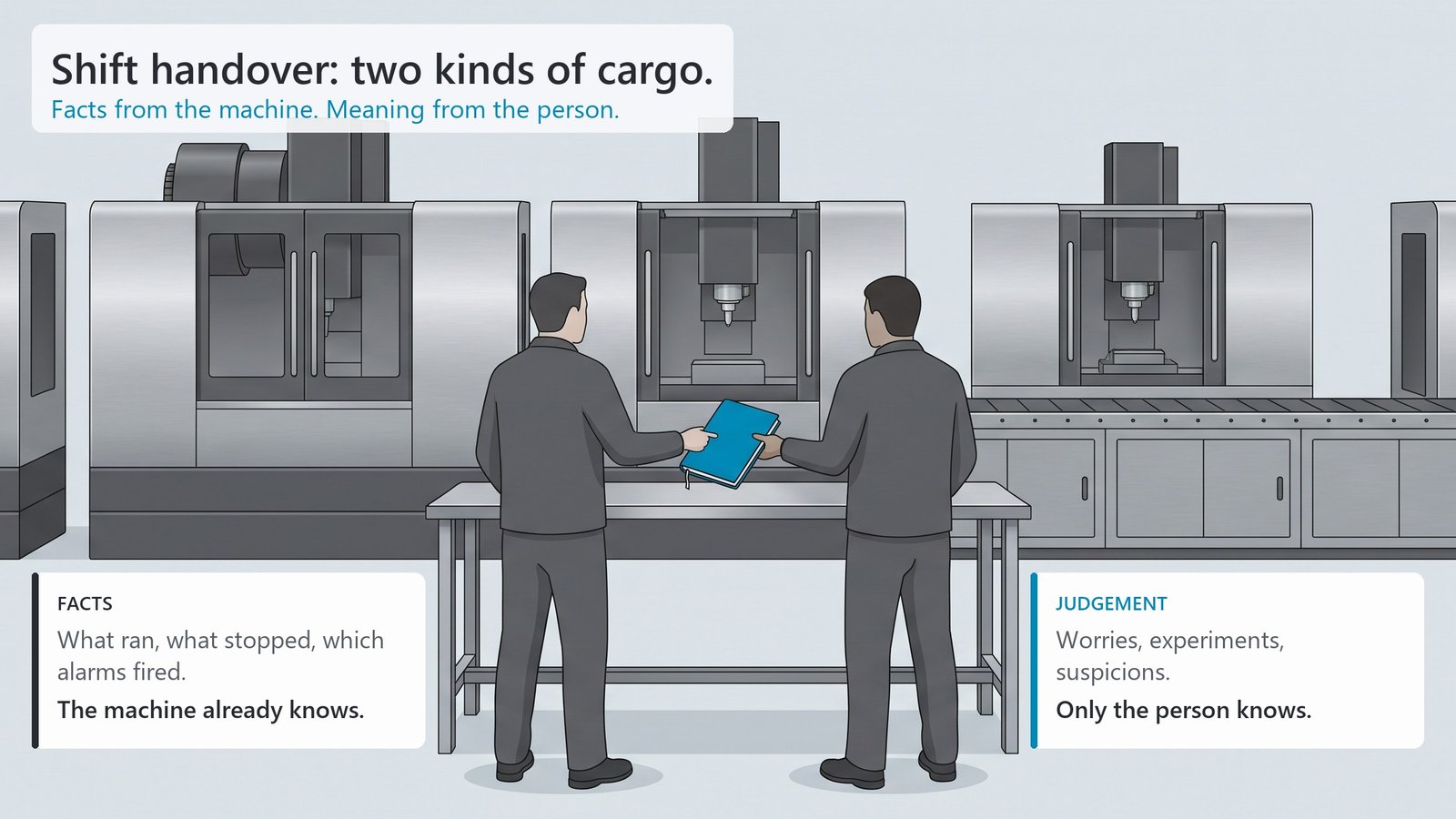
A handover carries two different kinds of cargo, and the notebook treats them as one.
The first cargo is facts. What ran. What stopped, when, and for how long. Which alarms fired. How many good parts, how many rejects. Which program, which tool, which batch. These are not opinions. They happened, they happened at a specific second, and in almost every modern machine they were known to the machine at the time.
The second cargo is judgement. I don't like the sound of the spindle on 7. I tried a slower feed on the new aluminium and it helped. The setter thinks the fixture is going. Watch the bar feeder. None of this exists in any machine. It exists only in the head of the person going home.
The notebook asks the same tired person to hand-carry both, in the same eight minutes, on the same page. And the two cargoes compete unfairly. Facts are easy to write, so they get written first. They feel like diligence. Judgement is hard to write — it is tentative, it might be wrong, it might make the writer look anxious — so it gets compressed into all quiet or left for the conversation at the machine, which may or may not happen.
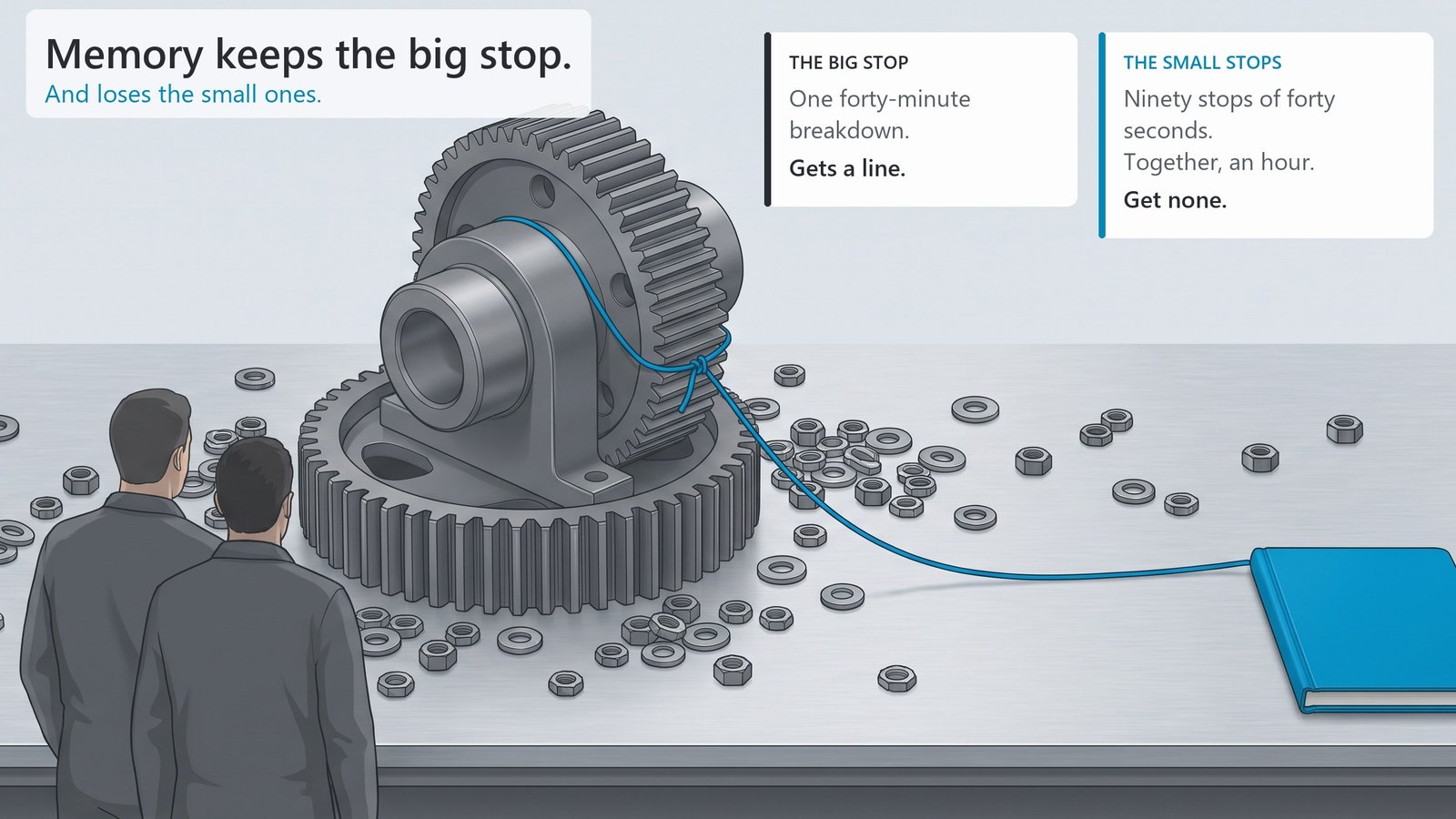
There is a second structural problem, and it is about what memory selects. A handover written from recall records what is salient, not what is frequent. The forty-minute breakdown gets a line. Ninety stops of forty seconds each do not, although together they cost an hour. No single one of them was memorable, and as a pattern they are invisible to the person who lived through them. That is not carelessness. It is how recall works, and it is why the loss a plant discusses is so often not the loss a plant has. We have written separately about those short stops, and why they almost never reach any report at all.
The third structural problem is incentive. A shift book is read by two audiences: the incoming shift, who wants to know what to do, and management, who will read it after something goes wrong. The second audience is the one with consequences. So over time the book drifts from here is what you need to know towards here is evidence that we did our job. We call this the shift book as alibi, and every plant manager has read one.
None of these three problems is solved by better handwriting, a better template, or a stricter rule about completing the book. They are properties of the medium.
Why now
Shift handover has been a known weak point for decades, so the fair question is why it deserves attention this winter. Two things have moved, both checked on 17 November 2026.
The people who carry the judgement half are leaving. Germany's largest birth cohorts, born 1954 to 1969, are reaching statutory retirement age now, and all of them will have reached it by 2036 (IW-Kurzbericht 39/2026, accessed 2026-11-17). We have set out those numbers, and what a plant can do before the farewell party, in a separate article on capturing an expert's knowledge before they retire. For handover the consequence is narrow and direct: the long-serving Schichtführer who knows what a spindle should sound like is the person whose judgement the notebook was never built to pass on.
Hiring is easier than it was, and that is less of a relief than it sounds. The skills-shortage unit of the Institut der deutschen Wirtschaft (KOFA) reports that the gap fell by 24.1 per cent in 2025 (KOFA Kompakt 03/2026, accessed 2026-11-17), and that in manufacturing occupations it kept falling because of weak economic activity. The Federal Employment Agency's 2025 shortage analysis (Fachkräfteengpassanalyse 2025, accessed 2026-11-17) no longer finds a shortage in machining. KOFA itself expects that to turn in 2026, as manufacturers anticipate harder recruiting. So the argument is not that you cannot hire. It is that a plant running below capacity has less room to absorb hours lost to a handover that forgot something, and that a new hire arrives without the judgement that is leaving.
Architecture Deep Dive
The fix is not to write more. It is to stop asking people to write the half that does not need them.
Split the cargo
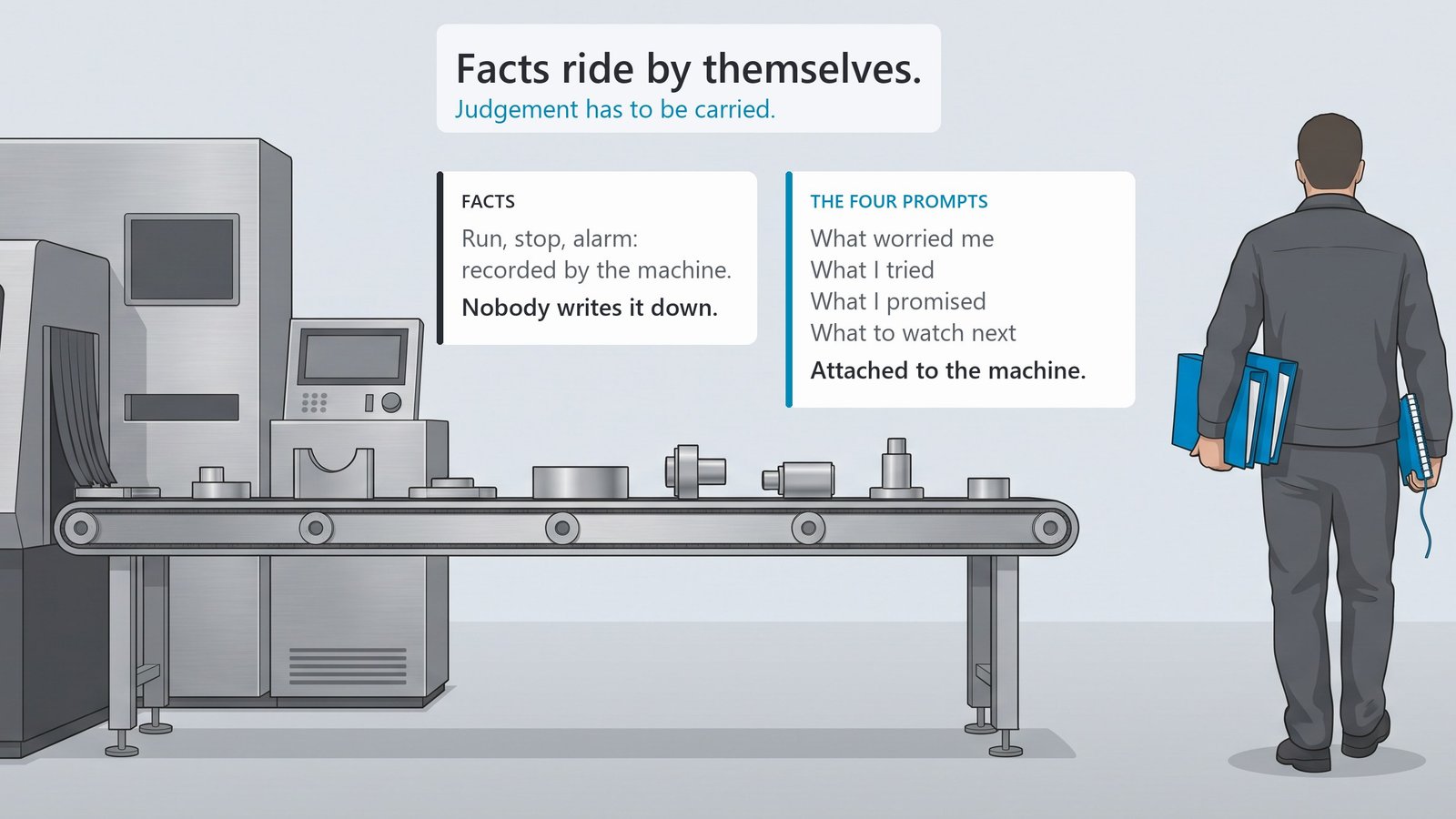
Facts should arrive on their own. The machine already knows its state, its alarms, its counts and its program. Getting those into the handover is a data problem, not a discipline problem, and it has a data solution. The incoming shift should be able to see the last eight hours of every machine — running, stopped, waiting, in alarm — without anybody having transcribed it.
Judgement should get the whole handover. Once nobody has to write Line 3 running, the ten minutes are free for the things only a person knows. The handover document shrinks to what it should always have been: a short, human record of worries, experiments and suspicions, attached to the machines they concern.
Call it facts from the machine, meaning from the person. It is the entire architectural idea of this article. Everything below is how to get there without breaking anything.
What the machines can already tell you
Many CNC machines, including some older ones, expose their state in a form that can be read without touching the control program. The common routes are OPC UA (with the umati companion specifications for machine tools), MTConnect, and on simpler equipment Modbus TCP registers. We have covered what each can and cannot tell you in our article on getting a single OEE number out of a mixed fleet, and in our piece on connecting older machines; the short version is that execution state, alarm state, program, and a part counter are widely available, and that "is it running?" turns out to be a harder question than it looks.
For handover purposes, you do not need all of it. You need, per machine, per shift:
- a timeline of state — running, stopped, waiting, in alarm — at a resolution of seconds, not minutes;
- the alarms that fired, including the ones that were acknowledged and cleared, which means reading alarm events or the control's alarm history rather than polling the current state;
- counts, if the machine can report them reliably;
- the program or job that was active.
That is enough to replace almost every factual line in a typical shift book.
What the person still writes
The human half should be short, with enough structure to be findable later. Four prompts cover most of it:
- What worried me — and on which machine.
- What I tried — and whether it helped.
- What I promised someone — a setter, maintenance, quality.
- What the next shift should watch.
Each entry is attached to a machine, not to a page. That single decision changes what the record is good for. A note that says spindle noise on 7 is useful at 14:00. The same note, attached to machine 7 and sitting next to the machine's own alarm history, is still useful three weeks later, when maintenance is trying to decide whether the bearing failure was sudden.
The overlap is for talking, not reading
The HSE's own guidance says handover should be face-to-face, two-way, and supported by both verbal and written communication. That is exactly right, and it is only achievable once nobody spends the overlap reading a list of facts aloud. With the facts already on a screen, the conversation can start where it should: here is what I'm worried about.
The pattern that works
Take the facts out of the book first. Before designing any new form, get the machine timeline in front of the incoming shift. Expect the written entry to shrink. If it does not, the facts were never what filled it.
Shrink the form, do not grow it. A digital handover with thirty fields is a longer memory test. Four prompts and a free-text line per machine.
Attach every note to a machine. Never to a shift, never to a person.
Close the loop on promises. A worry that has been handed over three times without a work order is not a worry, it is an orphaned fault, and the system should make it visible as one.
Keep the paper book for one month in parallel. Not as a fallback — as a measurement. Compare what the book said with what the machines recorded. The gap is your business case.
Why Most Handover Projects Fail to Scale
The tablet shift book. A common project, and a common disappointment. The paper form is reproduced on a tablet, the entries become searchable, and the content does not change at all, because it is still recollection. It is digitised recollection: same memory test, better font.
Mandatory fields. Someone reasonably decides that entries are too thin and makes fields compulsory. The fields get filled — with "n/a", "ok", and copies of the previous shift's entry. The form now looks complete and carries less information than before.
Designed for the second audience. The project is scoped by whoever reads the book after an incident, so it is written for traceability and sign-off. The incoming shift, who needed to know what to do, is not consulted. The result is a better alibi.
The facts never arrive. The machine-data half is postponed as "phase two" because it involves the control network, and the project delivers only the human half — which, without the facts beside it, is the old book again.
No one owns the orphaned fault. Notes accumulate, nobody closes them, and within a few months the handover screen carries so many open items that everyone stops reading it. An open list nobody prunes is noise.
Governance, Security and EU Compliance Considerations
The works council, first and early. A shift book is about people in a way a machine signal is not. The moment handover becomes digital, it also becomes something that could be read as a record of who did what on which shift. In Germany, a technical system capable of monitoring employees' behaviour or performance is a co-determination matter, and the system needs the Betriebsrat's agreement before it is introduced, not after.
That is not an obstacle. It is an ally, because the design in this article is the one a works council should prefer. The facts half is a record of machines, not of people. The judgement half is written by the people concerned, about machines, for their colleagues. The rail is that neither half becomes a league table between shifts. Show the data model to the Betriebsrat before anything is installed, and write down what it will not be used for.
Safety-relevant information needs its own path. A handover that mentions a machine under maintenance, a bypassed interlock, or a permit still open is carrying safety information, and that must not depend on someone reading a free-text note. Most plants already have a permit or lock-out procedure for this. The handover should reference it, never replace it.
Security posture. Reading machine state means a connection into the machine network. Decide up front that the connection only reads and never writes, which network segment it sits on, and who is responsible for it. A handover screen does not need to write anything to a machine, and nothing about it should be able to.
Retention. Handover notes are, at least in part, personal data about the people who wrote them. Decide how long they are kept and why, and keep the machine timeline and the human notes under separate rules if that makes the answer simpler.
Decision Framework for Platform Evaluation
If you are evaluating a tool for shift handover — or deciding whether the one you have is doing the job — five questions separate most options:
- Do the facts arrive without anyone typing them? If every fact on the handover screen was entered by a person, it is a form, not a system.
- Are notes attached to machines, or to shifts? Notes attached to shifts are unfindable in three weeks.
- Is the human part shorter than your current book? If the new tool asks for more writing than the old one, it will be filled in less honestly.
- Does an unresolved worry become visible after it has been handed over more than once? It is the behaviour that separates a handover tool from a form.
- Can you show your Betriebsrat, in one page, what is recorded and what it will never be used for? If the vendor cannot help you write that page, you will be writing it alone.
Executive Summary — Board-Level Interpretation
One. The shift handover is the moment the plant's operating state passes between people, several times a day. In most plants it is carried by a document written from memory, under time pressure, by the person who is leaving. It is systematically incomplete in a predictable direction: it keeps dramatic events and loses frequent small ones.
Two. The fix is architectural, not disciplinary. Facts should come from the machines, which already have them. People should spend the handover on judgement, which only they have. Digitising the existing book without making that split produces a searchable copy of the same gaps.
Three. The timing is demographic. The Institut der deutschen Wirtschaft estimated in June 2026 that the number of people born 1954 to 1969 who are still below retirement age will fall from 14.1 million today to 7.6 million by 2030. The judgement half of a handover is carried by experience, and experience is concentrated in the people nearest retirement. That knowledge — Erfahrungswissen — leaves when they do, and a handover designed as a memory test cannot capture it.
The failure to guard against at board level is funding the tablet and calling it done.
Practical Implementation Checklist
Before buying anything
- Collect four weeks of shift-book entries for one line. Mark every sentence as fact or judgement. The ratio is your starting point.
- Pick the three machines that generate the most handover conversation. Those are the pilot.
- Ask three Schichtführer what they wish the previous shift had told them last week. Write the answers down verbatim.
- Brief the Betriebsrat on the intent before any technical work begins.
First month
- Put the machine timeline for the pilot machines in front of the incoming shift, as a view only. Change nothing else.
- Keep the paper book running in parallel. Compare it weekly with the timeline.
- Introduce the four prompts — worried, tried, promised, watch — as the only written part.
Before extending it
- Check that the written entries got shorter and more specific. If they got longer, the form is too big.
- Check that at least one orphaned fault was found and closed because it became visible.
- Ask the incoming shift whether they walk the line differently. That is the only outcome that matters.
A note on where we stand
We make software in this space, so we are not a neutral party. This article deliberately does not describe what our software does. The argument above is true whichever tool you use, including a whiteboard and a well-placed screen, and it should be judged on that basis.
If you want a quick view of whether your plant's machine data is in a state to support any of this, we publish a free self-assessment at criussoftware.com/res/kits/readiness/. It asks for your work email, company and role, and returns a scored result, with a PDF report by email. It is a self-check, not an audit, and the answer may be "not yet".
Questions worth asking in your next review
- Read last week's handover entries for one line. What fraction of the words are facts a machine already knew?
- When did an entry last say "all quiet" about a shift that had stops in it — and how would you know?
- Which fault has been handed over verbally more than twice without a work order?
- If the incoming Schichtführer could ask one question the book never answers, what would it be?
- How many minutes of the overlap are spent reading, and how many deciding?
- If your longest-serving Schichtführer retired this year, which of their handover habits would survive them?
- Would your Betriebsrat recognise your shift book as a record of machines, or a record of people?
The part that matters
A handover is not a report. It is the one moment in the day when everything the plant knows has to pass through a single person's memory and out the other side.
Asking that person to transcribe what the machines already know is a waste of the only ten minutes in which judgement can be passed on. Let the machines write the facts. Let people write what only people know.
The notebook is not the problem. The problem is what we have been asking it to carry.
Sources
- UK Health and Safety Executive, Human factors: Shift handover (accessed 2026-11-17)
- J. Ross, Shift Handover – Where are we now? (PDF), IChemE Hazards 24, Symposium Series 159 — summarising the published investigation findings on shift logs and handover documentation at Buncefield (2005) and Texas City (2005) (accessed 2026-11-17)
- Institut der deutschen Wirtschaft, IW-Kurzbericht 39/2026 (PDF), on the 1954 to 1969 birth cohorts reaching retirement age, 15 June 2026 (accessed 2026-11-17)
- Kompetenzzentrum Fachkräftesicherung (KOFA) at the Institut der deutschen Wirtschaft, KOFA Kompakt 03/2026: Jahresrückblick 2025 (PDF) (accessed 2026-11-17)
- Bundesagentur für Arbeit, Fachkräfteengpassanalyse 2025 (accessed 2026-11-17)
Take last week's handover entries for one line and mark every sentence as fact or judgement. Then put the machines' own record for the same week beside them. Where the two disagree, you have found what your handover has been losing.
Read next
- Micro Stops in Manufacturing: The OEE Losses Reports Miss — the ninety short stops a handover written from memory never records.
- The Expert Who Retires in 2027: Capturing Plant Knowledge — the demographic numbers behind the judgement half of the handover.
- Brownfield Connectivity: Retrofitting Legacy Machines — getting state, alarms and counts out of older machines without touching the control program.
- OEE for Multiple CNC Machines: One Number, Not Four Portals — what OPC UA, MTConnect and Modbus can and cannot tell you in a mixed fleet.
- OEE Dashboard Not Working? Why Visibility Isn’t Action — why putting the facts on a screen is the start of the work, not the end.
Full blog text — board-ready report format
Shift Handover Is a Document, Not a System: What a Plant Loses Three Times a Day
Every plant you have ever worked in transfers its entire operating state from one group of people to another, two or three times a day, in about ten minutes. In most of them, that transfer is carried by a notebook.
This article is about what the notebook can and cannot carry, why putting it on a tablet changes less than it appears to, and how to split a handover into the part a machine should write and the part only a person can.
Industrial Reality Check
It is 13:52. The early shift ends at 14:00. The Schichtführer has eight minutes, a pen, and a book that has been on the same desk for longer than some of the operators have been employed.
The entry reads, more or less: Line 3 running. Machine 7 tool change done. Coolant topped up on 4. All quiet otherwise.
Every word of it is true. None of it is what happened.
What happened included a spindle alarm on machine 7 that was acknowledged twice and cleared itself once, a batch on line 3 that ran slow for most of the morning because the bar feeder kept faulting for a few seconds at a time, and a conversation with the setter about a fixture that "needs looking at before it goes properly". Nobody left any of that out deliberately. It is not what a tired person remembers in the last eight minutes of a shift when the question is "anything I should know?".
The incoming Schichtführer reads all quiet, walks the line, and finds out about machine 7 at 16:30, when it stops properly. The fixture comes up again on Thursday, from a different setter, as if for the first time.
Nobody in this story did anything wrong. That is the point. The handover failed because it was built as a memory test, and people are bad at memory tests at the end of a shift.
This is not a small-plant problem, and it is not a new one. The UK's Health and Safety Executive, whose guidance on it goes back to the 1990s, states the purpose of handover plainly — the accurate, reliable communication of task-relevant information across shift changes — and records that many accidents have followed a failure of exactly that communication, most of them involving planned maintenance work. The investigations into two of the most-cited refinery and fuel-depot disasters of this century both named the handover record among the contributing causes: at Texas City a shift log that was brief and ambiguous, at Buncefield handover documentation designed to record only the state at the end of the shift rather than what had happened during it.
Most machine shops will never face a consequence of that scale. They face a smaller version of it every day, three times a day, and they pay for it in hours rather than headlines.
Why the Problem Exists Structurally
A handover carries two different kinds of cargo, and the notebook treats them as one.
The first cargo is facts. What ran. What stopped, when, and for how long. Which alarms fired. How many good parts, how many rejects. Which program, which tool, which batch. These are not opinions. They happened, they happened at a specific second, and in almost every modern machine they were known to the machine at the time.
The second cargo is judgement. I don't like the sound of the spindle on 7. I tried a slower feed on the new aluminium and it helped. The setter thinks the fixture is going. Watch the bar feeder. None of this exists in any machine. It exists only in the head of the person going home.
The notebook asks the same tired person to hand-carry both, in the same eight minutes, on the same page. And the two cargoes compete unfairly. Facts are easy to write, so they get written first. They feel like diligence. Judgement is hard to write — it is tentative, it might be wrong, it might make the writer look anxious — so it gets compressed into all quiet or left for the conversation at the machine, which may or may not happen.
There is a second structural problem, and it is about what memory selects. A handover written from recall records what is salient, not what is frequent. The forty-minute breakdown gets a line. Ninety stops of forty seconds each do not, although together they cost an hour. No single one of them was memorable, and as a pattern they are invisible to the person who lived through them. That is not carelessness. It is how recall works, and it is why the loss a plant discusses is so often not the loss a plant has. We have written separately about those short stops, and why they almost never reach any report at all.
The third structural problem is incentive. A shift book is read by two audiences: the incoming shift, who wants to know what to do, and management, who will read it after something goes wrong. The second audience is the one with consequences. So over time the book drifts from here is what you need to know towards here is evidence that we did our job. We call this the shift book as alibi, and every plant manager has read one.
None of these three problems is solved by better handwriting, a better template, or a stricter rule about completing the book. They are properties of the medium.
Why now
Shift handover has been a known weak point for decades, so the fair question is why it deserves attention this winter. Two things have moved, both checked on 17 November 2026.
The people who carry the judgement half are leaving. Germany's largest birth cohorts, born 1954 to 1969, are reaching statutory retirement age now, and all of them will have reached it by 2036 (IW-Kurzbericht 39/2026, accessed 2026-11-17). We have set out those numbers, and what a plant can do before the farewell party, in a separate article on capturing an expert's knowledge before they retire. For handover the consequence is narrow and direct: the long-serving Schichtführer who knows what a spindle should sound like is the person whose judgement the notebook was never built to pass on.
Hiring is easier than it was, and that is less of a relief than it sounds. The skills-shortage unit of the Institut der deutschen Wirtschaft (KOFA) reports that the gap fell by 24.1 per cent in 2025 (KOFA Kompakt 03/2026, accessed 2026-11-17), and that in manufacturing occupations it kept falling because of weak economic activity. The Federal Employment Agency's 2025 shortage analysis (Fachkräfteengpassanalyse 2025, accessed 2026-11-17) no longer finds a shortage in machining. KOFA itself expects that to turn in 2026, as manufacturers anticipate harder recruiting. So the argument is not that you cannot hire. It is that a plant running below capacity has less room to absorb hours lost to a handover that forgot something, and that a new hire arrives without the judgement that is leaving.
Architecture Deep Dive
The fix is not to write more. It is to stop asking people to write the half that does not need them.
Split the cargo
Facts should arrive on their own. The machine already knows its state, its alarms, its counts and its program. Getting those into the handover is a data problem, not a discipline problem, and it has a data solution. The incoming shift should be able to see the last eight hours of every machine — running, stopped, waiting, in alarm — without anybody having transcribed it.
Judgement should get the whole handover. Once nobody has to write Line 3 running, the ten minutes are free for the things only a person knows. The handover document shrinks to what it should always have been: a short, human record of worries, experiments and suspicions, attached to the machines they concern.
Call it facts from the machine, meaning from the person. It is the entire architectural idea of this article. Everything below is how to get there without breaking anything.
What the machines can already tell you
Many CNC machines, including some older ones, expose their state in a form that can be read without touching the control program. The common routes are OPC UA (with the umati companion specifications for machine tools), MTConnect, and on simpler equipment Modbus TCP registers. We have covered what each can and cannot tell you in our article on getting a single OEE number out of a mixed fleet, and in our piece on connecting older machines; the short version is that execution state, alarm state, program, and a part counter are widely available, and that "is it running?" turns out to be a harder question than it looks.
For handover purposes, you do not need all of it. You need, per machine, per shift:
- a timeline of state — running, stopped, waiting, in alarm — at a resolution of seconds, not minutes;
- the alarms that fired, including the ones that were acknowledged and cleared, which means reading alarm events or the control's alarm history rather than polling the current state;
- counts, if the machine can report them reliably;
- the program or job that was active.
That is enough to replace almost every factual line in a typical shift book.
What the person still writes
The human half should be short, with enough structure to be findable later. Four prompts cover most of it:
- What worried me — and on which machine.
- What I tried — and whether it helped.
- What I promised someone — a setter, maintenance, quality.
- What the next shift should watch.
Each entry is attached to a machine, not to a page. That single decision changes what the record is good for. A note that says spindle noise on 7 is useful at 14:00. The same note, attached to machine 7 and sitting next to the machine's own alarm history, is still useful three weeks later, when maintenance is trying to decide whether the bearing failure was sudden.
The overlap is for talking, not reading
The HSE's own guidance says handover should be face-to-face, two-way, and supported by both verbal and written communication. That is exactly right, and it is only achievable once nobody spends the overlap reading a list of facts aloud. With the facts already on a screen, the conversation can start where it should: here is what I'm worried about.
The pattern that works
Take the facts out of the book first. Before designing any new form, get the machine timeline in front of the incoming shift. Expect the written entry to shrink. If it does not, the facts were never what filled it.
Shrink the form, do not grow it. A digital handover with thirty fields is a longer memory test. Four prompts and a free-text line per machine.
Attach every note to a machine. Never to a shift, never to a person.
Close the loop on promises. A worry that has been handed over three times without a work order is not a worry, it is an orphaned fault, and the system should make it visible as one.
Keep the paper book for one month in parallel. Not as a fallback — as a measurement. Compare what the book said with what the machines recorded. The gap is your business case.
Why Most Handover Projects Fail to Scale
The tablet shift book. A common project, and a common disappointment. The paper form is reproduced on a tablet, the entries become searchable, and the content does not change at all, because it is still recollection. It is digitised recollection: same memory test, better font.
Mandatory fields. Someone reasonably decides that entries are too thin and makes fields compulsory. The fields get filled — with "n/a", "ok", and copies of the previous shift's entry. The form now looks complete and carries less information than before.
Designed for the second audience. The project is scoped by whoever reads the book after an incident, so it is written for traceability and sign-off. The incoming shift, who needed to know what to do, is not consulted. The result is a better alibi.
The facts never arrive. The machine-data half is postponed as "phase two" because it involves the control network, and the project delivers only the human half — which, without the facts beside it, is the old book again.
No one owns the orphaned fault. Notes accumulate, nobody closes them, and within a few months the handover screen carries so many open items that everyone stops reading it. An open list nobody prunes is noise.
Governance, Security and EU Compliance Considerations
The works council, first and early. A shift book is about people in a way a machine signal is not. The moment handover becomes digital, it also becomes something that could be read as a record of who did what on which shift. In Germany, a technical system capable of monitoring employees' behaviour or performance is a co-determination matter, and the system needs the Betriebsrat's agreement before it is introduced, not after.
That is not an obstacle. It is an ally, because the design in this article is the one a works council should prefer. The facts half is a record of machines, not of people. The judgement half is written by the people concerned, about machines, for their colleagues. The rail is that neither half becomes a league table between shifts. Show the data model to the Betriebsrat before anything is installed, and write down what it will not be used for.
Safety-relevant information needs its own path. A handover that mentions a machine under maintenance, a bypassed interlock, or a permit still open is carrying safety information, and that must not depend on someone reading a free-text note. Most plants already have a permit or lock-out procedure for this. The handover should reference it, never replace it.
Security posture. Reading machine state means a connection into the machine network. Decide up front that the connection only reads and never writes, which network segment it sits on, and who is responsible for it. A handover screen does not need to write anything to a machine, and nothing about it should be able to.
Retention. Handover notes are, at least in part, personal data about the people who wrote them. Decide how long they are kept and why, and keep the machine timeline and the human notes under separate rules if that makes the answer simpler.
Decision Framework for Platform Evaluation
If you are evaluating a tool for shift handover — or deciding whether the one you have is doing the job — five questions separate most options:
- Do the facts arrive without anyone typing them? If every fact on the handover screen was entered by a person, it is a form, not a system.
- Are notes attached to machines, or to shifts? Notes attached to shifts are unfindable in three weeks.
- Is the human part shorter than your current book? If the new tool asks for more writing than the old one, it will be filled in less honestly.
- Does an unresolved worry become visible after it has been handed over more than once? It is the behaviour that separates a handover tool from a form.
- Can you show your Betriebsrat, in one page, what is recorded and what it will never be used for? If the vendor cannot help you write that page, you will be writing it alone.
Executive Summary — Board-Level Interpretation
One. The shift handover is the moment the plant's operating state passes between people, several times a day. In most plants it is carried by a document written from memory, under time pressure, by the person who is leaving. It is systematically incomplete in a predictable direction: it keeps dramatic events and loses frequent small ones.
Two. The fix is architectural, not disciplinary. Facts should come from the machines, which already have them. People should spend the handover on judgement, which only they have. Digitising the existing book without making that split produces a searchable copy of the same gaps.
Three. The timing is demographic. The Institut der deutschen Wirtschaft estimated in June 2026 that the number of people born 1954 to 1969 who are still below retirement age will fall from 14.1 million today to 7.6 million by 2030. The judgement half of a handover is carried by experience, and experience is concentrated in the people nearest retirement. That knowledge — Erfahrungswissen — leaves when they do, and a handover designed as a memory test cannot capture it.
The failure to guard against at board level is funding the tablet and calling it done.
Practical Implementation Checklist
Before buying anything
- Collect four weeks of shift-book entries for one line. Mark every sentence as fact or judgement. The ratio is your starting point.
- Pick the three machines that generate the most handover conversation. Those are the pilot.
- Ask three Schichtführer what they wish the previous shift had told them last week. Write the answers down verbatim.
- Brief the Betriebsrat on the intent before any technical work begins.
First month
- Put the machine timeline for the pilot machines in front of the incoming shift, as a view only. Change nothing else.
- Keep the paper book running in parallel. Compare it weekly with the timeline.
- Introduce the four prompts — worried, tried, promised, watch — as the only written part.
Before extending it
- Check that the written entries got shorter and more specific. If they got longer, the form is too big.
- Check that at least one orphaned fault was found and closed because it became visible.
- Ask the incoming shift whether they walk the line differently. That is the only outcome that matters.
A note on where we stand
We make software in this space, so we are not a neutral party. This article deliberately does not describe what our software does. The argument above is true whichever tool you use, including a whiteboard and a well-placed screen, and it should be judged on that basis.
If you want a quick view of whether your plant's machine data is in a state to support any of this, we publish a free self-assessment at criussoftware.com/res/kits/readiness/. It asks for your work email, company and role, and returns a scored result, with a PDF report by email. It is a self-check, not an audit, and the answer may be "not yet".
Questions worth asking in your next review
- Read last week's handover entries for one line. What fraction of the words are facts a machine already knew?
- When did an entry last say "all quiet" about a shift that had stops in it — and how would you know?
- Which fault has been handed over verbally more than twice without a work order?
- If the incoming Schichtführer could ask one question the book never answers, what would it be?
- How many minutes of the overlap are spent reading, and how many deciding?
- If your longest-serving Schichtführer retired this year, which of their handover habits would survive them?
- Would your Betriebsrat recognise your shift book as a record of machines, or a record of people?
The part that matters
A handover is not a report. It is the one moment in the day when everything the plant knows has to pass through a single person's memory and out the other side.
Asking that person to transcribe what the machines already know is a waste of the only ten minutes in which judgement can be passed on. Let the machines write the facts. Let people write what only people know.
The notebook is not the problem. The problem is what we have been asking it to carry.
Sources
- UK Health and Safety Executive, Human factors: Shift handover (accessed 2026-11-17)
- J. Ross, Shift Handover – Where are we now? (PDF), IChemE Hazards 24, Symposium Series 159 — summarising the published investigation findings on shift logs and handover documentation at Buncefield (2005) and Texas City (2005) (accessed 2026-11-17)
- Institut der deutschen Wirtschaft, IW-Kurzbericht 39/2026 (PDF), on the 1954 to 1969 birth cohorts reaching retirement age, 15 June 2026 (accessed 2026-11-17)
- Kompetenzzentrum Fachkräftesicherung (KOFA) at the Institut der deutschen Wirtschaft, KOFA Kompakt 03/2026: Jahresrückblick 2025 (PDF) (accessed 2026-11-17)
- Bundesagentur für Arbeit, Fachkräfteengpassanalyse 2025 (accessed 2026-11-17)
No comments yet. Be the first to comment.